News
Akpabio Presents Nigeria’s Counter Terrorism Strategic Plan 2025–2030

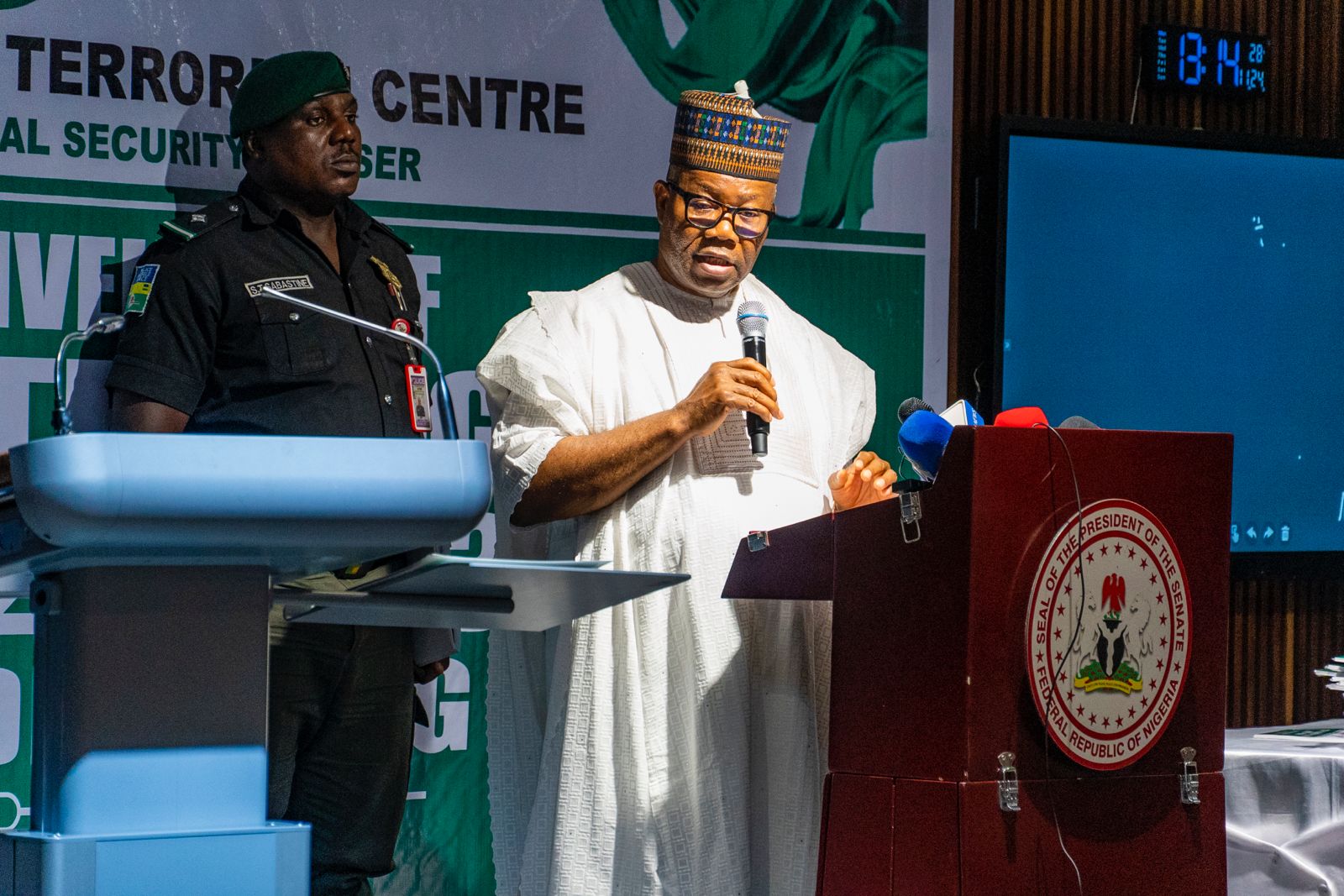
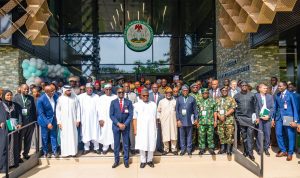
The President of the Senate, Godswill Akpabio, on Monday officially presented Nigeria’s Counter Terrorism Strategic Plan for 2025–2030.
This Strategic Plan was developed by the National Counter Terrorism Centre under the Office of the National Security Adviser.
Delivering his keynote address, Akpabio emphasized that the event was not just the unveiling of another policy document but a significant milestone in the country’s progress.

According to him, “It is a moment when Nigeria again reaffirms that our people deserve to live without fear, that our children deserve a future of peace, and that our nation must be secured to prosper.”
The Senate President noted that every generation must confront and answer the questions that history poses.
“For ours, the question is clear: How do we secure our nation, safeguard our people and set Nigeria irreversibly on the path of peace, growth and stability?

“The Strategic Plan 2025–2030 provides this answer with clarity, discipline and ambition. It presents a framework for transforming our institutions, modernising our security architecture, strengthening national resilience and expanding partnerships across government, industry, civil society and the international community.”
Akpabio explained that insecurity threatens the very basis of development, pointing out that investors pull out, schools shut down, farmers flee their lands and hope fades for young people. He stressed that a practical, forward-thinking and implementation-oriented plan such as this is both timely and essential.
He added that while security is a constitutional duty shared by all branches of government, the legislature carries a distinct responsibility — to provide the legal, oversight and financial support that sustains and strengthens security agencies.
He reiterated that the 10th National Assembly has approached this responsibility with seriousness, enacting major laws covering defence, policing, intelligence coordination, cybersecurity and counter-terrorism.
“We have strengthened agency mandates, encouraged inter-agency cooperation and advocated improved welfare for those who risk their lives daily so that Nigerians can feel secure in their homes, confident in their communities and proud to raise children in a nation where safety is guaranteed rather than optional.”
He maintained that legislation alone cannot secure the nation. There is a need for investment in personnel, technology, training and strategic alliances.
Akpabio stressed that Nigeria must shift from reactive measures to long-term planning, noting that the Strategic Plan is crucial because it turns intentions into actions and actions into measurable outcomes.
He further stated that the plan acknowledges security as a shared responsibility involving government, citizens, communities, traditional authorities, the private sector and international partners. According to him, its strength lies in its Whole-of-Government and Whole-of-Society approach.
Representing the National Security Adviser, Nuhu Ribadu, the Coordinator of the National Counter-Terrorism Centre, Major General Adamu Laka, said the newly unveiled Strategic Plan is the result of rigorous research, inter-agency collaboration and broad consultations across ministries, security bodies, academia, civil society groups and global partners.
He added that the vision is to position the National Counter Terrorism Centre as a regional hub for excellence in combating terrorism and violent extremism within West Africa and the Sahel.