
News
NIPS Hails Military Gains, Warns Against Politicising Security Efforts

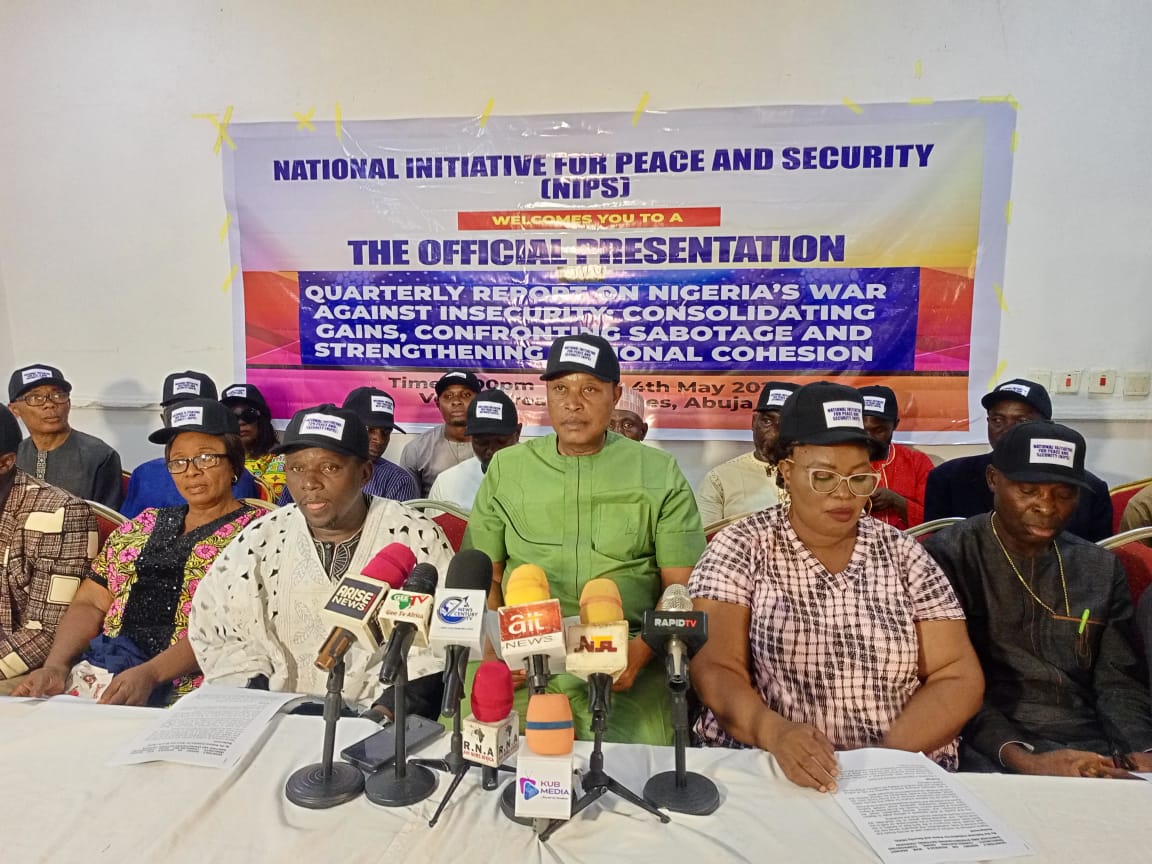
The National Initiative for Peace and Security (NIPS) has praised the Armed Forces of Nigeria for notable operational achievements recorded across various theatres in the first quarter of 2026.
Led by its Executive Director, Dr. Adams Kings, the group stated that under the leadership of General Olufemi Oluyede, the military intensified coordinated operations. This led to the neutralisation of over 200 terrorists, the arrest of nearly 300 suspects, and the rescue of about 188 kidnapped civilians in April alone.
In its quarterly assessment of the fight against insecurity, NIPS observed that these successes were recorded across the North-East, North-West, North-Central, South-South, and South-East regions. According to the group, this reflects improved logistics, enhanced inter-service collaboration, and a shift in strategy from direct combat to dismantling the support systems of criminal networks.
NIPS described the period as a significant phase in Nigeria’s counter-insurgency and internal security operations.
“The Armed Forces have demonstrated an increased operational tempo nationwide. These outcomes indicate a more aggressive and coordinated strategy targeting both fighters and the enabling structures of criminal groups,” the report noted.
The organisation further emphasised that the operations were nationwide rather than region-specific, pointing to improved strategic coordination.
“In the North-East, sustained offensives have weakened insurgent strongholds with over 130 terrorists neutralised. Similar gains were recorded in the North-West through the disruption of bandit activities and rescue of victims,” it added.
The report also highlighted a stronger focus on dismantling systems that sustain criminal operations, including the destruction of camps, illegal arms production sites, and logistics networks.
According to NIPS, this strategy is aimed at weakening the long-term capacity of criminal groups to regenerate in asymmetric warfare environments.
“Rescuing women, children, farmers, and other civilians has restored dignity to affected communities and strengthened public confidence in government institutions,” the report stated.
It also noted that operations were conducted in line with rules of engagement and international humanitarian standards, helping to sustain legitimacy.
However, NIPS expressed concern over what it described as the politicisation of military efforts by some political actors.
“While democracy allows for debate and dissent, certain narratives have undermined the morale of security forces and distorted public understanding of ongoing operations,” the organisation said.
It warned that some political actions inadvertently reinforce the propaganda of terrorist and criminal groups.
“This includes dismissing verified military achievements, amplifying fear without context, and presenting security challenges purely as political tools,” the report added.
NIPS cautioned that such actions could have serious consequences, noting that intelligence assessments sometimes link these narratives to increased confidence among criminal elements.
The organisation stressed that when security issues are politicised, both civilians and frontline personnel suffer the consequences.
Despite the progress recorded, NIPS acknowledged that challenges remain, as criminal groups continue to adapt to terrain and exploit local grievances.
To sustain momentum, the group recommended continued offensive operations, increased investment in intelligence gathering, and stronger civil-military relations.
It also called for adequate funding and timely release of resources to support military operations.
“National security must not be trivialised or used for political advantage. Public statements carry consequences beyond immediate political gains,” the report emphasised.
NIPS urged political leaders to act responsibly in their public engagements and called for enhanced socio-economic measures to tackle the root causes of insecurity.
Dr. Adams Kings also advocated for a unified national narrative that encourages collective responsibility and resilience against extremist propaganda.
The organisation concluded that the first quarter of 2026 reflects growing effectiveness in Nigeria’s security operations under General Olufemi Oluyede’s leadership.
It, however, warned that these gains must be reinforced by national unity and not weakened by internal divisions.