
Opinion
THE GRAVE IS NOT THE RICHEST PLACE ON EARTH!

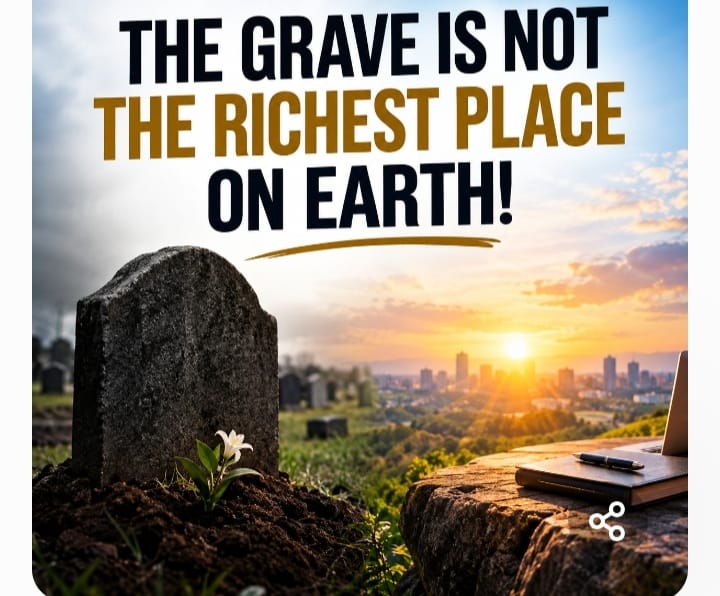
I have heard many attribute the cliché, “The grave is the richest place on earth,” to Myles Munroe he is, rightly so entitled to his opinion. That is perfectly fine. But presenting it as an unquestionable truth, to be sung as a creed or quoted as a universal doctrine, is a no-no for me.
I beg to disagree.The grave is not rich; it is empty. It contains neither the books that were never written nor the inventions that were never created. It contains human remains, not unrealised achievements.
We must be careful not to confuse potential with accomplishment, intention with contribution, or imagination with wealth.
A seed is not a forest, and a dream is not a legacy.
If the grave is supposedly the richest place on earth because of what people failed to accomplish, then the living must be richer in possibilities because they still possess the opportunity to act, create and transform their world.

By a simple definition, riches are things of value that are possessed, created or available to benefit someone. In what sense, then, can the grave be called rich because of things that never came into existence?
Why celebrate the grave for what was never realised instead of challenging the living to make their possibilities count?
The tragedy is not that the grave contains unfulfilled dreams; it is that we sometimes glorify those dreams after death instead of demanding their pursuit while life still offers the opportunity.
The grave does not inherit our possibilities. It marks the end of our opportunity to fulfil them. It is not rich, much less the richest place on earth.

At best, the grave may symbolise the premature termination of budding potential, unexplored possibilities and creativity that was never fully maximised. These are legitimate reasons to reflect on the tragedy of lost opportunities, but they do not establish the grave as the richest place on earth.
Indeed, many people die having emptied themselves of their gifts. They have exhausted their creativity, deployed their talents, added value to their communities and made meaningful contributions to humanity.
Their lives demonstrate that potential can be realised before death, rather than remaining perpetually buried in possibility.The living, therefore, possess what the grave no longer offers: the capacity to create, the opportunity to influence, the freedom to innovate and the ability to multiply value exponentially. The living can still turn ideas into inventions, visions into institutions and knowledge into solutions that improve human life.
The grave cannot.
When we embrace and repeat this cliché without interrogating its meaning, we risk committing the fallacy of equivocation. We conflate actual riches with unrealised potential, mistaking possibility for actuality and absence for possession.
An unwritten book is not a literary masterpiece. An unbuilt hospital is not a healthcare institution. An untested idea is not a proven invention.
Their potential value may be immense, but potential value is not the same as realised wealth. The statement may be emotionally compelling, but emotional resonance does not establish logical validity.
At best, the saying is a metaphor for lost opportunities, not a demonstrable fact about where the world’s greatest riches lie.
The world’s greatest riches are not necessarily buried with the dead; they are continually being created in the minds and through the hands of the living. Every second, minute, hour, day, week, month and year presents opportunities for people to develop ideas, create tangible innovations and contribute meaningfully to humanity.
Why, then, should we locate the greatest riches in the grave, a place of stillness and silence, when the living world remains a theatre of creativity, productivity and human advancement?
The grave may hold the remains of what once was, and it may symbolise what could have been. But it cannot create what is yet to be.
The grave is not the richest place on earth. The living still have the opportunity to make the world richer. That cliche The grave is the richest place one earth is misleading and should be used circumspectively. It could a rich place metaphorically certainly not the richest both metaphorically and literally.
Jarlath Uche Opara
jarlathuche@gmail.com