
Legislature
Senate Moves to End Unnecessary Aircraft Holding Over VIP Movements at Airports

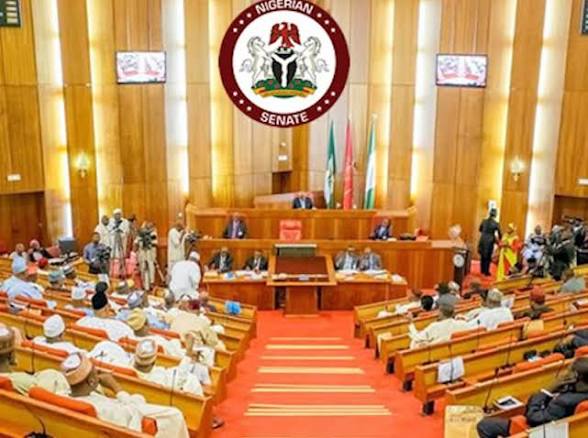
By Bashir Meyere, Abuja
The Senate has urged the Nigerian Civil Aviation Authority (NCAA), Nigerian Airspace Management Agency (NAMA) and Federal Airports Authority of Nigeria (FAAN) to enforce operational procedures requiring advance coordination and prompt notification of planned airspace restrictions to airlines.


This followed a motion of urgent public importance moved by Senator Isa Jibrin, representing Kogi East Senatorial District, on the need to address the disturbing practice of keeping aircraft airborne in holding patterns because of movements involving Very Important Persons (VIPs) at Nigerian airports.


Senator Jibrin maintained that such situations must be properly managed by the relevant authorities at ground traffic points of origin rather than allowing aircraft to take off without adequate coordination.
The senator noted that the safety of passengers and aircraft crews is essential to the reliability and economic viability of air transport.
He further noted that commercial air transport operates on a highly coordinated system of schedules covering aircraft departure and arrival slots, fuel planning, crew duty-time limitations, passenger connections, airport operations and air traffic management, all of which require a high degree of coordination among the various aviation authorities.
Senator Isa Jibrin observed from experience that, on some occasions, commercial aircraft scheduled to land at certain local airports are forced to remain airborne in holding patterns for extended periods, in some cases reportedly for over an hour, as landing operations are temporarily suspended to accommodate VIP movements or other security-related activities.
He also observed that international flights scheduled to land at Nigerian airports sometimes divert to alternative airports within the country when airspace or airport access is temporarily restricted at their destination airports due to VIP movements, thereby avoiding the risks associated with landing delays.
“The security and operational requirements associated with VIPs and other related security movements are legitimate and must be respected, but such requirements should be managed in such a way as not to place commercial aircraft at avoidable aviation safety risks.”
The lawmaker expressed concern that prolonged airborne holding patterns could result in significant fuel consumption and reduce the operational fuel reserves available to an aircraft, particularly when the holding period extends beyond the time reasonably anticipated by the pilot and the airline.
He further expressed concern that prolonged holding could expose aircraft to additional operational risks, including deteriorating weather conditions, air traffic congestion, reduced flexibility for diversion, crew duty-time constraints and the possibility of fuel-related emergencies, especially when several aircraft are simultaneously awaiting clearance to land.
Consequently, the Senate urged its Committee on Aviation to interface with the NCAA, NAMA and FAAN to ensure strict adherence to the Senate’s recommendations and report back to the Senate within two weeks.