
Legislature
Senate Moves to Decriminalise Attempted Suicide, Prioritise Treatment and Rehabilitation.

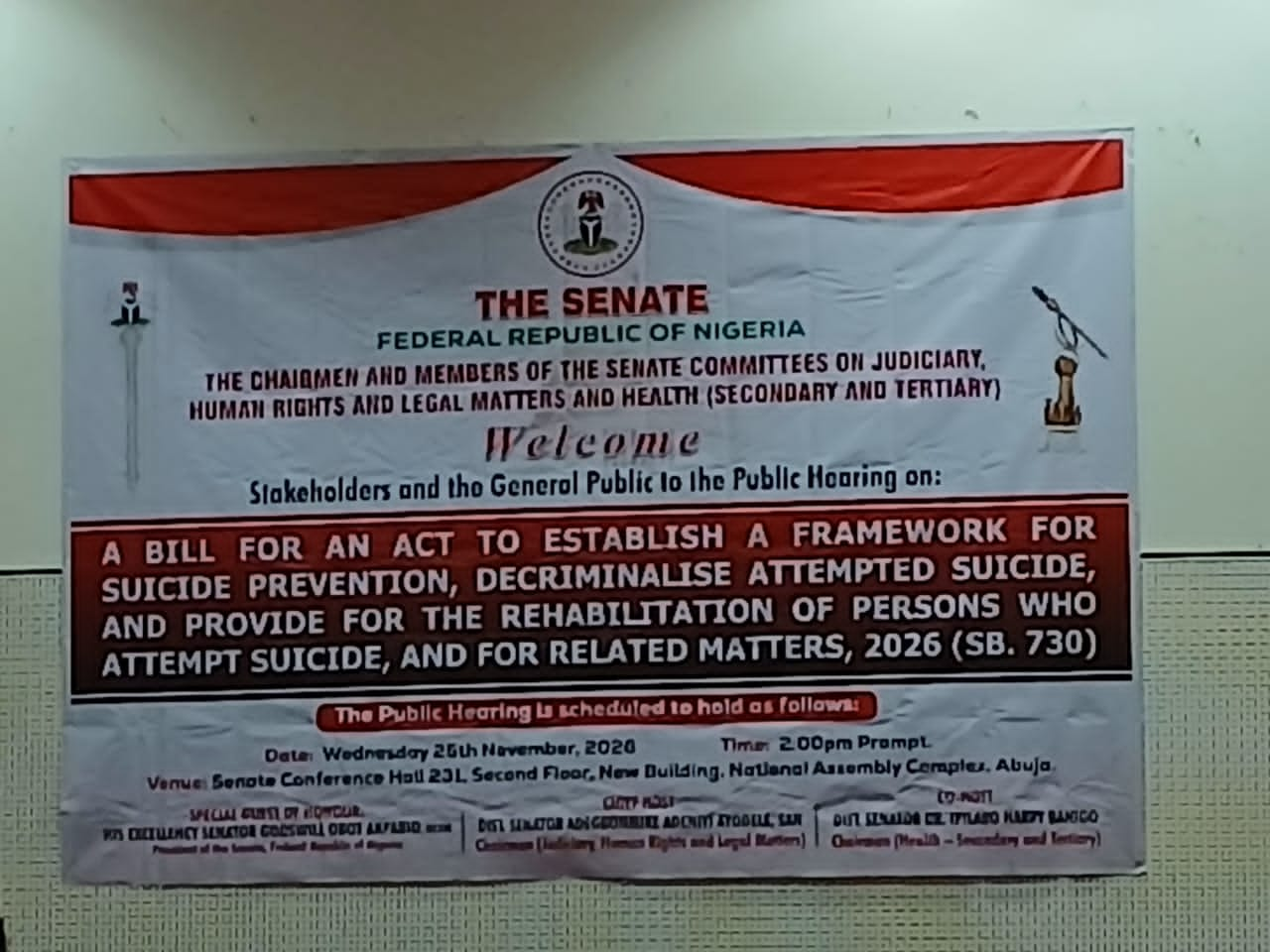
By Bashir Mayere, Abuja
The President of the Senate, Godswill Akpabio, represented by the Deputy Leader, Senator Lola Ashiru, gave the assurance during a one-day public hearing on a bill seeking to protect and decriminalise persons who attempt suicide in the country.


“The National Assembly will continue to pull together and put its people at the centre of the world. We will listen to those whose lives our laws touch, as well as those who are affected by these laws, and use our oversight powers to ensure that the protections provided by these laws reach the people for whom they were written.


He added that the mandate Nigerians had given them carried a responsibility to make their voices heard in the chambers and ensure that the work of the National Assembly made a difference in the lives of their children.
Welcoming guests, the Chairman of the Senate Committee on Judiciary, Human Rights and Legal Matters, Senator Adeniyi Adegbonmire, emphasised that the bill seeks to decriminalise attempted suicide and replace prosecution with treatment, rehabilitation and prevention.
He also said the essence of the bill was not to debate the reasons that push people to attempt suicide, but to change how the state responds to the act itself, moving from punishment to care.
Commenting on the bill, its sponsor, Senator Asuquo Ekpenyong (Cross River South), said the hearing recorded one of the largest turnouts for a public hearing in recent times, bringing together government institutions, medical practitioners, civil society organisations, correctional services officials and persons with lived experience.
Senator Ekpenyong further explained that the turnout demonstrated the importance Nigerians attached to the issue, noting that the plenary hall could not accommodate the large number of stakeholders present.
He explained that the bill seeks to address a contradiction in Nigeria’s laws, questioning whether the state’s first response to a suicide survivor should be prosecution or protection, considering that the Mental Health Act of 2023 treats attempted suicide as a psychiatric emergency requiring treatment, while Section 327 of the Criminal Code and Section 231 of the Penal Code classify it as a crime.
In an interview with journalists shortly after the hearing, both the chairman and sponsor of the bill spoke on concerns that economic hardship drives many people to such decisions.
Ekpenyong said suicide was complex and could not be attributed to poverty alone, citing mental health conditions, family situations, abuse and other factors. He noted that even wealthy people battle depression.
He clarified that the bill does not legalise assisted suicide, stressing that helping someone to end their life would remain a criminal offence, while what is being decriminalised is the survivor who needs intervention, treatment and rehabilitation.
Among the key institutional stakeholders, the Nigerian Law Reform Commission, the Nigeria Police Force and Medical Directors of Federal Neuropsychiatric Hospitals all supported the bill while calling for safeguards, harmonisation and a shift from punishment to care.
The Nigerian Law Reform Commission said it supported the prevention provisions and the reasons advanced for decriminalisation but proposed an exception for attempted suicide carried out in furtherance of terrorism.
The Commission argued that while the National Mental Health Act describes suicide as a psychiatric emergency, an act carried out to further terrorism cannot be treated the same way because, unlike general suicide, which involves self-harm, it seeks to harm others.
The Nigeria Police Force described suicide as an urgent public health issue and said victims of attempted suicide, previously prosecuted under Section 327 of the Criminal Code, should henceforth be treated not as criminals but as victims who require rehabilitation.
Medical Directors of all Federal Neuropsychiatric Hospitals, speaking through Dr. Ngozichukwu Nneka Unaogu of the Federal Psychiatric Hospital, Enugu, said the bill addresses a critical public health and human rights concern and protects survivors through prevention, treatment and rehabilitation.