General News
Edo Government Empowered 3,000 Women, Advances SDGs Implementation — Okpebholo

By Iyojo Ameh
The Edo State Government says it is accelerating the implementation of the United Nations Sustainable Development Goals (SDGs) through targeted initiatives focused on women empowerment, creative industry development, education, and clean energy.
The First Lady of Edo State, Mrs.
Speaking at the event, Mrs. Okpebholo said the state had adopted an innovation-driven approach to strengthen SDG delivery, adding that over 3,000 rural women had already benefited from empowerment schemes spanning agriculture, clean energy, education, health services, and film production.
“For impact to be meaningful, it must start with the rural woman,” she said. “We believe in empowering the total woman financially, mentally, and in health. Our programmes are aligned with all SDG targets, but at the core is ensuring the complete development of women.”
While enumerating the progress under SDG 7 (Clean and Affordable Energy), she revealed that clean cooking stoves were recently distributed to women in rural communities to reduce health risks associated with firewood and kerosene use.
She explained that Edo State had also invested in the creative sector as part of its SDG-linked development strategy.
“We recently entered a strategic partnership with a German film academy to train emerging filmmakers, expose them to world-class production techniques, and provide access to modern equipment,” she said.
According to her, the initiative is expected to expand Edo’s creative economy while promoting films that educate the public on sustainable development.
Mrs. Okpebholo added that through her foundation the Better Life and Care Foundation the government had transformed the lives of numerous girls and women with training, financial support, and community-based development programmes.
She reaffirmed the government’s commitment to the SDGs, stressing that achieving them required partnership beyond government.
“Our vision is a future where every child, every community thrives in a safe, sustainable and prosperous society. Government cannot do this alone citizens and creatives must also take responsibility,” she said.
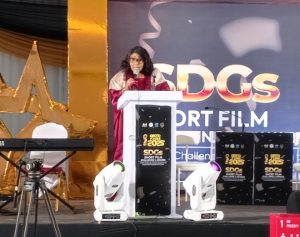
Mrs. Edesili delivering her goodwill message
Also speaking at the event, the Queen Consort of the Olu of Warri, Olori Ivie Atuwatse III, commended filmmakers for using storytelling to advance sustainable development.
She described film as one of the most powerful tools for social transformation.
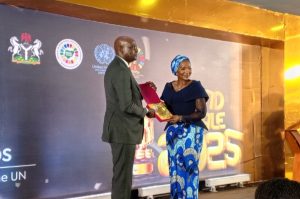
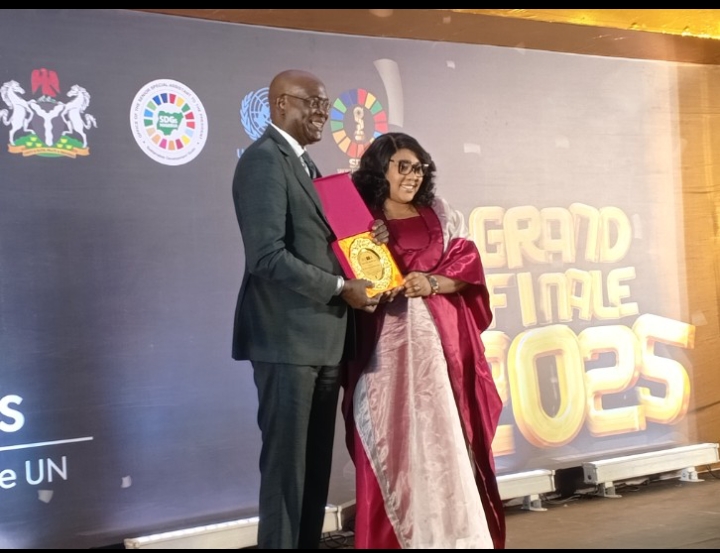
Queen Olori Atuwase III receiving her award
“You have turned global development goals into relatable human stories,” she said. “A filmmaker in Kano can tell the story of climate resilience in Hausa, and an animator in Enugu can teach a 10-year-old girl the meaning of gender equality that is how change happens.”
She called on governments and development agencies to invest in storytelling as a tool for accelerating SDG implementation.
The event featured the presentation of awards of excellence to Mrs. Okpebholo and Olori Atuwatse III for their contributions to sustainable development.
Cash prizes were also presented to winners across categories including Best Indigenous Short Film, Best Animation, and other SDG-themed productions.
Organisers said the SDGs Short Film Challenge serves as a national platform for emerging storytellers to showcase community actions, policy impacts, and innovation driving progress toward the global goals.

Some of the awardees
The initiative is supported by the United Nations, FreshNEWS Multimedia Networks Ltd, and other stakeholders.