General News
Nigeria’s Energy Sector Records 5% Increase in Access – Power Minister Adebayo Adelabu


By Iyojo Ameh
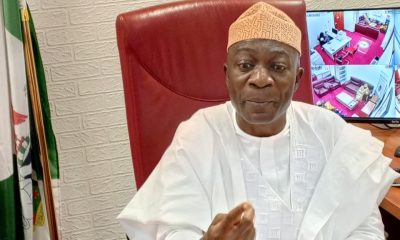
Nigeria’s Minister of Power, Adebayo Adelabu, has announced a remarkable improvement in the country’s energy access, which rose by 5% in 2024. According to the minister, energy access moved from 59% at the end of 2023 to 64% by the end of 2024, driven by grid expansion and renewable energy projects across the country.
Adelabu shared this during a committee briefing, where he highlighted key achievements in power generation, grid stability, and distribution infrastructure.
The minister disclosed that Nigeria’s power generation capacity grew by 30% in the 2024 fiscal year. He noted that the administration inherited an average of 4,100 megawatts (MW) of power generation in 2023, but the figure rose to a peak of 5,528 MW by the end of 2024.
“We added a new hydroelectric power dam, Zumbiru, which generated 700 MW, while other hydro and thermal plants like Kainji, Shiroro, and Dadinkowa also improved significantly,” Adelabu said.
Power plants under the Niger Delta Power Holding Company (NDPHC) – including Olorunsogo, Omotosho, and Sapele – also contributed to this growth.
However, the minister noted that the government missed its 6,000 MW target due to grid challenges experienced toward the end of the year.
Adelabu acknowledged that while progress was made in expanding the national grid, Nigeria experienced eight grid collapses in 2024, with five being full collapses and three partial.
Out of the five full collapses, three were attributed to power generation issues, such as a reduction in solar generation and gas infrastructure challenges. The remaining two collapses were due to vandalism.
The minister highlighted the vandalization of critical transmission lines, including the Kaduna-Shiroro-Mando line and the Ugwuachukwu-Bauchi-Makurdi line, as key issues affecting grid stability.
“These vandalized lines caused blackouts in the northern region, and although we managed to restore one line, the Kaduna-Shiroro-Mando line remains unfixed due to insecurity,” he stated.
The situation, according to Adelabu, has left the grid fragile, as only one transmission line currently supplies power to the northern region.
The minister also spoke on improvements in distribution infrastructure. He noted that the government guaranteed 20 to 24 hours of electricity for consumers on Band A, who agreed to pay cost-reflective tariffs introduced in 2024.
“Empirical evidence shows that power supply has improved for this category of consumers. The plan is to continue migrating more customers into this category while strengthening distribution feeders and other infrastructure,” Adelabu said.
Adelabu emphasized the government’s commitment to expanding renewable energy sources, including solar, wind, and small hydropower projects, as part of Nigeria’s energy transition plan.
The focus for 2025, he added, would be on stabilizing the grid through the Presidential Power Initiative, which aims to revamp the entire grid and address the challenges of frequent collapses and transmission losses.
The minister highlighted insecurity as a major impediment to repairing vandalized power lines, particularly the Kaduna-Shiroro-Mando line. He revealed that the matter has been handed over to security agencies, but progress has been slow.
“This security challenge has made our grid fragile, and we are working with relevant agencies to address the situation. Until this line is restored, the grid remains vulnerable to collapses,” Adelabu added.
Despite challenges, the minister expressed optimism about the government’s efforts to improve electricity supply. He stated that Nigeria’s power infrastructure is outdated and requires urgent modernization.
“As we move into 2025, the focus will be on addressing these technical and security challenges to ensure that Nigerians enjoy stable and reliable electricity,” he said.
Adelabu reiterated the government’s commitment to expanding energy access and improving power supply for all Nigerians.