
Legislature
Senate frowns at multiple budgets in fiscal year, tasks FIRS on N35trn revenue for 2026 FG laments N30trn shortfall from N40trn revenue target for 2025

By Iyojo Ameh
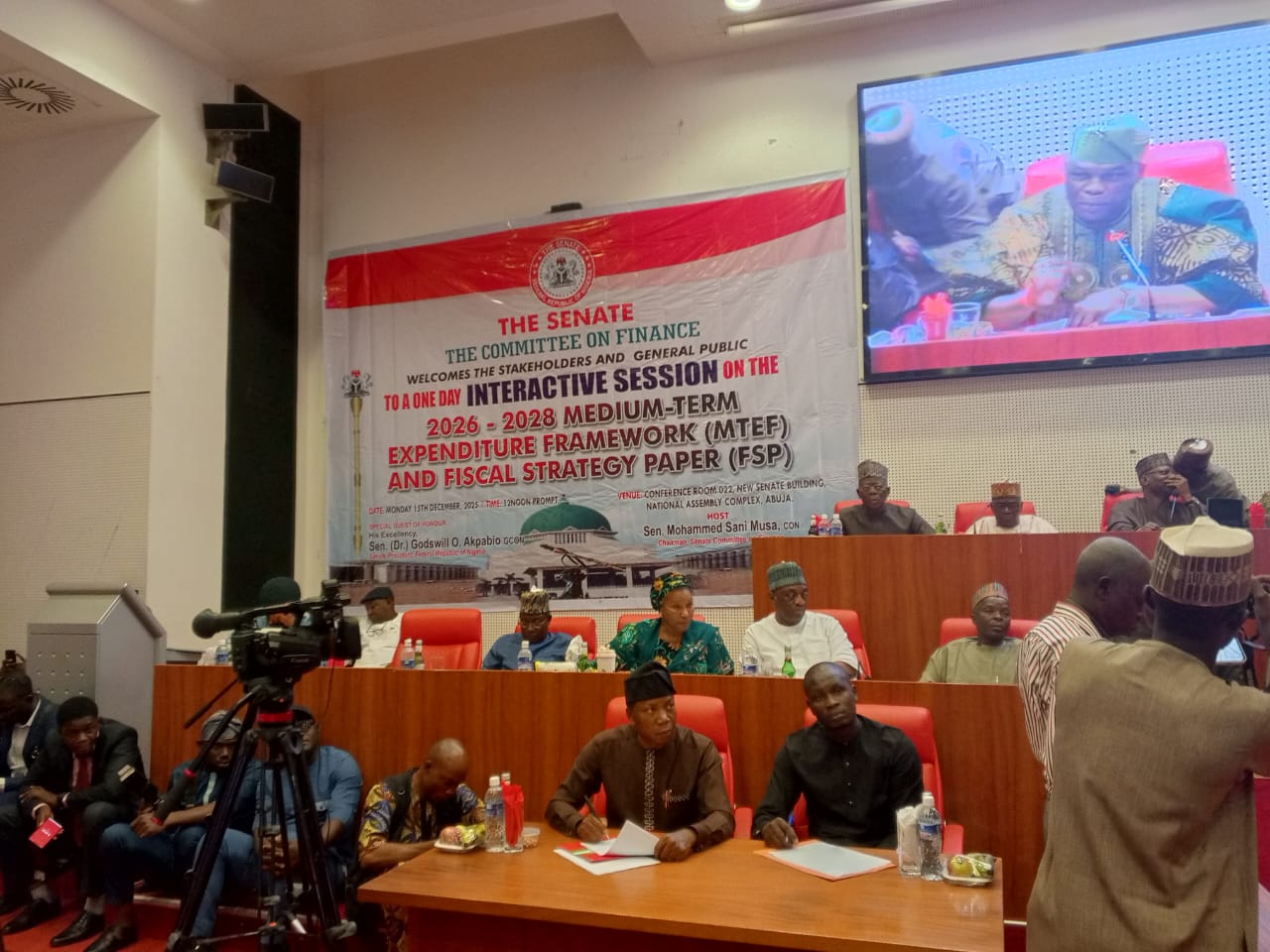
The Nigerian Senate, through its Committee on Finance,has expressed displeasure over the implementation of multiple budgets within a single fiscal year by the Federal Government, as experienced in 2025.
It consequently tasked the Federal Inland Revenue Service (FIRS) to raise its projected revenue target for 2026 from N31 trillion to N35 trillion, even as the Federal Government lamented a N30 trillion shortfall from its N40 trillion revenue target for the 2025 fiscal year.
The senators’ displeasure over multiple budget implementations came to the fore during an interactive session between the Senate Committee on Finance, chaired by Senator Sani Musa (Niger East), and key managers of the nation’s economy on the 2026–2028 Medium Term Expenditure Framework (MTEF) and Fiscal Strategy Paper (FSP).
The Minister of Finance and Coordinating Minister of the Economy, Mr. Wale Edun, while providing explanations on projections for the 2026 budget and the implementation of the 2024 and 2025 budgets, informed the committee that while revenues for the 2024 budget had been fully realized, those of 2025 had fallen short.
According to him, funding for the capital component of the 2024 budget was achieved through the realization of the total projected N26 trillion revenue, but the same could not be said for 2025.
“Out of the projected N40 trillion revenue for the 2025 fiscal year, only N10 trillion has been realized, leaving a shortfall of N30 trillion. Consequently, about 70 per cent of capital projects captured in the 2025 fiscal year are being rolled over to 2026,” he said.
Disturbed by the submission, some members of the committee, including Senators Danjuma Goje (Gombe Central), Olalere Oyewumi (Osun West), Victor Umeh (Anambra Central), Aminu Iya Abbas (Adamawa Central), and others, expressed concern over the practice of implementing multiple budgets within a single fiscal year.
Specifically, Senator Goje described the practice as unacceptable to Nigerians, urging that it should end with the current fiscal year. He stressed that budget implementation must be normalized from 2026.
In his remarks, Senator Oyewumi advised the Minister that since budget proposals were not dictated by the governed, the government should present realistic and achievable proposals to avoid non-implementation, which often leads to the rollover of budgets into subsequent years.
Senators Victor Umeh and Ireti Kingibe also queried why the Federal Government failed to bridge revenue gaps through borrowings already approved by the Senate and the National Assembly.
Responding, Senator Sani Musa, in his capacity as Chairman of the Committee, assured his colleagues and Nigerians that normalization of budget projections and implementation would commence from 2026. He added that a three-man ad hoc committee would be set up to liaise with the Minister of Finance and the Accountant-General of the Federation to ensure the payment of local contractors for projects executed in 2024 before the expiration of the budget on December 31.
On revenue generation, Senator Musa tasked the Chairman of FIRS, Mr. Zacch Adedeji, to work towards realizing N35 trillion as revenue for the 2026 fiscal year, instead of the earlier projected N31 trillion.
Earlier, the FIRS Chairman disclosed that the agency generated N20.2 trillion in revenue in 2024 and N25.2 trillion in 2025. However, he noted that the huge revenues realized by FIRS and other agencies such as the Nigeria Customs Service were being eroded by the implementation of multiple budgets within a single fiscal year.
Meanwhile, the Minister of Budget and Economic Planning, Senator Atiku Bagudu, and the Minister of State for Petroleum Resources, Senator Heineken Lokpobiri, defended the parameters set for the proposed N54.4 trillion 2026 budget. The parameters include an oil production benchmark of 1.84 million barrels per day, an oil price benchmark of $64.85 per barrel, and an exchange rate of N1,512 to one US dollar.