
News
The Akpabio Paradox: When Harmony Becomes a Crime in Nigerian Politics

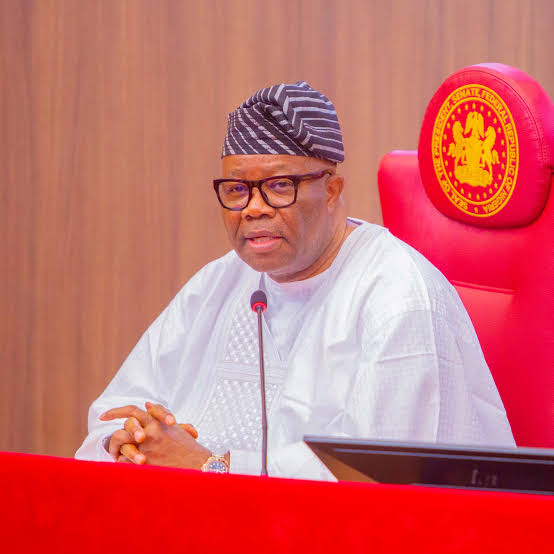
A curious phenomenon defines the current tenure of Senate President Godswill Akpabio. Here is a leader, celebrated as “The Uncommon Transformer” for his gubernatorial record in Akwa Ibom State, who now struggles to connect with a segment of the Nigerian public. The vitriol directed at him often feels manufactured, rooted not in a forensic assessment of his legislative leadership, but in a singular perception: his perceived closeness to President Bola Ahmed Tinubu.

In essence, Senator Akpabio has inherited the political adversaries of the President. His “sin” is presiding over a Senate that chooses strategic collaboration with the executive over the chaotic theatrics of the past. This shift has left some critics nostalgic over an era of recurring gridlock that dogged past relationships, revealing a dangerous pathology in our political appetite where conflict is mistaken for vigilance.
To appreciate the present,we must recall the past. The previous model of legislative-executive relations was characterized by open warfare, where “checking” the executive often meant crippling governance. A telling example is the 2017 budget, where the then-Senate leadership, under Bukola Saraki, slashed the allocation for the critical Lagos-Ibadan Expressway from N31 billion to N20 billion. Senator Saraki publicly justified this cut, arguing that budgeting for the road did not show “seriousness”. This move, which directly impacted a vital national infrastructure, was framed not as a failure but as a point of pride, a classic demonstration of resistance without responsibility.
Contrast this with the output-focused leadership of the 10th Senate.Under Senator Akpabio, the legislature has moved with dispatch to pass transformative bills requested by the executive, understanding that nation-building requires synergy, not sabotage.
The Student Loans (Access to Higher Education) Act, 2024: Responding to President Tinubu’s request, the Senate gave accelerated passage to the bill establishing the Nigerian Education Loan Fund (NELFUND). This landmark legislation aims to remove financial barriers to tertiary education for millions of Nigerian youth.
The National Minimum Wage Act (Amendment) Bill, 2024: In a historic one-day proceeding, the National Assembly passed the bill raising the minimum wage from N30,000 to N70,000. Senator Akpabio led the delegation to the State House for the signing, emphasizing that this was a critical intervention for Nigerian workers.
Beyond headline bills, the Senate has advanced long-stalled regional development commissions, including the South East Development Commission (SEDC). These are not mere symbols but practical frameworks designed to address historical grievances and catalyze development across all zones.
The criticism that Akpabio’s relationship with the executive is”too good” is a critique that prefers drama over delivery. It misses a fundamental point: the chaotic fights of the past did not lower food prices, create jobs, or improve security. They provided entertaining headlines but poor governance. Nigeria’s current challenges—economic hardship, security threats, and infrastructural deficits—demand focused collaboration, not performative conflict.
The task before Senator Akpabio is to continue demonstrating that this collaborative model yields tangible benefits for the people. The early signs, from the student loan fund to the new minimum wage, are evidence of such promising relationship. It is a paradigm shift from a legislature that saw its role as stopping government to one that is focused on making government to work for the people.
To President Bola Ahmed Tinubu, I say: keep faith with this leadership. Do not be swayed by naysayers who long for the destabilizing chaos of the past. The partnership between a reform-minded executive and a productive, collaborative legislature is the surest foundation for the national renewal we all seek. The ultimate judgment will not be based on the volume of political drama but on the quality of life of the average Nigerian by which measure, the Akpabio-led Senate is charting a purposeful new course.
Ahmed Tijani ibn Mustapha writes from Abuja.