
News
The Empire of Flattery: How Sycophants Rule Politics, Religion, and Business in Nigeria

By Sam Agogo
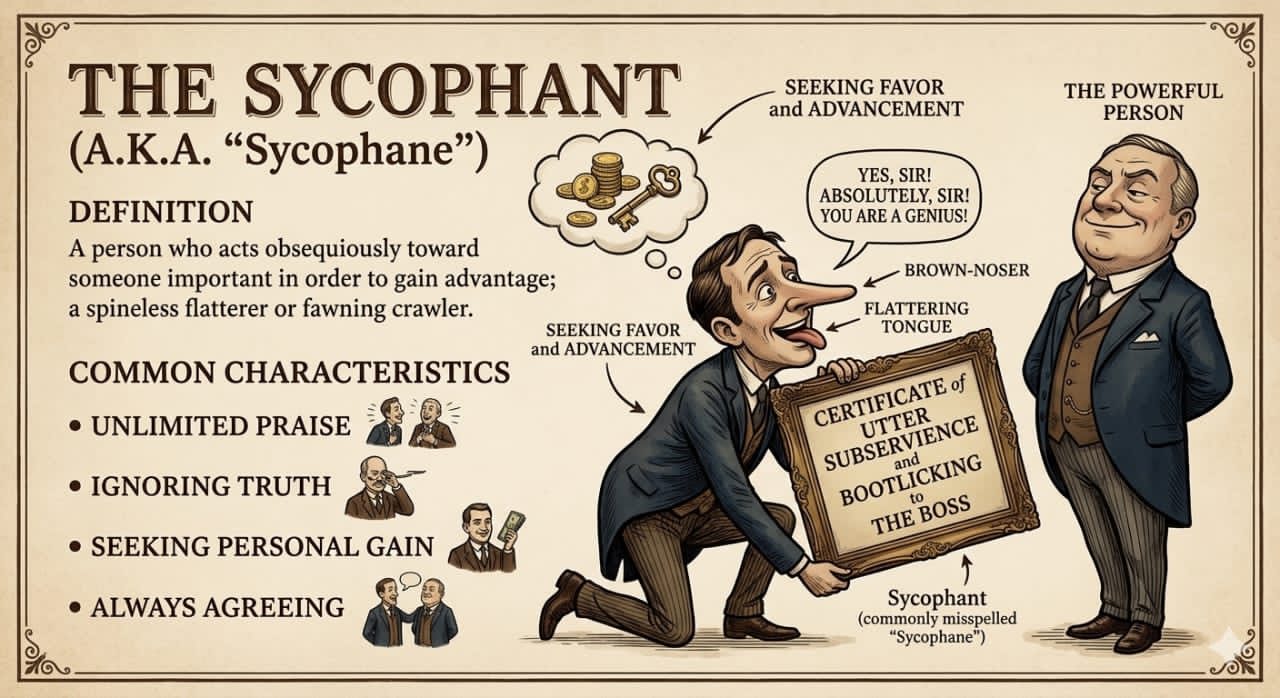
In Nigeria today, sycophancy has become a booming enterprise, thriving across politics, religion, business, and even daily life. It is the shameless trade of flattery, blind loyalty to power, and opportunistic praise that has replaced truth, integrity, and accountability. In a country where survival often depends on proximity to authority, sycophancy has become more valuable than competence, merit, or hard work.
A sycophant is not just an admirer of leaders. They are those who clap for wrongs instead of condemning them, who only work when the boss is watching, who rush to welcome politicians or clerics just to be noticed, and who scramble for crumbs while others suffer. In churches, sycophants elevate pastors to near-godlike status, silencing dissent and discouraging accountability. In mosques, they exalt clerics beyond measure, turning sacred spaces into arenas of praise rather than places of truth. In business, they thrive by currying favor rather than innovating. In everyday life, they manipulate relationships to secure privileges, often at the expense of honesty and fairness.

As Nigeria approaches the 2027 general elections, sycophancy is already shaping the political atmosphere. Politicians are surrounded by praise singers who hail them as saviors regardless of their record. These voices drown out genuine criticism, creating an illusion of popularity. Sycophants amplify propaganda, ensuring that falsehoods are repeated until they sound like truth. They act as gatekeepers, controlling access to leaders and inflating their own importance. During campaigns, they switch allegiance swiftly, abandoning yesterday’s hero for today’s rising star. Their loyalty is transactional, not ideological. After elections, they position themselves for appointments, contracts, and favors, often sidelining competent professionals who could genuinely serve the nation.
The National Assembly, once a place where legislators consulted their constituents before critical national debates, has also fallen into this trap. Today, discussions are shaped not by the will of the people but by the amount of money exchanged. Decisions that should reflect the collective interest are reduced to transactions. A businessman once confessed that the reason he supports a particular candidate is because of his personal business. In his words, once you can collect for yourself, others can go and suffer. This mindset captures the essence of sycophancy—self-interest above national interest, personal gain above collective progress.
The judiciary has not been spared. Once regarded as the last hope of the common man, it is now increasingly perceived as a marketplace where judgments are influenced by power and money. Cases that should uphold justice are sometimes decided to please the powerful, while ordinary citizens are left to languish. When the judiciary bends to sycophancy, the very foundation of democracy is shaken.

The executive arm of government also thrives on sycophancy. Leaders are surrounded by advisers and aides who tell them only what they want to hear, not what they need to hear. Policies are praised even when they fail, and decisions are defended even when they harm the people. Executives reward loyalty over competence, creating a cycle where sycophants rise while genuine voices are silenced.
Even more troubling is the way critics who once condemned this administration have now become its boldest supporters. Many of them, after receiving appointments or lucrative contracts, suddenly changed their tune. Others, after collecting money, now defend the very policies they once described as destructive. This transformation is not born out of conviction but out of convenience. It shows how sycophancy can turn principled voices into instruments of propaganda, eroding trust in public discourse. Citizens who once looked up to these critics for courage now see them as part of the machinery that perpetuates the same problems they once opposed.
Looking ahead to 2027, sycophants will intensify their activities. They will flood social media with orchestrated praise campaigns, painting politicians as messiahs of democracy. They will infiltrate grassroots movements, pretending to be loyal supporters while pursuing personal gain. They will rewrite narratives, turning failures into “strategic sacrifices” and mistakes into “bold decisions.” Their ability to manipulate perception will be a powerful tool in shaping the elections.
The danger is that sycophancy has seeped into every sector of Nigerian life. In churches, it breeds unquestioning congregations who elevate leaders beyond measure. In mosques, it silences critical voices and replaces truth with blind loyalty. In the legislature, it reduces national debates to transactions. In the judiciary, it bends justice to please the powerful. In the executive, it rewards loyalty over competence. In business, it rewards mediocrity while punishing innovation. In everyday life, it normalizes dishonesty, teaching young people that success comes not from hard work but from flattery.
Nigeria’s future depends on whether citizens can resist the lure of sycophancy. The 2027 elections will be a test of whether the nation continues to reward praise singers or demands accountability, competence, and truth. Sycophancy may be one of the fastest-selling “businesses” in Nigeria, but it is also one of the most destructive. If left unchecked, it will not only shape the elections but also define the destiny of the nation.
The balance of Nigeria’s three arms of government today tells the story clearly: a legislature compromised by money, a judiciary weakened by influence, and an executive surrounded by flatterers. Together, they reflect the dangerous spread of sycophancy. The challenge before Nigerians is whether to continue down this path or to reclaim integrity, merit, and accountability as the true pillars of leadership. Only then can the nation break free from the grip of sycophancy and chart a future built on truth, justice, and genuine progress.
For comments, reflections, and further conversation, email samuelagogo4one@yahoo.com or call +2348055847364.