
News
Concession, Consequence, and the Children of Oriire: Nigeria’s Banditry Crisis Enters a Dangerous New Phase

_By Sam Agogo_
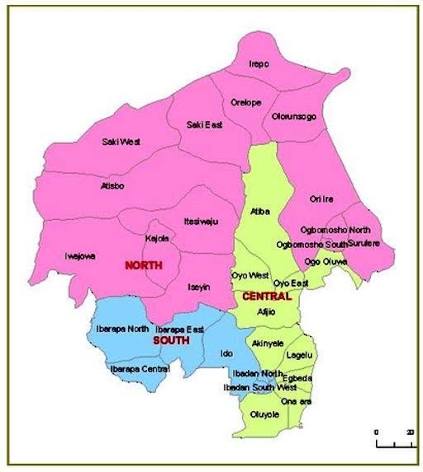
Oriire Local Government Area occupies the northern flank of Oyo State, where the guinea savannah gradually displaces the southern rainforest and the terrain settles into a broad, agricultural expanse that communities have worked for generations. Spanning more than two thousand square kilometres, it is a local government defined by rural industry — farming, grazing, and the quiet commerce that sustains land-dependent societies across this part of the Yoruba heartland. The historic city of Ogbomoso anchors the region’s cultural and commercial life. To the north, the area borders forest corridors extending into the Old Oyo National Park — a protected reserve of approximately 2,512 square kilometres straddling the Oyo-Kwara border — terrain that once represented ecological heritage. That same terrain has, in the reckoning of 2026, become the principal highway through which armed violence has entered the southwest, and it is through those forests that the men who took the children of Oriire arrived, and through which they vanished.
The deterioration of security in Oriire did not begin in May 2026. Through 2025 and into early 2026, intelligence confirmed that armed groups fleeing military operations in the northwest were relocating southward, exploiting porous forest corridors connecting the north to the southwest. Governor Seyi Makinde had publicly warned that dangerous elements from the northwest were moving into Oyo State. Hunters, Oodua Peoples Congress operatives, and local residents all reported the same pattern: armed men arriving through the forests, launching attacks, and retreating before security forces could respond. By January 2026, Oriire was already paying the price. Among the early incidents was a brazen assault on the National Park Service office at Oloka Village, in which five forest guards were killed. The community absorbed that blow and waited. The worst was still ahead.
Nigeria’s banditry crisis did not originate in the southwest. Its roots lie in the northwest, where a criminal cell operating in Zamfara in 2011 grew over a decade into a network spanning six states, sustained by cattle rustling, kidnapping for ransom, and the shadow economy of ungoverned territories. Between the first half of 2024 and 2025 alone, abductions across the country increased by one hundred percent while armed attacks spiked by more than two hundred and fifty percent. Schools became the preferred target — soft, symbolically significant, guaranteed to generate media attention and compel state engagement. Since 2012, more than two thousand four hundred students have been abducted from Nigerian schools. Each ransom paid proved the model. What began in Zamfara had, by 2026, found the forests of Oyo State.
On the morning of Friday, May 15, 2026, armed men descended on three schools in the communities of Esinele, Yawota, and Alawusa in Oriire with a precision that suggested months of planning. Before they withdrew into the forests, they had killed a teacher, an okada rider, and a student, and taken with them 39 pupils and seven teachers, among them children as young as two years old. One teacher, Michael Oyedokun, a mathematics teacher at Community Grammar School in Ahoro-Esinele, was subsequently beheaded in captivity, with a video of the act circulating online. Two weeks after the attack, schoolbags, food flasks, exercise books, and small shoes remained scattered across classroom floors — the only evidence of a population that had vanished.
That was the attack. What followed was something far more consequential.
The abductors’ demands, when they came, were not those of ordinary criminals. They wanted one billion naira, paid into a bank account in the Republic of Benin. They wanted two Hilux utility vehicles and food supplies. They wanted the release of detained terrorist commanders held in Oyo and Ibadan. And they wanted the implementation of Sharia law across Oyo State. These conditions no longer resembled a ransom demand. They resembled the ultimatum of a movement declaring its ambitions.
The Muslim community of Oyo State swiftly rejected the Sharia demand, insisting that Islam strictly forbids kidnapping and terrorism and that no criminal enterprise speaks on behalf of the religion. That rejection, however principled, does not dissolve the strategic logic behind it. From 2021, the northwest bandit commander Turji had already been implementing Sharia in villages under his control. What is new in Oyo is the geography — Sharia being demanded not in the Muslim-majority north but in a Yoruba-majority, religiously plural southwestern state with no constitutional basis for such an arrangement. The demand is not a religious aspiration. It is a probe, and a template in the making.
The demand for vehicles is equally transparent in its purpose. Hilux trucks delivered as ransom conditions are force multipliers — resources that underwrite the next operation. The Zamfara experience has documented this logic with brutal clarity. Communities across the northwest paid hundreds of millions in ransom, delivered motorcycles and fuel, and watched as attacks resumed with greater ferocity and better equipment. Concession did not purchase peace. It purchased better-equipped adversaries who understood that sustained pressure compels results.
The Oyo State House of Assembly responded by rejecting negotiation outright and calling on the Federal Government to establish a permanent military base in Oriire, while renewing demands for state police, citing the inability of conventional formations to operate effectively in dense forest terrain. Meanwhile the communities of Oriire exist in suspended animation — schools shuttered, farms abandoned, families scattered. What is unfolding there is not only a kidnapping crisis but the methodical hollowing out of a community’s social and economic foundations.
The parallel with Boko Haram’s early trajectory is difficult to ignore. That insurgency, too, began with school attacks, mixed criminal extraction with religious demands, and was dismissed as manageable criminality before it consumed a decade and tens of thousands of lives. The Mali precedent is equally instructive: by 2013, Bamako had been compelled to offer northern armed groups a constitutional restructuring of the state — decentralised government, regional assemblies, institutional representation — delivered under duress. The promises collapsed, the crisis deepened, and Mali lost effective control of significant northern territory. The lesson is that the moment demands become constitutional, the crisis has migrated beyond policing into the domain of political survival.
Nigeria has not reached that threshold. But the trajectory of the Oriire demands points in that direction. If met, even partially, they will become a manual for every armed group in the country with children within reach of a forest. The surest path to the return of the Oriire hostages is not a billion naira wired to Benin Republic, nor Hilux vehicles handed to men already planning the next assault. It is a security response that closes the terrain these groups inhabit, a political will that refuses constitutional concessions to criminal ultimatums, and a national seriousness commensurate with a crisis that has left classrooms empty and communities hollow across one of Nigeria’s most historically peaceful states.
Nigeria’s schools have become the front line of a war the country has not yet fully named. The children of Oriire deserve more than a ransom negotiation. They deserve a state determined to make their abduction the last of its kind.
_For comments, reflections and further conversation, email samuelagogo4one@yahoo.com or call +2348055847364._