
Governance
FG Moves $500m AGROW Project From Planning To Action, Targets Agricultural Growth

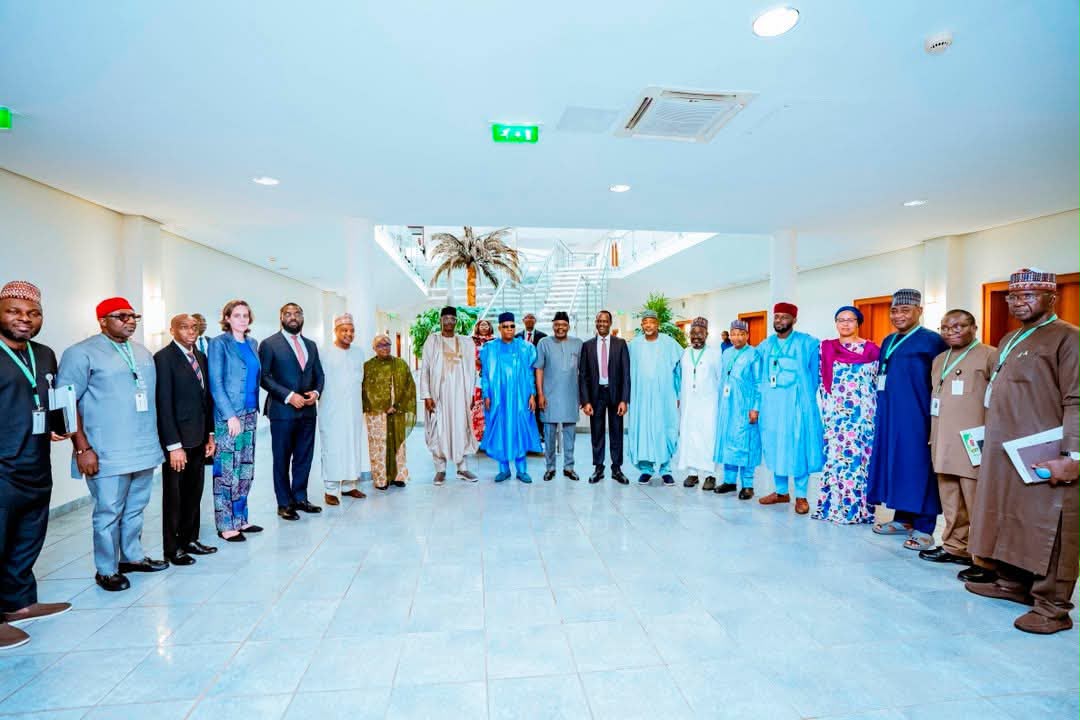
The Federal Government has received the final report of the National Technical Working Group on the World Bank-supported $500 million Sustainable Agricultural Value Chains for Growth Programme (AGROW), signaling the completion of the programme’s design phase and the commencement of implementation.
Vice President Kashim Shettima, who received the report during a briefing at the Presidential Villa, Abuja, said the initiative would help bridge the gap between farmers and national economic planning as well as policy decisions.
The Vice President noted that one of the major challenges facing Nigeria’s agricultural sector has been the disconnect between farmers who produce food and the systems responsible for determining the value and impact of their work.
He said AGROW was designed to reduce that gap by creating a programme centred on farmers’ realities, implemented through states and capable of attracting private sector investment to move agriculture from subsistence farming to large-scale production.
The $500 million World Bank-supported programme was developed through seven zonal consultations involving 32 states, reflecting growing commitment by state governments towards agricultural productivity, infrastructure development, extension services and market expansion.
Describing the report as a major milestone, Shettima said AGROW represents a shift towards placing farmers at the centre of Nigeria’s economic planning.
According to him, agriculture contributes about 23 per cent to the nation’s Gross Domestic Product and provides livelihoods for 34 per cent of the workforce, making it a sector that must receive priority attention.
The Vice President explained that improved agricultural productivity would lead to increased food supply, reduced food prices, stronger rural incomes, industrial growth and improved economic stability.
He stated that what happens on farms directly affects the nation, adding that agricultural productivity remains critical to economic growth, employment creation, food security and poverty reduction.
On the implementation structure, Shettima disclosed that $355 million, representing 71 per cent of the financing package, would be executed through participating states because agriculture is primarily driven at community and state levels.
He, however, noted that despite the commitment shown by 32 states, the $500 million funding would not completely address decades of challenges in agricultural infrastructure, technology, extension services, processing and market access.
The Vice President commended members of the National Technical Working Group for producing an inclusive and evidence-based report, saying their mandate had been successfully completed.
He formally accepted the final report and approved the dissolution of the technical working group, transferring responsibility to the Federal Ministry of Agriculture and Food Security as chair of the National Steering Committee and host of the Project Coordination Office.
Shettima also acknowledged the role of the Presidential Food Systems Coordinating Unit in coordinating the design process and supporting the work of the technical group.
Earlier, Nasarawa State Governor Abdullahi Sule informed the Vice President that state governments remained committed to the success of the programme, recalling that governors were briefed on the initiative through the Nigerian Governors’ Forum.
The governor thanked the Vice President for creating opportunities for states to participate and maximise the benefits of the programme.
Similarly, Kaduna State Deputy Governor Hadiza Balarabe said the state was ready to participate fully, adding that a state-level coordination mechanism would be established to ensure effective implementation.
She disclosed that Kaduna State already allocates more than 13 per cent of its budget to agriculture due to the sector’s importance in driving economic transformation.
The Minister of Finance and Coordinating Minister of the Economy, Dr Taiwo Oyedele, described the presentation of the report as a significant step towards implementation, saying AGROW reflects what can be achieved when stakeholders work together.
Oyedele added that the programme goes beyond food production, as it would contribute to economic transformation, job creation and macroeconomic stability.
Minister of Agriculture and Food Security, Senator Abubakar Kyari, praised Vice President Shettima’s leadership in mobilising stakeholders for the programme’s design.
Kyari assured stakeholders of the ministry’s commitment to implementing AGROW in line with the Renewed Hope Agenda of the President Bola Ahmed Tinubu administration.
He said the completion of the report had moved the programme into the next phase, which includes financing arrangements, borrowing plans and legal processes needed to commence implementation.
The World Bank Programme Leader for AGROW, Ms Bertine Kamphuis, said the final report represented the outcome of a national assignment initiated by the President and Vice President.
She assured Nigeria of the bank’s continued support, noting that the programme would help improve food security and reduce poverty through stronger agricultural interventions.
Kamphuis also stressed the need for increased private sector participation across the agricultural value chain, alongside supportive policies and an enabling environment.
The Technical Advisor to the Vice President on Agriculture and Executive Secretary of the Presidential Food Systems Coordinating Unit, Ms Marion Moon, said the working group developed an eight-indicator framework to identify priority agricultural value chains based on Nigeria’s ecological conditions, soil, rainfall and farming potential.
She added that the group’s consultations across seven zones and 32 states helped shape the final AGROW programme design through feedback from key agricultural stakeholders.
The meeting ended with the formal presentation of the AGROW programme report to Vice President Kashim Shettima by members of the National Technical Working Group.
Stanley Nkwocha
Senior Special Assistant to the President on Media & Communications
(Office of the Vice President)
21st July, 2026