
Opinion
The Market Crossroads: Traders vs. Foreign Retail Power

_By Sam Agogo_
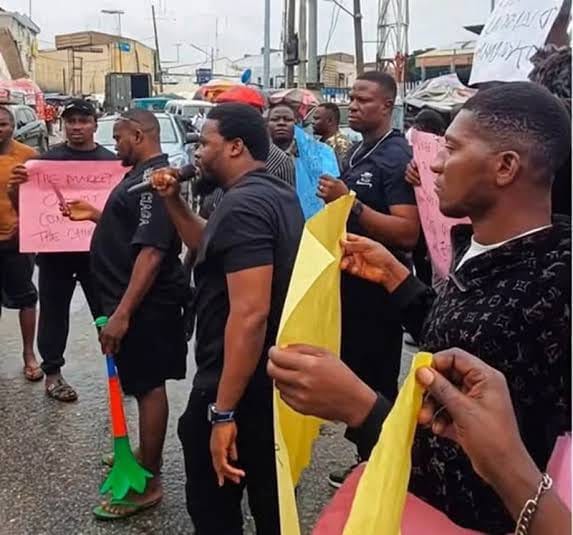
The recent protest at the Lagos International Trade Fair Complex was more than a passing disruption; it was a powerful signal of the growing strain within Nigeria’s retail economy.
Traders, who for years had depended on Chinese wholesalers for stock, now find themselves competing directly with those same suppliers. By moving into retail and selling at near-wholesale prices, foreign merchants have unsettled the delicate balance of distributive trade, leaving Nigerian retailers squeezed and questioning whether the rules of engagement in the marketplace are being fairly enforced.Although the demonstration was quickly suspended after intervention by market leaders, government officials, and the police, the underlying tension remains unresolved.

At its heart lies a pressing national question: what exactly are foreign traders permitted to do in Nigeria’s markets, and who is ensuring compliance with the country’s laws?For decades, Nigerian importers relied on Chinese manufacturers to supply affordable goods, a relationship that seemed mutually beneficial. But as suppliers began bypassing Nigerian middlemen and selling directly to consumers, the arrangement shifted dramatically.
Local traders, burdened with landed costs, taxes, and overheads, now face competitors who control the entire chain—from factory to shipping to retail outlet.
The imbalance is stark, and many Nigerian traders argue that survival under such conditions is nearly impossible.The Centre for the Promotion of Private Enterprise has amplified these concerns, noting that distributive trade employs nearly 27.5% of Nigeria’s workforce. This sector is not only a major source of livelihood but also a critical pillar for micro, small, and medium enterprises.

The think-tank stresses that retail is not a specialised activity requiring foreign expertise, and warns that unchecked foreign participation could erode the foundation of Nigerian small business.The government’s response has so far been measured. The management board of the Trade Fair Complex acknowledged the traders’ grievances, with Executive Director Veronica Safiya Ndanusa assuring that their concerns would be taken seriously.
At the same time, she emphasized Nigeria’s commitment to maintaining a fair and lawful environment for legitimate foreign investment. The police, however, focused on maintaining order, reportedly investigating the protest organisers—a move that highlighted the authorities’ dual concern for stability and compliance.Political reactions have been divided. Lere Olayinka, aide to Minister Nyesom Wike, dismissed the protesters’ demands on social media, arguing that “the market belongs to neither group.” Though personal, his remark reflected the sharp divisions in public opinion and the lack of a clear federal stance.Legally, foreign-owned retail businesses are permitted under the Nigerian Investment Promotion Commission Act, which allows foreigners to own up to 100% of enterprises in most sectors.
Compliance, however, is the sticking point. Foreign-owned companies must meet strict requirements: registration with the Corporate Affairs Commission, minimum share capital of ₦100 million, permits from the Ministry of Interior, expatriate quotas under immigration law, and proper tax documentation. Traders suspect many foreign stalls are cutting corners, but regulators have yet to provide evidence of enforcement.
Cheap Chinese goods undeniably benefit Nigerian consumers, especially in an economy where purchasing power is weak. Economists argue that competition drives efficiency and lowers costs.
But traders warn that artificially low prices—sustained by under-declared imports, unpaid duties, or subsidies—create distortions that no Nigerian retailer can withstand.
The real test, they argue, is not whether a product is Chinese, but whether it is sold under equal legal and tax conditions.Nigeria is not alone in facing this dilemma. Ghana reserves petty trading and market sales for its citizens, while South Africa and Kenya impose licensing and employment restrictions on foreign small traders.
Enforcement remains a challenge across the region, but the principle of protecting local traders is widely recognised.Nigeria’s own history offers cautionary lessons.
In the early 1980s, it expelled thousands of Ghanaian traders, while Nigerians faced similar treatment in Ghana. These episodes inflicted hardship on ordinary traders and strained bilateral relations.
International law permits countries to set conditions for foreign trade, but history shows that expulsions and retaliatory measures often hurt the poorest most.
Nigeria’s interests argue for firm rules, firmly enforced, rather than retaliation.It would be simplistic to blame Chinese traders alone for the struggles of Nigerian retailers.
The sector faces multiple challenges unrelated to foreign competition: high foreign exchange costs, rising energy prices, poor infrastructure, multiple taxation, and limited access to credit.
These structural issues weigh heavily on Nigerian businesses, and a Chinese stall may be a visible target, but these are the quieter killers.What Nigeria requires is clarity and enforcement.
The government should publish the rules on foreign participation in retail in plain terms, decide whether retail should be reserved wholly or partly for Nigerians, and say so openly.
It should audit the markets, check registrations, capital, permits, and customs documents, and prosecute offenders—Nigerian or foreign—who cut corners. It should support Nigerian traders with credit, cheaper power, and better infrastructure, while keeping the door open to foreign investors who build factories, create jobs, and transfer skills.
The Trade Fair protest was more than a disruption—it was a warning. Nigeria must decide whether its markets remain ladders for local entrepreneurs or arenas where they merely watch others dominate.
*For comments, reflections and further conversation
Email: samuelagogo4one@yahoo.com
Phone: +2348055847364*