
Uncategorized
The Harpy Eagle: The Silent King of the Rainforest

_By Sam Agogo_
High above the rainforest, where sunlight struggles to reach the ground and giant trees stand like ancient sentinels, a ruler watches from the shadows.
It does not roar like a lion. It does not run like a cheetah. It does not need to.
Perched on a branch forty metres above the forest floor, the Harpy Eagle waits. Silent. Patient. Unmoving. Then, in a flash of feathers and power, it launches from its perch. Within seconds, a monkey or sloth that moments earlier felt perfectly safe becomes the eagle’s next meal.
This is the Harpy Eagle, one of the largest and most powerful birds of prey on Earth.
Many people have never heard of it, yet few creatures command more respect in the rainforests of Central and South America. To local communities, the sight of a Harpy Eagle is unforgettable. To scientists, it is one of nature’s greatest masterpieces. To the animals that share its world, it is the undisputed king of the canopy.

The Harpy Eagle derives its name from the harpies of Greek mythology, winged beings said to possess immense strength. Yet the real bird surpasses the imagination of ancient storytellers.
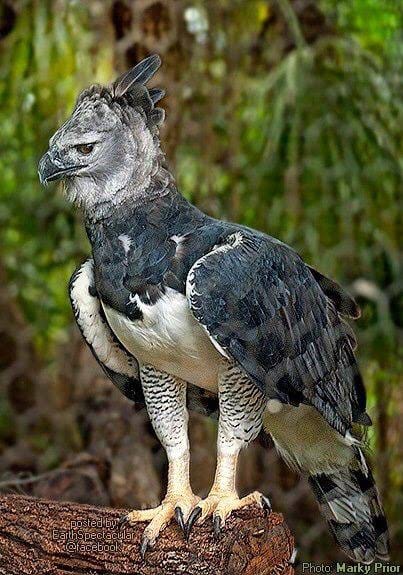
A fully grown female Harpy Eagle can weigh up to nine kilograms and stand nearly as tall as a young child. Its wings can stretch to about two metres across. But it is not its size alone that makes it extraordinary.
Its talons are among the largest of any eagle in the world. Some measure more than ten centimetres in length, almost the size of a human hand. These powerful claws can grip with tremendous force, allowing the bird to seize prey and crush bones in an instant.
Looking at the Harpy Eagle, one immediately notices its fierce appearance. Its grey head is crowned with a striking crest of feathers that rise when the bird is alert. Its dark eyes seem to miss nothing.
There is intelligence in that stare, a calm confidence that comes from sitting at the very top of the food chain.
What makes the Harpy Eagle truly remarkable, however, is its ability to hunt in one of the most challenging environments on Earth.
Most large eagles prefer open skies where they can soar over plains and mountains searching for prey. The Harpy Eagle lives in a different world entirely. Its kingdom is the dense rainforest, a maze of branches, vines and towering trees.
Flying through such a forest requires special skills. Nature has equipped the Harpy Eagle with short, broad wings and a long tail that help it twist, turn and manoeuvre through the canopy with astonishing precision. It can move between trees with the agility of a much smaller bird while retaining the strength of a giant predator.
Its eyesight is equally impressive. From high above the forest floor, it can detect the slightest movement among leaves and branches. Few animals can hide from a hunter with such vision.
The Harpy Eagle’s menu is as impressive as its hunting skills. Its favourite prey includes sloths and monkeys, but it also feeds on opossums, porcupines, anteaters, reptiles and large birds. A single successful hunt can provide enough food for several days.
Unlike many predators that constantly search for food, the Harpy Eagle often spends hours observing and waiting. It understands the value of patience. The bird wastes neither energy nor opportunity.
In many ways, the Harpy Eagle is the rainforest’s natural regulator. By controlling populations of tree-dwelling animals, it helps maintain the balance of the ecosystem. Scientists often regard it as an indicator of a healthy forest. Where Harpy Eagles thrive, nature is usually doing well. When they disappear, it often signals that the environment is under pressure.
The bird’s family life is no less fascinating.
Harpy Eagles build enormous nests in the crowns of giant trees, often among the tallest in the forest. These nests can be used for many years, with the birds adding fresh branches and repairs each breeding season.
The female typically lays two eggs, though usually only one chick is successfully raised. Both parents invest considerable time and energy in caring for their offspring. The young eagle remains dependent on its parents long after it learns to fly, spending months mastering the skills needed to survive.
This slow and careful approach to raising young has served the species well for thousands of years. Unfortunately, it has also become one of its greatest challenges in the modern world.
Today, the Harpy Eagle faces a threat greater than any predator.
Human activity.
Across the Amazon and other tropical forests, vast areas of land are being cleared for agriculture, logging, mining, roads and settlements. Every forest lost means less hunting ground, fewer nesting sites and a smaller future for the Harpy Eagle.
The giant trees that support its nests are often among the first to fall. Without them, the bird has nowhere to raise its young. Because Harpy Eagles reproduce slowly, their populations struggle to recover from losses.
Yet there is still reason for hope.
Across Latin America, conservationists, scientists and local communities are working tirelessly to protect the species. Protected forests, education programmes and wildlife conservation projects are helping ensure that the eagle continues to soar above the rainforest.
Many communities now understand that preserving the Harpy Eagle means preserving the forest itself. The bird has become a symbol of conservation and a reminder that nature’s greatest treasures cannot be replaced once they are lost.
As I reflect on this magnificent creature, I am struck by how much it represents. The Harpy Eagle is more than a bird. It is a symbol of strength without arrogance, power without cruelty, and authority without noise.
It does not dominate through fear. It dominates because it belongs.
For countless generations, it has watched over the rainforest from its lofty perch, maintaining a balance that humans are only beginning to fully appreciate. The Harpy Eagle asks for very little from the world, only healthy forests, abundant wildlife and the freedom to live as nature intended.
Perhaps there is a lesson in that.
In a world that grows louder every day, the Harpy Eagle reminds us that true greatness often speaks softly. It reminds us that power can exist without destruction and that the survival of even the mightiest creature depends on the health of the environment around it.
High above the rainforest canopy, the silent king still reigns.
The question is whether we will leave enough of its kingdom standing for future generations to witness its majesty.
For comments, reflections and further conversation:
samuelagogo4one@yahoo.com
+2348055847364