
Opinion
How Abe’s assassination brought down a powerful religious empire.

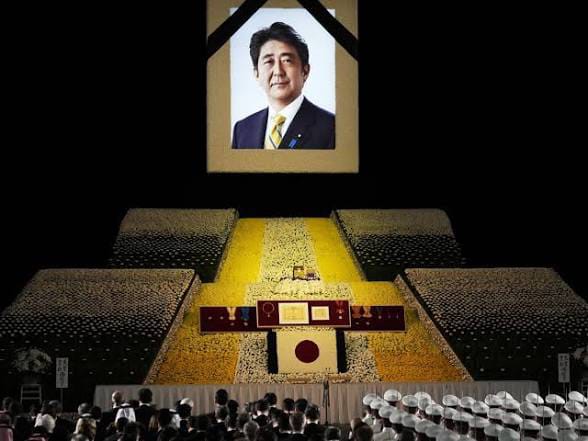
By Sam Agogo
The fatal shooting of former Japanese Prime Minister Shinzo Abe on a street in Nara on July 8, 2022, was not driven by politics in the conventional sense. Instead, it stemmed from a deeply personal tragedy that had consumed 41-year-old former naval officer Tetsuya Yamagami for nearly two decades. As Abe addressed supporters during a parliamentary election campaign, Yamagami approached from behind and fired two shots with a homemade firearm built from pipes, wood and tape. Abe collapsed, was rushed to hospital by helicopter, and died hours later. Yamagami made no attempt to flee and surrendered peacefully to police.
Investigations soon revealed that Yamagami’s actions were rooted in the collapse of his family. His mother had donated about 100 million yen—well over half a million dollars—to the Unification Church, officially known as the Family Federation for World Peace and Unification. The donations devastated the family’s finances, contributed to his father’s suicide, and left Yamagami and his siblings in poverty and isolation. He blamed the church for destroying his family and viewed Abe as a symbol of the political protection that had allowed the organisation to operate unchecked. That connection dated back to Abe’s grandfather, former Prime Minister Nobusuke Kishi, who supported the church’s expansion into Japan during the 1960s as part of an anti-communist alliance. Yamagami later admitted he targeted Abe not because of government policies but because he believed the former leader had legitimised the church.
Following his arrest, Yamagami stood trial at the Nara District Court and, in January 2026, was sentenced to life imprisonment after admitting to the charges from the outset. The court ruled that the killing was carefully planned, noting that he had spent months building and testing the weapon. However, the trial evolved into more than a criminal case against one man. It became a public examination of the church’s practices and the impact they had allegedly had on thousands of families.
That scrutiny culminated on June 22, 2026, when Japan’s Supreme Court unanimously dismissed the church’s final appeal and upheld an order dissolving it as a legal religious corporation. The court ruled that the organisation’s long-running pattern of soliciting donations had caused extensive financial and psychological harm, meeting the legal threshold for dissolution under Japan’s Religious Corporations Act. It marked the first time in post-war Japan that a religious organisation lost its legal status based on civil law violations rather than criminal convictions. As a result, the church forfeited its tax-exempt status, its assets entered liquidation, and a court-appointed administrator took charge of winding down its operations.
The landmark decision followed earlier judgments by lower courts. In March 2025, the Tokyo District Court first ordered the church’s dissolution after the Education Ministry sought legal action in 2023 following revelations from the Abe assassination investigation. The Tokyo High Court upheld that ruling in March 2026, citing billions of yen in damages suffered by victims of the church’s fundraising activities between the early 1970s and 2016. Although some advocates for religious freedom argued that the courts had unfairly held the entire organisation responsible for actions that were not criminal offences, the Japanese government and much of the public regarded the ruling as overdue justice for victims.
The church’s roots date back to 1954, when Sun Myung Moon founded the Holy Spirit Association for the Unification of World Christianity in Seoul, South Korea. Combining Christian teachings with his own claims of a divine mission, Moon expanded the movement into Japan during the late 1950s. Amid Cold War tensions, its strong anti-communist stance won support from conservative politicians, including Nobusuke Kishi, whose backing helped secure official recognition for the church in the 1960s. That alliance with Japan’s conservative political establishment endured for more than six decades.
Within Japan, the church became widely known for aggressive fundraising methods commonly referred to as reikan shoho or “spiritual sales.” Representatives persuaded vulnerable individuals that ancestral curses or spiritual debts could only be resolved by purchasing expensive religious items such as ceremonial vases, pagodas, seals and prayer beads, often costing hundreds of thousands or millions of yen. Members were warned that failure to contribute could bring misfortune upon themselves and their families. Investigations later concluded that more than 20 billion yen had been collected through these and related practices. Court proceedings found documented damages of approximately 7.4 billion yen between 1973 and 2016, while acknowledging that the true figure was likely much higher because many victims never reported their experiences.
Much of the money raised in Japan reportedly flowed back to the church’s headquarters and affiliated businesses in South Korea. Journalists, former members and lawmakers alleged that Japanese followers effectively became the financial backbone of the organisation’s international operations, which included media companies, universities, manufacturing businesses and other commercial ventures. Former adherents also claimed they were taught that Japan owed Korea a spiritual debt due to its colonial history, making sacrificial giving a religious obligation.
The turning point came after Abe’s assassination. Once Yamagami’s motives became public, investigative journalists and opposition lawmakers uncovered extensive links between the church and Japan’s ruling Liberal Democratic Party. Reports showed that more than half of the party’s lawmakers had, at various times, benefited from support provided by the church or its members through campaign volunteers, endorsements or participation in political events. Several senior officials acknowledged receiving election assistance linked to the church. The disclosures led to cabinet resignations and reassignments, while then-Prime Minister Fumio Kishida removed ministers with church connections and pledged to end the party’s relationship with the organisation. Public outrage eventually prompted the Education Ministry to seek the church’s legal dissolution.
The events also offer a broader lesson beyond Japan. According to the author, the tragedy that befell the Yamagami family and the eventual collapse of one of Japan’s most politically connected religious organisations was driven by a system in which fear of spiritual consequences became inseparable from financial demands. The article argues that similar patterns can be observed within parts of Nigeria’s religious landscape, particularly where worshippers are encouraged to give money in expectation of healing, promotion, marriage, prosperity or other breakthroughs, and where inability to give may attract subtle or open pressure.
The author notes that many Nigerian families have reportedly sold property, spent children’s school fees or gone into debt in pursuit of promised blessings that never materialised, often believing their lack of success reflected weak faith rather than unrealistic expectations. While Japan ultimately confronted the issue through years of legal proceedings and institutional action, the article contends that Nigeria has yet to develop similar mechanisms for examining or addressing such practices. It concludes that the dissolution of the Unification Church should not be viewed merely as a foreign development but as a cautionary reflection on the relationship between religion, money and accountability.
For comments, reflections and further conversation:
samuelagogo4one@yahoo.com
+2348055847364