
Crime
Mysterious White Helicopter, Hijab-Clad Fighter: Fresh Insights Into Kwara Massacre

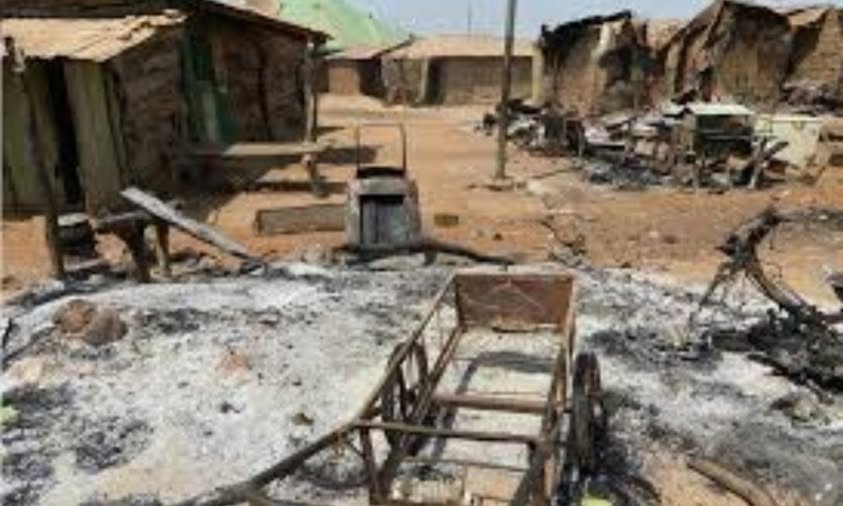
The deadly attack on Woro community in Kwara State was reportedly preceded by a letter sent to the village requesting permission to preach a particular interpretation of Islam.
The village head, Salihu Umar, disclosed that the letter, written in Hausa and dated 19 Rajab 1447 (January 8), was delivered to him about three weeks before the massacre.

According to Umar, the letter—signed by a group identified as JAS—indicated that the group sought a “secret” meeting with community leaders for preaching purposes and assured that residents would not be harmed.
He said he made photocopies of the letter and forwarded them to the Kaiama Emirate Council, while also sending a soft copy to the Department of State Services (DSS) office in Kaiama.
Eyewitness accounts revealed that on the day of the attack, gunmen arrived in Woro at about 5pm on motorcycles, carrying AK-47 rifles and explosive devices.
They reportedly surrounded the community and blocked all exit points.
Around 6pm, the attackers stormed the Emir’s palace, dragged out members of his family, and set the palace on fire, while gunshots echoed across the town.
Residents said a white helicopter bearing markings briefly hovered over the area but left without taking any action.
Between 6:30pm and 8pm, the assailants allegedly began what survivors described as an “execution phase,” during which men were rounded up, had their hands tied behind their backs, and were killed.
A military aircraft was said to have returned around 8pm, forcing the attackers to flee temporarily into nearby bushes. Believing the danger was over, some residents emerged from hiding around 9pm.
However, the attackers reportedly regrouped and used the call to prayer as a deception to draw people out before resuming the killings.
The violence reportedly ended around 2am, when the terrorists retreated into the forest, abducting women and children.
Survivors recount horror
Survivors of the attack on Woro community in Kaiama Local Government Area of Kwara State narrated that heavily armed terrorists carried out a coordinated assault on the town that lasted several hours.
One of the survivors, ZulQharnain Shero Musa, Special Assistant on Media to the Kaiama Local Government Chairman, said the attackers were believed to be operating from a dense forest around Kaiama.
He stated that the assailants stormed the community in large numbers, arriving mostly on motorcycles with two persons per bike, numbering in the hundreds.
According to him, the attackers were armed with sophisticated weapons, including AK-47 rifles, pump-action guns, and explosive devices, while there was no immediate security presence at the time of the attack.
Musa explained that the gunmen surrounded the village, went from house to house, dragged residents out, and executed them.
“They also went to the emir’s palace, brought out his wife and children, set the building on fire around 6pm, and began shooting sporadically across the town,” he said.
He added that motorists travelling along the busy federal highway passing through the community were stopped and attacked, describing the incident as a well-coordinated and systematic operation.
Musa said many residents fled into nearby bushes and farmlands, though some were shot while attempting to escape.
He recalled that a white helicopter with markings briefly flew over the area but left without intervening, after which the attackers intensified the killings from about 6pm to 8pm.
He further stated that a suspected military aircraft later returned, forcing the attackers to withdraw temporarily, but once it departed again, the assailants regrouped and resumed the attack under the pretense of calling people to prayer.
The violence, he said, continued until about 2am.
Musa disclosed that over 200 people were feared dead, with mass burials still ongoing.
He said that between Wednesday and Thursday, about 170 bodies were buried, while others were still being searched for, noting that women were abducted and taken deep into the forest.
According to him, bodies were still being recovered from bushes, rivers, and farmlands.
He added that approximately 95 percent of those killed were Muslims, while about five percent were Christians.
Describing the condition of Woro and neighbouring communities, Musa said the areas were largely deserted as residents had fled in fear.
He explained that the surrounding forests, known for illegal mining activities, had long been inaccessible to locals and now host settlements established by the attackers, complete with houses and boreholes.
He said farmers could no longer access their farmlands and economic activities had completely collapsed.
Musa also revealed that as recently as 4:30am on Thursday, gunshots were heard from distant farmlands, suggesting the attackers were still active.
Another survivor, Aliyu Abdul Hamid Jogodo, also known as Omo Salka, said the attackers abducted his friend’s mother.
He added that his boss’s brother, Dr. Muhammad Yusuf, who was the officer-in-charge of the Woro Primary Health Care Centre, was killed during the attack.
Jogodo said he escaped by fleeing into the bush when the shooting started and remained there until morning.
He appealed to the government to urgently deploy security personnel and provide relief materials.
A trader, Ruqqoyat Solihudeen, said the attackers disguised themselves as soldiers.
She explained that they wore full military uniforms and that one of them was a woman carrying ammunition, who also wore a hijab, making them appear convincing.
Solihudeen said the group passed in front of her shop while heading towards Woro from the Kaiama axis, and no suspicion was raised until gunshots rang out shortly afterward.
She said she managed to escape by initially pretending nothing was wrong before running to safety.
According to her, her seven-year-old stepsister, who suffers from a chronic illness, was abducted while attending a family event, along with another elder sister.
She expressed concern over their condition, fearing that her younger sister might not survive in captivity.
Solihudeen added that many houses and shops were destroyed during the attack.
She said a woman popularly known as Iya Bag from Kishi community lost all her belongings after her house was set ablaze by the attackers, who believed the family was inside, although they escaped through a back window.
She appealed to the government for immediate intervention.
Source: Saturday PUNCH
Continue Reading