
Special Report
Nigeria’s Gender Leadership Score Improves, But Women Still Missing From Power – Global Index

By Iyojo Ameh
Nigeria has recorded a modest improvement in perceptions about women in leadership, but women remain largely absent from key positions of power in politics and business, according to a new global survey.
Findings from the Reykjavík Index for Leadership 2025–2026 show that Nigeria’s score on perceptions of women’s suitability for leadership rose slightly to 59 out of 100, up from 57 in 2024.
The report, which measures public attitudes toward women leading across 23 sectors, indicates growing acceptance of female leadership among Nigerians, even as structural barriers continue to limit real representation.
The survey found that 89 per cent of Nigerians are comfortable with a woman serving as a Chief Executive Officer, while 77 per cent said they would support a woman as Head of Government.
Despite this high level of acceptance, women remain significantly underrepresented in leadership positions.
Women currently occupy only 12 per cent of CEO roles and just four per cent of seats in the National Assembly, reflecting a wide gap between public perception and actual leadership representation.

Advocacy Lead at Gatefield, Shirley Ewang, said the findings highlight the disconnect between societal acceptance and institutional realities.
“While most Nigerians are comfortable with a woman leading, women occupy only 12 per cent of CEO roles and four per cent of National Assembly seats. This highlights a stark disparity between comfort levels and actual representation,” she said.
Men Driving Perception Gains
For the first time since Nigeria joined the index, improvements in perception were largely driven by men.
While women maintained a score of 61, men’s score increased from 53 to 56, narrowing the gender perception gap from eight points to five.
The report also recorded the most notable shift among men aged 45 to 65, a demographic historically considered more conservative on gender leadership issues.
Belief in Workplace Equality Declines
Despite the improvement in the overall index score, the belief that gender equality has been achieved in workplaces declined.
The proportion of Nigerians who believe equality exists at work fell from 62 per cent in 2024 to 55 per cent in 2025, marking the lowest level in five years.
Interestingly, men were more likely than women to say workplace equality has not yet been achieved.
Childcare Sector Shows Strongest Bias
The index assessed perceptions of women’s leadership across 23 sectors, revealing significant disparities.
The highest scoring sectors included:
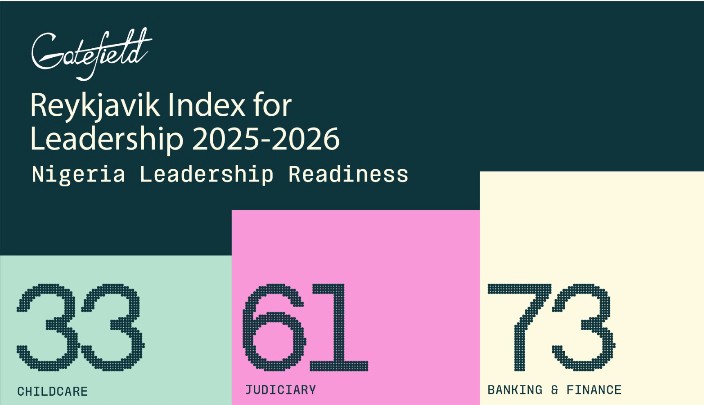
Banking and Finance – 73
Education – 72
Pharmaceutical and Medical Research – 70
Meanwhile, the lowest scoring sectors were:
Childcare – 33
Fashion and Beauty – 46
Engineering – 46
Childcare recorded the lowest score overall, sitting 13 points below the next lowest sector and 40 points below banking and finance.
Family Influence Shapes Leadership Views
When respondents were asked what influences their views about women in leadership, 30 per cent cited family and upbringing, 18 per cent education, 16 per cent personal experience, while nine per cent each mentioned media and religion.
No significant differences were found between men and women regarding these influences.
Nigeria’s Global Ranking
Globally, Nigeria’s score of 59 places it just below Germany (60) and ahead of Kenya (56).
However, the country remains below the Group of Seven average of 68 and far behind global leader Iceland, which scored 86.
Experts say the findings suggest that while Nigerians are increasingly open to women in leadership roles, policy reforms and institutional changes are needed to translate public support into real leadership opportunities.
The survey was conducted among 1,082 working-age Nigerians between 18 and 65, with results statistically weighted to reflect national demographics.