
Governance
Ododo Positions Kogi as Regional Trade Hub, Woos Investors to State

By Abah Benjamin Eneojoh
Government House, Lokoja
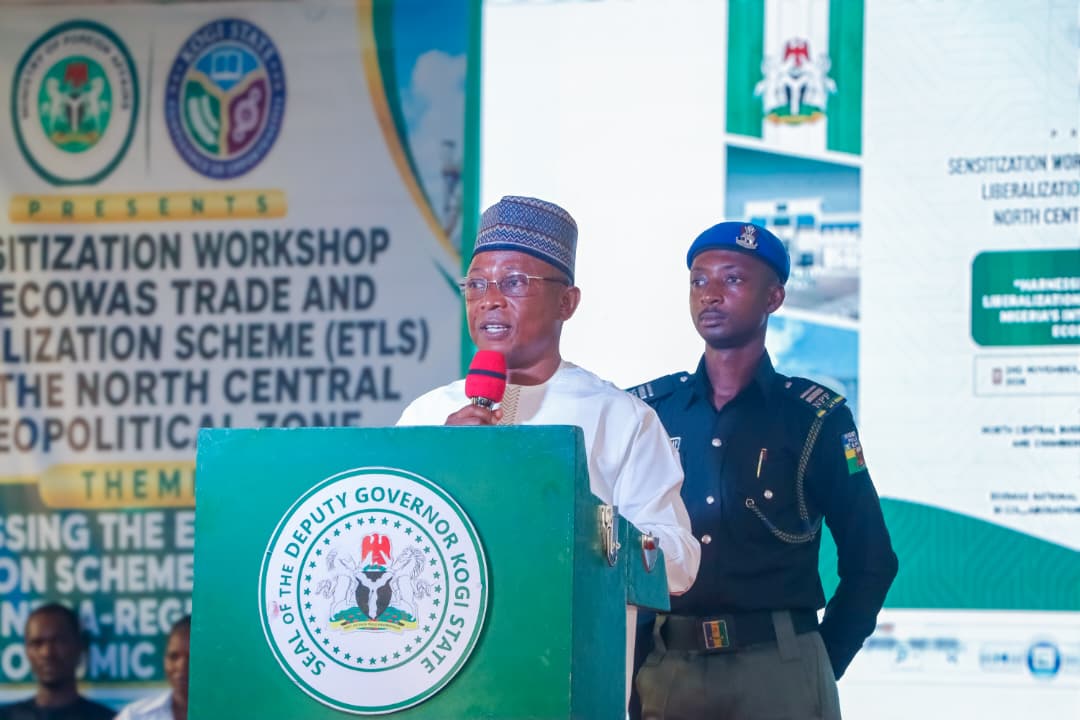
Kogi State Governor, Alhaji Ahmed Usman Ododo, has declared that the state is ready to emerge as a major centre for international trade, industrial production, agricultural processing and commercial activities in West Africa, leveraging its strategic geographical location and abundant natural resources.
The Governor made this declaration on Monday in Lokoja while receiving participants at the ECOWAS Trade Liberalization Scheme (ETLS) Sensitization Workshop for the North Central Geopolitical Zone, organised in collaboration with the Ministry of Foreign Affairs and the ECOWAS Commission.
Ododo noted that Kogi’s strategic location at the confluence of Rivers Niger and Benue, its vast agricultural resources, solid mineral deposits and road networks linking major economic centres offer enormous opportunities for the state to become a gateway for regional trade and investment.
He explained that his administration’s 32-Year Development Plan was designed to translate these natural advantages into sustainable economic prosperity. He disclosed that the proposed Ajaokuta Free Trade Zone, Agro-Processing Zone and Kogi International Airport were strategic projects aimed at attracting investors, increasing production capacity and connecting local businesses to international markets.
The Governor also highlighted the Kogi Rebrand Initiative and Invest in Kogi campaign as deliberate efforts to showcase the state’s investment opportunities in agriculture, solid minerals, tourism and industrial development.
He urged farmers, manufacturers, miners, processors and entrepreneurs to look beyond Nigeria’s domestic market and position their products to meet the demands of customers across West Africa, particularly in Accra, Abidjan, Lomé and Cotonou.
Ododo commended President Bola Ahmed Tinubu for his economic reform agenda, stressing that consistency in economic policies, local production and an enabling business environment were essential to building a competitive economy.
He assured that Kogi State would continue to complement Federal Government initiatives through infrastructure development, investment promotion and enterprise support.
Earlier, the Minister of State for Foreign Affairs, Ambassador Sola Enikanolaiye, described the ECOWAS Trade Liberalization Scheme as an important instrument for regional economic integration, explaining that it provides qualifying products originating from member states with preferential access to regional markets.
Enikanolaiye disclosed that Nigeria had registered approximately 3,500 companies and 20,000 products under the scheme, noting, however, that the figures remained below the country’s potential compared with the performance of some other ECOWAS member states.
He identified the abundant agricultural resources in Kogi and other North Central states, including livestock, mangoes, millet, maize, sugar, groundnuts and cashew, as opportunities for developing competitive value-added products for export.
The Minister encouraged participants to use the workshop to understand product registration, rules of origin, certification and other requirements for accessing regional markets.
He also stressed that increased trade among African countries would promote economic cooperation, strengthen relationships and contribute to peace and security across the continent.
In her remarks, the Secretary to the Kogi State Government, Dr. Folashade Ayoade Arike, reaffirmed the state government’s readiness to embrace international trade, describing Kogi as economically prepared to participate in regional and global markets.
She emphasised the importance of the proposed international airport and the ongoing Lokoja International Market project in facilitating the movement of goods and connecting businesses to wider markets.
She appealed to the Federal Government to support the completion of critical infrastructure projects that would strengthen the state’s commercial capacity.
Ayoade further assured participants of the state government’s commitment to security, describing it as a fundamental requirement for successful business operations and investment.