
Opinion
Seeing The Tumour Doesn’t Mean It’s Time to Operate…on leadership, competence, timing and compassion

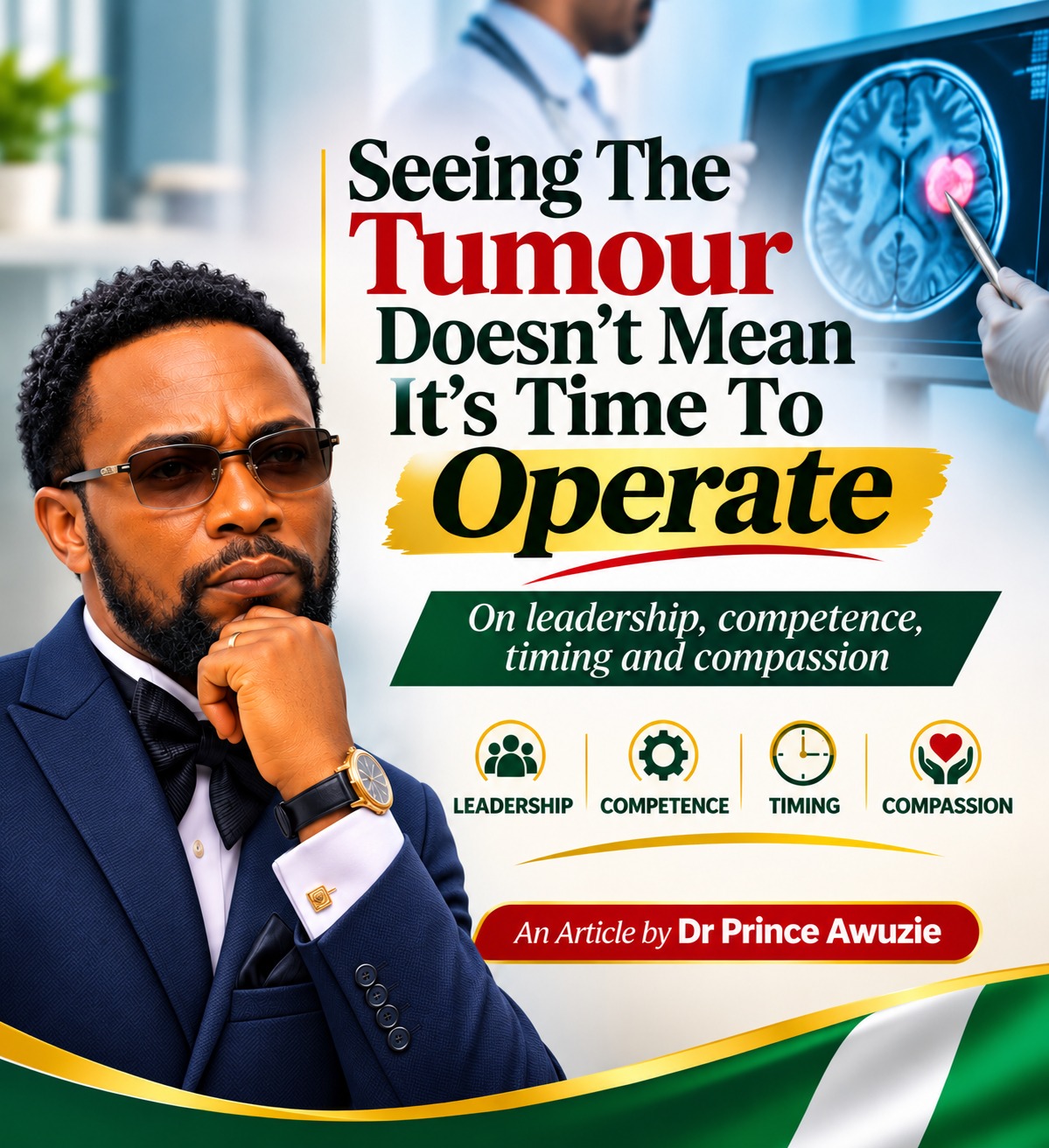
By Dr Prince Awuzie
There is something about leadership that troubles me deeply: the assumption that recognising a problem automatically qualifies someone to solve it.

Let me explain this through medicine.
Imagine a man with a visible tumour.
The entire village can see it.
The carpenter sees it. The panel beater sees it. The general practitioner sees it. The specialist sees it too.

Everyone agrees that something is wrong.
The carpenter knows how to cut. The panel beater knows how to remove damaged parts.

But an experienced specialist may say:
Wait. We must investigate before we operate.
What is the nature of this tumour? Where is it located? Which vital structures are involved? Is surgery even the appropriate treatment? What other conditions does the patient have? Can the patient withstand the procedure? What preparation is necessary? What complications are foreseeable? What happens after surgery?
And crucially, when is the safest and most appropriate time to intervene?
That pause is not necessarily cowardice. It may be the highest expression of professional competence.
As a psychiatrist, I am particularly concerned with what happens when people are subjected to severe, poorly managed shocks.
Economic decisions are not experienced by citizens as abstract figures in a government presentation.
They are experienced as food becoming unaffordable, transport consuming wages, medication being postponed, children missing school and families struggling with uncertainty.
SEEING THE TUMOUR DOESN’T MEAN IT’S TIME TO OPERATE
Such pressures can produce profound emotional distress, anxiety, conflict and worsening mental wellbeing.
As a philosopher, I ask another question:
Is a decision morally adequate simply because its objective is defensible?
I do not think so.
The ethics of an intervention must also consider its timing, method, foreseeable consequences and the people who must endure it.
Consider Nigeria’s petrol-subsidy removal.
There were legitimate economic arguments for reform. But identifying a financially unsustainable arrangement was only the diagnosis.
The treatment required much more.
What was the appropriate timing? Were transport and social-protection measures ready? Had the consequences for food prices, livelihoods, wages and healthcare been adequately anticipated? Were vulnerable households protected before the shock reached them?
We should also remember the opportunity presented by the global oil-price collapse in 2020, when the gap between market prices and regulated prices narrowed.
Nigeria began a transition toward market-based petrol pricing, but that reform was not sustained.
That history raises important questions about missed opportunities, political resistance, preparation and the consequences of postponement.
By 2023, the circumstances were different.
The World Bank supported the broad fiscal case for subsidy reform while emphasising the need to protect vulnerable households. The IMF subsequently reported that compensating support had not been expanded promptly enough.
A reform can be necessary and still be poorly executed.
And compassion is not what a government offers in a speech after hardship has begun.
Compassion belongs in the planning itself.
It is the discipline of asking what will happen to the mother selling food by the roadside, the worker travelling to work, the patient requiring medication and the child whose education depends on a family’s already strained income.
Compassion does not mean that difficult decisions must never be taken.
SEEING THE TUMOUR DOESN’T MEAN IT’S TIME TO OPERATE
It means that difficulty must never become an excuse for avoidable suffering.
The best surgeon is not necessarily the one who cuts fastest, removes the largest tissue or performs the most dramatic operation.
The better question is whether the intervention was appropriate, carefully planned, skilfully performed and followed by adequate care.
Leadership should face a similar test.
Courage without competence can become recklessness.
Competence without compassion can become cruelty.
Compassion without sound judgment may produce good intentions and poor outcomes.
In my view, exceptional leadership requires all three—supported by careful consultation, appropriate timing and the humility to reconsider a decision when its consequences demand it.
We should not measure a reform merely by the magnitude of the change announced.
We should examine what happened to the people who had to live through it.
Because in medicine, the disappearance of the tumour is not, by itself, proof of a successful treatment.
And in governance, the removal of a subsidy is not, by itself, proof of successful leadership.
The ultimate question is not merely what the leader removed, but what the people survived, what was protected, and whether their lives ultimately improved.
DR PRINCE AWUZIE is a Crisis & Complexity Strategist | Psychiatrist | Philosopher
Medical Educator | Philosophical Adviser.
Dr Prince Awuzie brings together international consultant-level psychiatry, clinical governance, philosophy, leadership research and institutional systems design.
His work focuses on diagnosing complex human and organisational problems, clarifying high-stakes decisions and translating insight into accountable action. His original initiatives include ARISE, TRUE PHISA, SharedProof, Oaths Office and NSC ROOTS.
ACADEMIC & PROFESSIONAL QUALIFICATIONS
MBBS | MRCPsych (UK) | MSc Clinical Psychiatry (Distinction), University of South Wales MSc Medical Education for Healthcare Professionals, University of Warwick Advanced Diploma in Mental Health Law, King’s Inns, Dublin
APPA Certified Affiliate in Philosophical Counselling.
The views expressed are entirely his own and do not represent any institution or organisation.