
Legislature
Senate Demands Safety Guarantees for Nigerians in South Africa

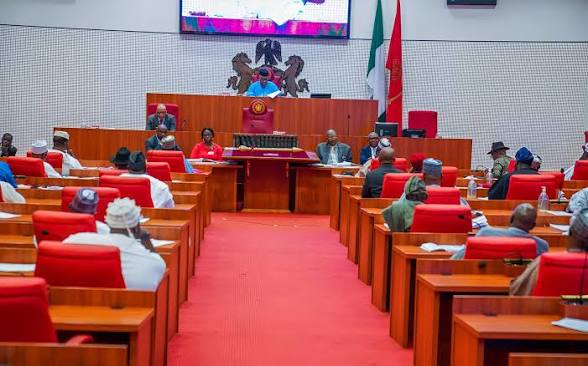
The Nigerian Senate has urged President Bola Ahmed Tinubu’s administration to collaborate with the Nigerian High Commission in South Africa, to obtain written assurances from the South African government on the protection of Nigerians following the expiration of the June 30 ultimatum.
The upper chamber also demanded the arrest and prosecution of those responsible for acts of violence, intimidation, looting and unlawful immigration enforcement targeted at Nigerians in South Africa.
The resolutions followed the adoption of a motion during plenary on Tuesday.
The motion, titled “Need to Halt the Recurring Pattern of Xenophobic Attacks and Intimidation Against Nigerians and Other African Nationals in South Africa,” was sponsored by Senator Asuquo Ekpenyong (APC–Cross River).
Presenting the motion, Ekpenyong expressed concern over the renewed wave of xenophobic attacks, intimidation and anti-foreigner vigilantism against Nigerians and other African nationals in South Africa.
He said the anti-migrant groups’ ultimatum directing foreign nationals considered undocumented to leave South Africa by June 30, 2026, had been accompanied by displacement, violence and attacks on foreign-owned businesses and homes.
According to him, the intimidation has extended beyond undocumented migrants to Nigerians and other foreign nationals with valid residence, work and immigration permits, some of whom have reportedly been threatened, profiled, evicted or instructed to leave by unauthorised vigilante groups.
Ekpenyong said the indiscriminate targeting of foreign nationals, including lawful residents, shows that the campaign cannot be regarded merely as immigration enforcement but constitutes xenophobic hostility based on nationality and perceived foreign origin.
He recalled that Nigeria, alongside other African countries, stood firmly with South Africa during the struggle against apartheid by providing sustained diplomatic, financial and material support to the liberation movement and the release of Nelson Mandela.
He also noted that the Senate, in its resolution of May 5, had condemned the attacks and called for diplomatic engagement, protective measures and parliamentary intervention.
However, he expressed concern that Nigerian-owned businesses in South Africa have continued to be attacked, looted, closed or abandoned under threat, while South African-owned enterprises and brands, including MTN and DStv, continue to operate successfully and lawfully in Nigeria.
According to him, Nigeria has chosen the path of restraint, African brotherhood and respect for the rule of law by rejecting reprisals against South African nationals and lawful commercial interests in Nigeria.
He regretted that subsequent developments, including the voluntary repatriation of Nigerians and the expiration of the June 30 ultimatum, indicate that previous interventions have not provided sufficient protection or a lasting solution.
Ekpenyong maintained that while South Africa has the sovereign authority to enforce its immigration laws, such enforcement must be carried out exclusively by authorised state institutions and in accordance with the rule of law, human dignity and the fundamental rights of all persons.
Senator Mohammed Monguno (APC–Borno), who seconded the motion, said Nigeria’s diplomatic engagement should be driven primarily by the interests of its citizens.
Senator Babangida Hussaini (APC–Jigawa) called for the strengthening of Nigeria’s foreign policy to effectively address xenophobic attacks against Nigerians.
Senator Abdul Ningi (PDP–Bauchi) urged Nigeria to sever diplomatic relations with South Africa, saying such a move would send a strong signal to the South African authorities.
In its resolutions, the Senate condemned in the strongest terms the recurring xenophobic attacks against Nigerians and other African nationals in South Africa.
It also urged the Ministry of Foreign Affairs and the Nigerians in Diaspora Commission to strengthen emergency consular arrangements for Nigerians in South Africa.
The Senate called for the compilation of a verified register of Nigerians who have suffered death, injury, displacement, unlawful detention or loss of businesses and property to facilitate legal redress, restitution and compensation.
It further urged the Federal Government to engage other affected African countries and relevant organs of the African Union to establish effective early-warning and accountability mechanisms for preventing xenophobic violence and protecting African migrants.
The Senate also directed its Committees on Foreign Affairs and Diaspora, as well as Non-Governmental Organisations, to review the implementation of previous Senate resolutions and Nigeria–South Africa bilateral commitments.
The committees were mandated to report back to the Senate within two legislative weeks on measures taken, assurances obtained and outstanding actions required.