General News
TCN: National Grid Not a Bottleneck, Can Wheel 8,700MW – MD


By Iyojo Ameh
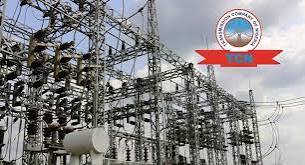
The Transmission Company of Nigeria (TCN) has dismissed claims that its infrastructure is the weak link in Nigeria’s electricity supply chain, insisting that the national grid currently has the capacity to transmit up to 8,700 megawatts (MW) of power.
Managing Director/Chief Executive Officer of TCN, Sule Ahmed Abdulaziz, made the clarification on Thursday at a four-day Parliamentary and Stakeholders’ Engagement Summit on Power Sector Reforms held in Lagos.
He said available operational data show that the transmission network has consistently wheeled all electricity made available to it, stressing that the real constraint in the power sector lies elsewhere.
According to him, Nigeria’s installed generation capacity stands at 13,625MW, while the highest power ever generated and transmitted to the national grid was 5,801.84MW, recorded on March 4, 2025.
“The transmission network has consistently wheeled every megawatt made available to it. Our grid has the capacity and our operators have the competence. The transmission network of Nigeria is ready,” Abdulaziz said.

He explained that TCN has expanded wheeling capacity from about 7,000MW to 8,700MW through infrastructure upgrades supported by the Federal Government and international development partners.
Abdulaziz also disclosed that on the day peak generation was recorded, the national grid delivered 128,370.75 megawatt-hours (MWh) of electricity the highest daily energy transmission in Nigeria’s history.
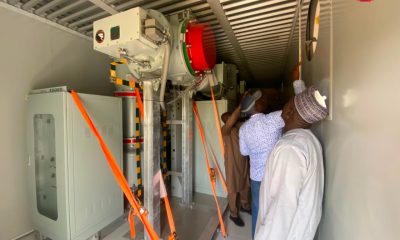
He highlighted key achievements between January 2024 and November 2025, including the commissioning of 82 power transformers nationwide, adding about 8,500 megavolt-amperes (MVA) to grid capacity.
Major upgraded locations include Ajah, Egbin, Enugu New Haven, Onitsha, Gombe, Kano Kumbotso, Apo, Jos, Benin, and Bauchi substations.
He also listed ongoing and completed transmission projects such as the Delta-Effurun 132kV line reconductoring, Benin-Ajaokuta 330kV line strengthening, and the Ihovbor/Benin-Ajaokuta 330kV Turn-In Turn-Out project, which he said has improved grid stability and evacuation capacity.
The TCN boss said the company has secured over $1.4 billion in funding from international partners including the World Bank, African Development Bank, Japan International Cooperation Agency and Agence Française de Développement for transmission expansion projects.
He added that the company is deploying a Supervisory Control and Data Acquisition (SCADA) system to modernise grid operations, enhance real-time monitoring and improve fault detection and response.
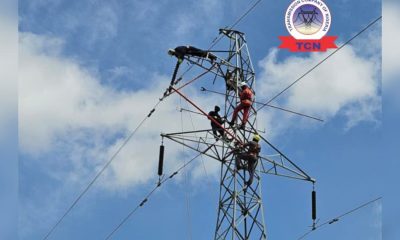
Despite the progress, Abdulaziz identified persistent challenges such as vandalism of transmission infrastructure, right-of-way encroachment, funding constraints, foreign exchange volatility, and coordination gaps within the power sector.
He called on the National Assembly to strengthen legal protections for critical electricity infrastructure and support full implementation of the Electricity Act 2023.
“The journey to reliable electricity is not a sprint; it is a structured, long-term national project requiring sustained commitment and coordinated investment,” he said, reaffirming TCN’s commitment to improving grid reliability and national power delivery.