Opinion
2027 in the Balance: INEC, The Voter Register, and the Long Road to 2027 Credibility

By Kenneth Eze
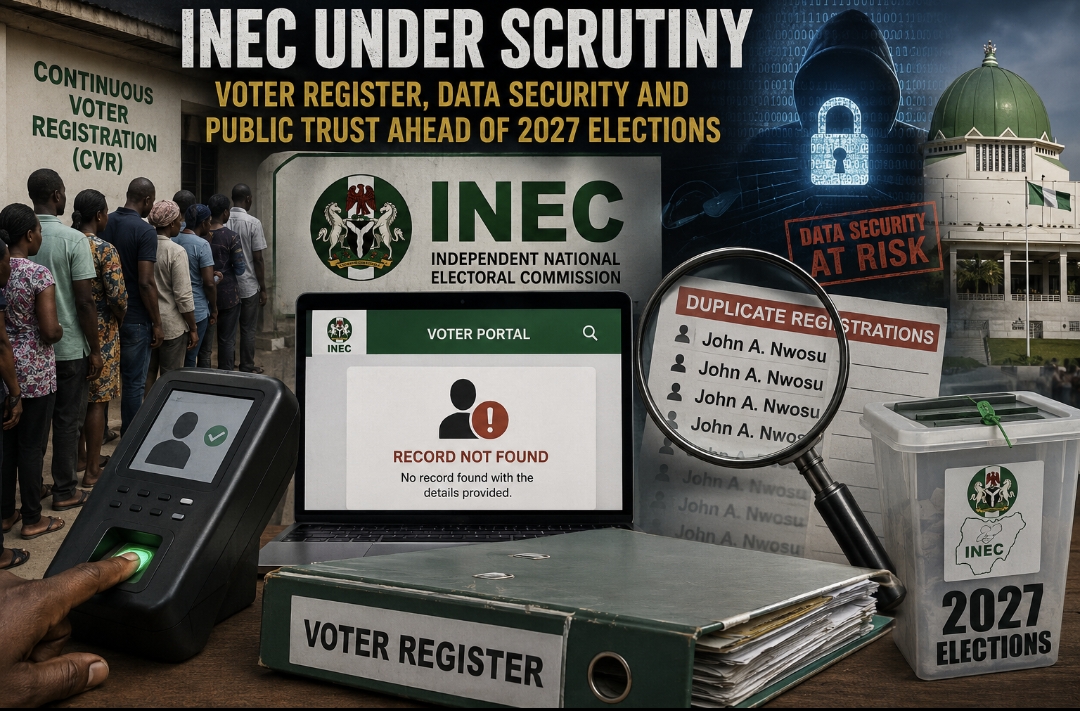
The Independent National Electoral Commission (INEC) is once again under intense public scrutiny, and this time the concerns strike at the very foundation of electoral credibility: the voter register.
In recent weeks, Nigerians who participated in the 2023 general elections have taken to social and traditional media to report that they can no longer find their records on the INEC portal, especially when attempting to transfer polling units or better still check the voting status ahead of 2027.
Alongside these complaints are separate reports of duplicate registrations appearing under the same names. On their own, database errors can occur in any large biometric system during migration, upgrades, or deduplication.
But in a political environment already marked by low trust, technical anomalies are quickly interpreted as signs of manipulation. The distinction between a glitch and a plot is now paper-thin in the public mind, and that perception is itself a threat to the 2027 process.
The anxiety has been compounded by a separate controversy around voter data security. Media reports have circulated alleging that the private registration details of a prominent opposition figure were obtained and leaked, with the source traced not to external hacking but to internal handling.
INEC has been quoted as clarifying that its systems were not breached by outsiders, yet that clarification has unsettled many observers. Cybersecurity professionals consistently rank insider risk as one of the most difficult vulnerabilities to manage because it bypasses firewalls and exploits legitimate access.
If voter data can leave the Commission through internal channels, the question becomes less about code and more about controls, audit trails, and consequences. Nigerians are therefore looking for more than assurances.
They are asking for evidence of robust access management, routine audits by the Nigeria Data Protection Commission (NDPC), and public disclosure of remedial steps. Without that, the neutrality of the umpire remains an open question in the minds of citizens and political actors alike.
Perception of neutrality is also shaped by the conduct and history of leadership. Early this year, screenshots purportedly from an old social media account linked to the INEC chairman Prof Joash Amupitan SAN official have been widely shared, with contents that critics describe as partisan.
The authenticity, context, and timing of such posts are often disputed, and institutions typically avoid commenting on individual digital footprints from years past.
Still, the episode illustrates a broader challenge for election management bodies globally: impartiality must not only be practiced but must be seen to be practiced. Many electoral commissions now adopt codes of conduct that cover past and present public expression, require disclosure, and set clear recusal thresholds where perception of bias could arise.
INEC’s ability to inspire confidence will depend partly on whether it institutionalizes such standards and communicates them clearly, so that personal history does not become institutional liability.
All of this is unfolding against the backdrop of significant public expenditure. The National Assembly has appropriated over one trillion naira for 2027 election preparations, covering logistics, technology, personnel, and security. Citizens and civil society groups are rightly asking whether that investment will produce a credible outcome.
The voter register is the first place to show value for money. When substantial funds are committed to biometric devices, server upgrades, and the Automated Biometric Identification System, the public expects fewer missing records and fewer duplicates, not more.
The European Union Election Observation Mission to Nigeria in 2023 and domestic groups both recommended greater transparency around the technology stack and the cleanup of the register, including publishing methodologies for duplication and statistics on additions, transfers, and deletions. Adopting those recommendations now would help align spending with trust.
The ongoing Continuous Voter Registration (CVR) exercise has become another flashpoint. INEC announced that the current CVR phase will end on 10 July, describing it as the final window before 2027. Deadlines are a normal part of election administration because the register must be closed, printed, and distributed ahead of polls.
The controversy, however, is about access within the window. Reports from several states describe long queues and slow processing times, with some applicants spending hours to complete registration.
Civil society observers have noted that if the pace does not improve, eligible citizens, especially in rural and high-density urban areas, may be shut out.
The Electoral Act 2022 gives the Commission discretion to extend registration where necessary, and that provision exists precisely to prevent inadvertent disenfranchisement due to operational constraints.
Whether INEC uses that discretion, and how it communicates the criteria, will shape public interpretation of its intent.
On leadership, it is important to be precise. As of 2026, the publicly listed Chairman of INEC is Prof. Joash Amupitan SAN. Any assessment of the Commission’s performance should reference verifiable records and official statements.
Where allegations are made against specific individuals, the responsible approach is to demand investigation by relevant authorities including the National Assembly, the Code of Conduct Bureau, and the police — rather than to present claims as established fact.
Nigeria’s democracy is not served by replacing one form of distrust with another. The issue is institutional: does INEC have the rules, transparency, and enforcement needed to insulate itself from both interference and error, regardless of who sits in the chair?
The path to restoring confidence is narrow but navigable, and it starts with the register. First, INEC should commission an independent audit of the voter roll and the ABIS process, with terms of reference made public. The audit should sample records across the six geopolitical zones, test for false negatives in transfers, and quantify residual duplicates.
The findings, methodology, and management response should be released in full. Second, the Commission should publish real-time CVR metrics: number of machines deployed per local government, average registrations per machine per day, downtime incidents, and resolution times. Data quiets rumour.
When citizens can see why a centre is slow and what is being done, suspicion gives way to scrutiny. Third, on data security, INEC should work with the NDPC to conduct a privileged-access review and publish a redacted report showing how role-based permissions, logging, and alerts are configured.
Every export of voter data should be traceable to a named official, purpose, and time stamp. Fourth, the Commission should clarify the post-10 July plan. If the date stands, there should be targeted mop-up operations in wards with documented technical failures.
If an extension is warranted, the legal basis and coverage should be explained ahead of time, not after the fact. Fifth, INEC should update and publicize its code of conduct for national and resident electoral commissioners, including social media policy, recusal standards, and sanctions. Neutrality is a practice, and practices can be written, taught, and enforced.
Civil society and political parties also have roles to play. Voter education must now focus on how to verify registration status, initiate transfers, and file complaints with INEC’s Voter Registry Department.
Parties should train agents to collect evidence rather than amplify allegations, and they should use the administrative and legal channels created by the Electoral Act to challenge anomalies.
The media must distinguish between a verified breach and an untested claim, because the cost of getting it wrong is public faith in the next election.
The danger ahead of 2027 is not that Nigeria cannot run an election. The country has done so repeatedly since 1999, often under difficult conditions. The danger is that a critical mass of citizens may conclude that the outcome is predetermined before the first ballot is cast. Once that belief takes hold, no amount of logistics can restore legitimacy.
The voter register is where that belief is formed. If people who voted in 2023 cannot find themselves in 2026, they will not believe in 2027.
If duplicates persist, losers will not concede and winners will govern without trust. And if data can walk out of the Commission without consequence, then the one trillion naira budget becomes an expensive preface to a crisis* .
INEC still has time to change the trajectory. The Commission can turn the current uproar into a case study in corrective transparency by opening its processes, admitting errors where they exist, and fixing them in public. It can demonstrate that deadlines are administrative, not punitive, by matching them with adequate capacity.
It can show that insider risk is not tolerated by publishing sanctions. And it can remind Nigerians that the law, not individual preference, runs elections. Doing these things will not end criticism.
Elections are contested and umpires are rarely loved. But it will create a record that can be defended, and a process that can be trusted.
Nigerians are not demanding a perfect register. No country has one. They are demanding a register that is accountable. They want to see their names when they search, to correct errors when they appear, and to know that the person who manages the data cannot misuse it. Provide that, and 2027 will be a contest of parties and policies.
Fail at it, and 2027 will be a contest over the referee. The Commission’s task, therefore, is not to win a public relations battle. It is to win back procedural legitimacy, one record, one audit, and one disclosure at a time.
The clock to 2027 is already ticking, and trust, once lost, is the most expensive thing to buy back with a trillion-naira budget.
Kenneth Eze, a Public Affairs Analyst writes from Abuja, Nigeria.
engrchukeze2014@gmail.com