
Education
Breaking the Silence on Dyslexia in Nigeria

By Chinelo Ngolikaego Ezigbo
When I first wrote about growing up in Nigeria with undiagnosed dyslexia, the response
reminded me I was not alone. Parents worried for their children, adults shared the hidden
scars they still carried, and teachers admitted they had never been trained to recognise
dyslexia. My story is not unique. Children today are still being labelled, misunderstood, and
punished, while their real needs remain unseen. Yet, unlike when I was a child, Nigeria now
has policies that promise every child dignity and inclusion, but those promises are broken
daily.
The Wounds We Don’t See
Children growing up in Nigeria with undiagnosed dyslexia carry a weight they cannot name.
As I once did, they live with confusion and humiliation, disciplined in classrooms that mistake
their struggle for stupidity, slothfulness, or stubbornness. As a child, I could not find the
words to explain what was happening in my own head. I only knew that the letters slipped
away from me, and that no matter how hard I tried, my effort was at best taken for
carelessness, more often branded as laziness or disrespect.
The adults around me could not make sense of why I was failing where others succeeded.
They did not have the knowledge to recognise dyslexia, nor the empathy to look deeper
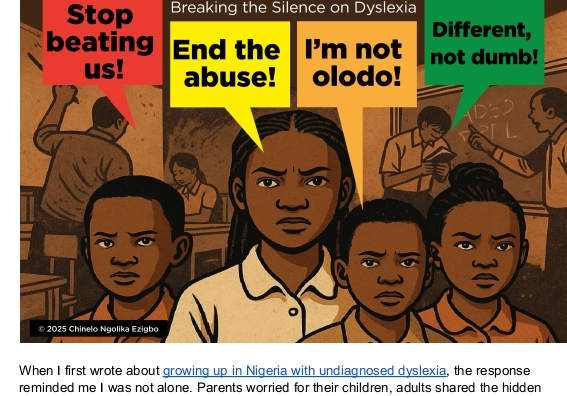
before dismissing me. I remember the names: iti, itiboribo (dullard), olodo (dunce), mumu
(fool). They stung more than the cane. I remember the knock on my head as the class
erupted in laughter. I remember being dragged to the front during a spelling lesson and
flogged, the teacher convinced I was ignoring his instructions. I wasn’t. I was trying my
hardest. But I couldn’t make out what he was dictating; the letters would not stay still, no
matter how carefully I listened or tried to think them through. That punishment, among many
others, still lingers painfully in my memory.
In our society, there is a dangerous belief that flogging or vicious knocks to the head can
somehow “open up the brain.
” Parents and teachers often misinterpret dyslexia as a child
“not having a head for education,
” being wilfully lazy, or even spiritually cursed. Some
children are taken to prayer houses instead of classrooms, which could give them the right
tools and support. These misguided approaches, which rely on violence to compel learning,
do not correct anything. They leave lasting damage, wounds no child should ever be forced
to carry.
I lived this brutal truth. The bruises faded, but the sense of inadequacy endured. I
shouldered the fault, marked by the sting of flogging and the cuts of verbal abuse, and it
shadowed me into adulthood. I grew up believing I was not enough, that my failures were a
matter of willpower, not wiring. That is the wound dyslexia carves in silence, the wound you
cannot see.
It was only much later, after leaving Nigeria, that the silence finally broke. In the UK, I was
diagnosed with dyslexia, and for the first time, there was language for what I had lived with.
There were tools and support. And with them I discovered I was never “lazy” or “stupid”; I
had always been a bright child with a learning difference no one around me had recognised.
That recognition brought freedom. I went on to earn a double degree in Mental Health
Nursing and Social Work, but even those achievements could not erase the memory of
being humiliated as a child.
Many children in Nigeria are still punished for what they cannot explain, and their scars, like
mine, will last long after the cane is put away. Challenging this cultural narrative is as
important as changing policy. The silence does not stop with the child. It is written into our
schools and policies, leaving children struggling in classrooms with no name for what they
are enduring, no training to enable teachers and parents to help. There is just no support for
dyslexia.
Silence in Our Systems
The abuses of knocks, flogging, and verbal humiliation persist because our systems remain
silent on dyslexia. Nowhere in the Child’s Rights Act, 2003 (CRA), the Universal Basic
Education Act, 2004 (UBE Act), the National Policy on Education, 2004 (as revised), the
National Policy on Inclusive Education, 2017; Revised 2023 (NPIE), or even the
National Mental Health Act, 2021 (NMHA) is dyslexia explicitly named. The absence of that
single word has meant weak enforcement, patchy implementation, and no direct safeguards
for children who learn differently.
In July 2024, the National Commission for Persons with Disabilities (NCPWD) issued
the National Standard Operating Procedures (SOPs) on Inclusion and Access of Persons
with Disabilities to Pre-Tertiary Education. These SOPs provide structured tools to prevent
misinterpretation and abuse, including enrollment assessments, the development of
Individualised Education Plans (IEPs), and clear responsibilities for teachers, school heads,
caregivers, and education authorities. The law establishing the NCPWD empowers it not
only to create these standards but also to monitor compliance and enforce the Disability Act.
Yet dyslexia is not explicitly named. Without specific recognition in training and accountability
systems, even these new SOPs risk being applied unevenly or ignored in practice.
Yet these laws and policies are not empty. The Child’s Rights Act, 2003 (CRA) insists on
every child’s right to dignity and protection from abuse. The Universal Basic Education
Act, 2004 (UBE Act) guarantees access to basic education. The National Policy on
Inclusive Education, 2017; Revised 2023 (NPIE) commits Nigeria to classrooms where no
child is left behind. The National Mental Health Act, 2021 (NMHA) protects children with
cognitive and learning differences from stigma. And the Disability Act, 2018, makes it
unlawful to exclude or mistreat anyone because of a disability or learning difficulty.
The silence on dyslexia does not erase these principles; it challenges us to apply them with
courage and clarity. This is the paradox in our systems: silence in the text but impetus in the
principle, an impetus we must use to confront the cultural narratives that brand struggling
children as lazy, cursed, or less than, and to move towards the strategies that can break this
cycle.
What Needs to Change
The question is not whether we have laws or policies; it is whether we have the will to
interpret and apply them with clarity. I know from my own story that silence is never neutral.
It protects the abuser, excuses the system, and leaves the child alone with wounds they
cannot explain. Yet Nigeria is not without protections. Our conventions, laws, and policies
already forbid harm, demand inclusion, and call for public awareness. They exist to prevent
the very experiences I endured, the shame, confusion, punishment, and stigmatisation that
come when learning differences like dyslexia are misread as laziness or a curse.
The mitigation strategies are clear. They fall under three fronts:
1. Prohibiting harm and discrimination.
2. Mandating inclusive education and support.
3. Raising public awareness and accountability.
The challenge is not to invent new principles but to live up to the ones already written, and to
apply them directly to children who learn differently.
1. Prohibiting Harm and Discrimination
I grew up in a culture where flogging, name-calling, and humiliation were seen as
tools for learning. The scars of that thinking are still with me. Yet the Child’s Rights
Act, 2003 (CRA) is clear: no child should ever be subjected to abuse, neglect, or
degrading treatment. The African Charter on the Rights and Welfare of the Child
(ACRWC), 1990, reinforces this duty, insisting that even parental discipline must
respect the dignity of the child. The Discrimination Against Persons with
Disabilities (Prohibition) Act, 2018 (Disability Act) makes it an offence to
discriminate, punish, or exclude because of a difference. The National Mental
Health Act, 2021, protects children with cognitive and learning conditions from
stigma and mistreatment.
The international obligations are no softer. The United Nations Convention on the
Rights of the Child, 1989 (UNCRC) requires that school discipline be consistent
with dignity. The Convention on the Rights of Persons with Disabilities, 2006
(CRPD), obliges us to remove discrimination and provide equal opportunities. These
commitments are not abstract; they speak directly to the knocks on the head, the
name-calling, the flogging, and the whispers of curses. Parents and teachers must
stop believing that pain “opens the brain.
” Trusted voices across our communities
must call out these myths. A child who struggles to read is not lazy, stupid, or cursed;
they may simply learn differently.
2. Mandating Inclusive Education and Support
Our laws already promise inclusive education. The Universal Basic Education Act,
2004 (UBE Act) guarantees free and compulsory schooling. The National Policy on
Education, 2004 (NPE) and the National Policy on Inclusive Education, 2017;
Revised 2023 (NPIE) commit to classrooms where no child is left out. The Disability
Act demands that learners are supported in the most appropriate language, mode,
and means of communication. At the global level, Nigeria’s ratification of the
Convention on the Rights of Persons with Disabilities, 2006 (CRPD), places a
clear duty on us to provide accessible, inclusive schools.
The revised 2023 Inclusive Education Policy goes further, naming children who learn
differently and requiring continuous teacher training, screening, and tailored support.
It mandates assessments to identify learning needs and the creation of Individualised
Education Programmes, ensuring that children are not unfairly judged against the
wrong yardstick. Extra time, learning aids, and empathetic teaching approaches are
not luxuries; they are rights already written into our national frameworks.
And yet dyslexia is still absent from the texts of most policies. That silence has made
it too easy to ignore. The framework is there. What is missing is the courage to name
dyslexia, to train teachers to recognise it, to use the tools we already have, and to
enforce what the law already intends: that every child has a right to learn.
3. Raising Public Awareness and Accountability
Policy on paper will not protect a child who is still beaten and flogged in school. Laws
that speak of inclusion mean little if parents are left in confusion and teachers are
without tools. Public awareness and enforcement must turn words into practice.
The Disability Act obliges the government to promote awareness of the dignity, rights,
and capabilities of persons with disabilities. The Inclusive Education Policy requires
campaigns that reach families in their own languages, faith spaces, and
communities, utilising mosques, churches, town criers, and local networks to shift
their beliefs. Teachers need training and resources to adapt their methods. Parents
need guidance to understand when a child learns differently, so they do not turn to
punishment or prayer houses. Communities must see that inclusion is not charity, but
justice.
My own story is proof of what is possible. Once I had the right tools and
understanding, I discovered I was not “stupid” but simply learned differently. With that
recognition, I thrived, earning a double degree and building a career. That same
transformation must be open to every Nigerian child. Our laws and international
commitments already give us the authority. What remains is the will to claim it, to
reshape our beliefs, to strengthen our policies, and to create the support children with
dyslexia need to thrive.
These laws and policies are not empty words. They already prohibit harm, mandate
inclusion, and require awareness. What is missing is the step from paper to practice. The
courage to use what we have and turn commitments into action.
From Law to Action
The tools are in our hands. What is required is the will to use them. Nigeria is not short of
legal frameworks. The Child’s Rights Act, 2003 (CRA) guarantees dignity. The Universal
Basic Education Act, 2004 (UBE Act) makes schooling compulsory. The Discrimination
Against Persons with Disabilities (Prohibition) Act, 2018 (Disability Act) outlaws
exclusion. The National Policy on Inclusive Education, 2017; Revised 2023 (NPIE)
promises continuous training and adaptation. The National Mental Health Act, 2021
(NMHA) protects against stigma. And through the United Nations Convention on the
Rights of the Child, 1989 (UNCRC), the Convention on the Rights of Persons with
Disabilities, 2006 (CRPD), and the African Charter on the Rights and Welfare of the
Child, 1990 (ACRWC), Nigeria has committed itself on the global stage.
The absence of implementation is the challenge. Too many of these protections are silent in
practice. Policies sit on paper while children sit in classrooms where knocks, flogging, and
ridicule continue. The Disability Act promises awareness campaigns, yet whole communities
remain uninformed. The UBE Act and NPIE require teacher preparation, yet most teachers
have never been trained to recognise dyslexia. Even in Oyo, home to the country’s only
specialised college for training teachers in special needs, dyslexia is not taught in depth. The
curriculum generally covers learning disabilities, but rarely mentions dyslexia or equips
teachers with practical tools for early screening and classroom support. As a result, many
teachers graduate knowing about inclusion in theory but are still unable to recognise or
assist a dyslexic child. Without follow-up in schools or clear guidance for parents, the
protections written on paper are not felt in the classroom.
What we lack is implementation. Too often, these protections remain Abuja documents
instead of classroom realities. A PAGE Analysis of the Domestication of the Nigerian
Disability Act, 2018 shows how low awareness and a charity-based approach to disability,
rather than a rights-based framework, keep children trapped in cycles of shame and
punishment.
To break this cycle, action must happen on two fronts:
1. At the community level:
We must tackle harmful cultural narratives. Parents and teachers must drop
damaging labels and replace punishment with patience and referral. Faith and
traditional leaders should lend their voices, in local languages, to explain that
dyslexia is a learning difference, not a curse. Awareness campaigns must reach rural
areas in the languages families use every day, carried by trusted community voices,
through mosques, churches, town halls, and local media.
2. At the system level:
Laws must be brought to life. Enforcement is critical. The CRA and Disability Act will
remain hollow if they are not implemented. Schools must introduce early screening
for learning differences, develop and enforce Individualised Education Programmes
(IEPs), and ensure accommodations such as extra time and appropriate learning
aids. Teacher training must be continuous, not occasional. NGOs must be funded to
extend support beyond Lagos and Abuja. Inspection and enforcement should also
check for these practices, not just attendance and timetables. Funding must also
reach rural communities where silence is deepest.
The step from paper to practice is the difference between silence and support.
Breaking the Silence
I know this because I lived it. I carried the silence for decades, until my diagnosis finally gave
me the tools and support I had been denied as a child. In my thirties, after moving to the UK,
I was told for the first time that there was a name for what I had struggled with. I was given
strategies, accommodations, and encouragement, and I discovered the proof that I was
never less. With support, I thrived and earned degrees that once seemed impossible.
Yet across Nigeria, many children are still living the same silence. They sit in classrooms,
mocked or flogged for what they cannot explain, while teachers and parents misinterpret
dyslexia as laziness or a curse. Countless talented children are pushed aside, labelled, and
punished, their potential locked away. Now imagine if they all had the same opportunities I
eventually received, in a faraway country where there is no silence, where children are
recognised early and supported to thrive.
Every Nigerian child deserves that recognition much earlier in life. Silence must end. Stigma
must fall. Neglect must never be allowed again. Nigeria has already signed its promises in
law: the Child’s Rights Act, 2003 (CRA), the Discrimination Against Persons with
Disabilities (Prohibition) Act, 2018 (Disability Act), the National Policy on Inclusive
Education, 2017; Revised 2023 (NPIE), and international conventions like the United
Nations Convention on the Rights of the Child, 1989 (UNCRC) and the Convention on
the Rights of Persons with Disabilities, 2006 (CRPD). Keeping those promises means
more than citing them. It requires explicitly naming dyslexia and other unseen disabilities in
our laws and policies, and creating dedicated measures for their implementation. Only then
will no child who learns differently be left to be broken in the classroom, at home, in a
religious place, or anywhere whatsoever.
Breaking the silence is not only about fairness. It is about unlocking the potential of millions
of Nigerians.
References
Nigerian Legislation and Policies
●
Discrimination Against Persons with Disabilities (Prohibition) Act, 2018.
●
National Policy on Inclusive Education (Revised 2023).
●
National SOPs on Inclusion and Access of Persons with Disabilities to Pre-Tertiary
Education, NCPWD (July 2024).
●
Compulsory, Free Universal Basic Education (UBE) Act, 2004.
●
Child’s Rights Act, 2003 (CRA).
●
National Mental Health Act, 2021.
●
Persons with Disabilities (Accessibility) Regulations, 2023.
Analytical and Governmental Reports
●
Adebayo, A. (2025). A PAGE Analysis of the Domestication of the Nigerian Disability
Act 2018.
●
Nigeria’s Initial Report on the Implementation of the CRPD, UN Doc. CRPD/C/NGA/1
(24 June 2024).
International Conventions (Ratified by Nigeria)
●
African Charter on the Rights and Welfare of the Child (1990).
●
UN Convention on the Rights of the Child (1989).
●
UN Convention on the Rights of Persons with Disabilities (2006).