
Crime
Growing Drug Addiction Among Nigeria’s Rich Kids Raises National Concern

By Sam Agogo
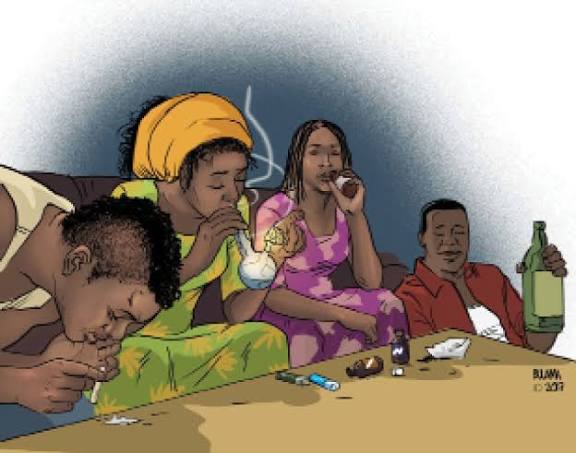
In the heart of Nigeria’s most exclusive neighborhoods—where opulence is the norm and privilege is inherited—an invisible crisis is tightening its grip. A growing number of children from wealthy families are falling prey to drug addiction, a scourge that is quietly devastating lives behind high walls and tinted glass. This disturbing trend is no longer a whisper among insiders; it is a national emergency demanding urgent attention.
The narrative is as tragic as it is shocking. In Lagos, a young man, desperate for a fix, traded his father’s luxury car—once worth ₦65 million—for a mere ₦1 million worth of cocaine. In another case, a Bolt driver recounted how he chauffeured the daughter of a prominent Nigerian figure to a known drug den. These are not isolated incidents. They are part of a growing pattern of self-destruction among the children of Nigeria’s elite—young people who, despite being surrounded by wealth, are drowning in emotional emptiness and psychological turmoil.

Take Tolu, a 19-year-old from a powerful business dynasty in Lagos. Once a top student, Tolu succumbed to the crushing pressure of academic excellence and family expectations. What began as casual use of study-enhancing pills spiraled into a full-blown addiction to methamphetamine. He dropped out of university, sold his designer belongings, and vanished into the shadows of Lekki’s party scene.
Amaka, the daughter of a senior government official in Abuja, was the picture of elegance and poise. But behind her curated social media presence was a young woman battling severe depression. She turned to opioids and eventually began injecting synthetic drugs in secret. Her collapse at a private event exposed a hidden life of dependency that her family had long ignored.
This epidemic is not confined to Nigeria. In London’s Chelsea district, 17-year-old Oliver—son of a hedge fund magnate—was found unconscious after overdosing on fentanyl. In Dubai, Leila, a 20-year-old influencer and daughter of a real estate tycoon, was arrested for drug possession during a yacht party. In Johannesburg’s Sandton, cocaine use among university students from wealthy families is on the rise. Across the globe, the children of the rich are increasingly vulnerable to the seductive pull of narcotics.
Experts warn that the causes of this crisis are multifaceted. While poverty may drive some into drug use, wealth can be equally dangerous. Easy access to money, combined with emotional neglect, peer pressure, and the glamorization of drug culture, creates a perfect storm. In elite circles, drugs are often seen not as vices but as status symbols—expensive, exclusive, and dangerously normalized.
Psychiatrists identify three core drivers: biological predisposition, psychological distress, and social influence. Many of these young people suffer from undiagnosed mental health conditions—depression, anxiety, trauma—yet lack the support systems to cope. In their world, vulnerability is weakness, and silence is survival. So they self-medicate, often with lethal consequences.
The drug trade in Nigeria is thriving, particularly in the Southwest. Lagos and Oyo States are epicenters, with notorious hotspots like Alaba International Market serving as distribution hubs. In upscale areas like Victoria Island, Lekki, and Maitama, drugs are trafficked through underground networks, hidden behind the façade of luxury lounges, pharmacies, and private events. Cannabis cultivation flourishes in Edo, Ogun, and Osun States, while hard drugs like heroin and cocaine enter through airports and porous borders.
Despite the efforts of the National Drug Law Enforcement Agency (NDLEA), enforcement remains a cat-and-mouse game. Dealers are becoming more sophisticated, using encrypted apps, peer networks, and even legitimate businesses to mask their operations. Meanwhile, families often choose secrecy over intervention, fearing scandal more than the loss of their children.
The consequences are devastating. Addiction corrodes the soul, shatters families, and derails futures. It breeds theft, violence, and in some cases, death. It also sends a dangerous message to society: that wealth can insulate one from accountability, and that addiction is a private shame rather than a public health crisis.
To combat this epidemic, a radical shift is needed. Parents must move beyond material provision and invest in emotional presence. Schools—especially elite institutions—must implement robust mental health programs and drug education initiatives. Communities must break the silence and confront the issue head-on. Media campaigns should challenge the myth that addiction is a “poor man’s problem” and expose the reality that no social class is immune.
Rehabilitation centers must be expanded and reimagined to cater to the unique needs of privileged youth, who often resist traditional treatment models. Religious institutions, NGOs, and youth advocates must create safe spaces for healing and mentorship. And policymakers must prioritize prevention, early intervention, and long-term recovery strategies that address both the supply and demand sides of the drug crisis.
This is not just a Nigerian problem. It is a global reckoning. From Abuja to Amsterdam, from New York to Nairobi, the children of the wealthy are crying out for help—often in silence. Behind the designer clothes and luxury cars are young lives unraveling, one pill, one injection, one line at a time.
We must listen. We must act. Because the cost of inaction is too high, and the price of privilege should never be addiction.
For comments, reflections, and further conversation, please contact:
📧 Email: samuelagogo4one@yahoo.com
📞 Phone: +2348055847364