
International
Igbo Union Cites Court Rulings Supporting Kanu, Insists on Rule of Law

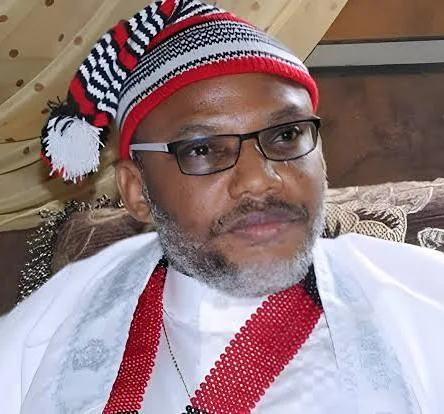
The Ndi-Igbo Worldwide Union (NIWU) has reeled out a number of court judgments and international decisions which it says support its call for the release of the leader of the Indigenous People of Biafra (IPOB), Mazi Nnamdi Kanu, stressing that the rule of law must be upheld in Nigeria.
The union made this known in a statement announcing its formal emergence as a global socio-cultural, advocacy and humanitarian body dedicated to advancing and protecting the interests of the Igbo people worldwide.
In the statement issued on Wednesday and signed by its Chairman, Ben Nwankwo, and Secretary, Hon. Chief Charles Edemuzo, the group said it was established in response to what it described as persistent injustice, marginalisation and institutional neglect confronting Ndi-Igbo. It added that it would henceforth take responsibility for articulating and acting on Igbo concerns in the absence of effective intervention by existing structures.
NIWU stated that the Igbo nation, with more than 50 million people in Nigeria and over 40 million in the diaspora, has endured systemic discrimination traceable to the colonial era and aggravated after the 1967–1970 Nigeria–Biafra civil war.

It recalled that although the war ended with the declaration of “no victor, no vanquished” alongside the policy of Reconstruction, Rehabilitation and Reconciliation, those commitments were never fully realised.
According to the union, the failure to implement post-war policies entrenched marginalisation and fuelled renewed agitation for self-determination among many Igbos.
The group pointed to what it described as the absence of major federal infrastructure in the South-East — including railways, seaports, cargo aviation facilities and gas pipelines — as clear evidence of continued exclusion from national development.
It also raised concerns over insecurity and religious violence, alleging that Christians, particularly Igbos and other minority groups, have been disproportionately targeted in attacks across the country.
NIWU cited figures it said were confirmed by United States lawmakers, claiming that more than 52,000 Christians have been killed since 2009, thousands of churches destroyed, and over five million people displaced into internally displaced persons (IDP) camps. It further alleged that more than 7,000 Christians were killed in 2025 alone as of June.
The union further alleged that Nigerian correctional facilities are overcrowded with Igbo youths detained on what it termed trumped-up charges linked to IPOB or the Eastern Security Network (ESN), noting that many are being held without trial. It maintained that the right to self-determination is guaranteed under Nigerian law as well as international instruments, including the United Nations Charter, the International Covenant on Civil and Political Rights (ICCPR) and the International Covenant on Economic, Social and Cultural Rights (ICESCR).
Describing Nigeria as a country where injustice has become institutionalised, NIWU cited the continued detention and prosecution of Nnamdi Kanu as a prime example. It argued that Kanu’s trial lacked jurisdiction and was based on what it described as “law unknown to man.”
The union strongly condemned what it termed the kidnapping, torture and extraordinary rendition of Kanu from Kenya to Nigeria, describing the act as a grave violation of international law and an abuse of state power. It said the action undermined Kenya’s sovereignty and amounted to an extraterritorial crime.
Rejecting Kanu’s conviction, the group said its stance was anchored strictly on justice and the supremacy of the rule of law. To support its position, it listed several judicial and institutional decisions it said favoured Kanu, including a January 19, 2022 ruling of the Federal High Court in Abia State which held the Nigerian government liable for the 2017 invasion of his home; an October 26, 2022 Federal High Court judgment declaring his extraordinary rendition from Kenya unlawful; a March 18, 2018 African Union resolution on IPOB activities; an October 26, 2023 Enugu State High Court judgment nullifying the proscription of IPOB; a July 22, 2022 opinion of the United Nations Working Group on Arbitrary Detention; and a Supreme Court ruling delivered in December 2023.
The union called on the Nigerian Bar Association (NBA) to live up to its responsibility of defending constitutionalism and the rule of law by intervening in the Kanu case.
“As a professional body, the NBA shares in the responsibility to guarantee and protect the rights of every citizen under the law,” the statement said.
NIWU also cautioned Igbo political elites against exploiting the situation for personal or political advantage, warning that history and justice would ultimately hold them accountable.
Addressing Igbo youths, the union said they had not failed their people but had instead been let down by some elders and political leaders who sacrificed their future for personal gain. It urged the youths to continue to pursue their rights through lawful and peaceful means, guided by justice, fairness and dignity.
The group expressed optimism that the coming year would mark a turning point for the Igbo people, allowing them to fully realise their potential and benefit meaningfully from Nigeria’s democracy. It called on all stakeholders to work towards making Ala-Igbo prosperous, strong and united once again.
The union also renewed its call for an end to ethnic and religious violence across the country and reiterated its demand for the immediate release of Nnamdi Kanu.