
General News
Women Deliver 2026: Global Leaders Demand Urgent Action for Gender Justice

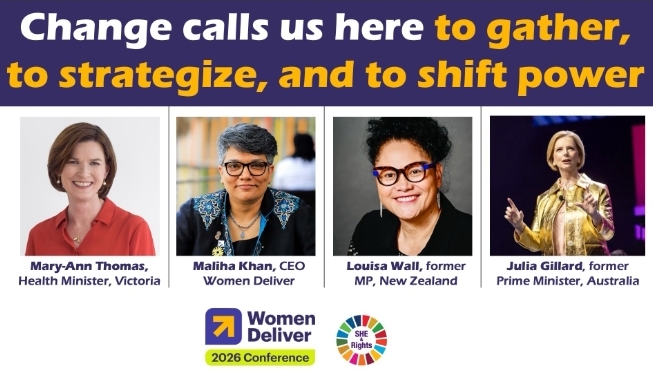
As wars, climate disasters, economic inequality, and rising anti-rights movements threaten progress across the world, global leaders are warning that the fight for gender justice can no longer be delayed.
This urgent call is at the heart of the Women Deliver Conference 2026, one of the world’s largest global gatherings focused on gender equality and the rights, health, and dignity of women, girls, and gender-diverse people.
For the first time since its launch in 2007, the conference will be hosted in the Pacific region, on the unceded lands of the Wurundjeri Woi Wurrung Peoples of the Kulin Nation in Narrm (Melbourne), Australia.

With more than 6,500 participants from 185 countries expected, the conference carries the theme: “Change calls us here.”
The message is clear: lasting change must shift power back to the people.
Louisa Wall, Oceanic Pacific Mobilisation Advisor for Women Deliver 2026, said bringing the conference to the Pacific marks a major turning point in ensuring that Indigenous women, First Nations peoples, and Pacific communities are no longer excluded from shaping decisions that affect their lives.
She noted that the Pacific region remains on the frontline of climate change, battling cyclones, rising sea levels, and the destruction of livelihoods, while women across the region continue to face high levels of gender-based violence and poor political representation.

According to her, women’s leadership, especially First Nations leadership, must be central to both regional and global solutions.
Australia’s own progress offers important lessons. Ranked 13th out of 148 countries on the Global Gender Gap Index, the country has made notable gains in gender equality.
In Victoria State, gender-responsive budgeting supports women’s education and workforce participation, while free sanitary products in schools, hospitals, libraries, and train stations have helped reduce period poverty.
Abortion care is also fully integrated into mainstream healthcare, with laws protecting women from harassment outside clinics and ensuring access without parental consent barriers for minors.
Former Australian Prime Minister Julia Gillard, the country’s first female prime minister and a Women Deliver Ambassador, warned that the world is facing multiple crises at once, including wars, climate injustice, economic inequality, and a growing anti-gender movement targeting women and marginalised communities.
She said that while poverty deepens for millions, wealth continues to concentrate in the hands of a few, creating unequal outcomes and worsening global instability.
“There is also an anti-gender politics being used in many parts of the world to gain popular support, and attitudes towards gender equality are going backwards, especially among young men,” she warned.
Dr Maliha Khan, Chief Executive Officer of Women Deliver, said the global system itself must be reimagined.
She argued that institutions created after the World Wars, though intended to guarantee peace and prosperity, have failed many women and post-colonial nations.
“We want justice, not just development,” she said, stressing the need for stronger local leadership, greater support for grassroots movements, and systems that truly centre those most affected.
According to her, the conference is not just about policy conversations, but about restoring accountability and ensuring every girl and woman has the right to shape her own future.
Women Deliver 2026 is more than a conference—it is a global reminder that gender equality is not optional, but essential to building a safer, fairer, and more sustainable world.
Because when women lead, communities rise.