News
XENOPHOBIA AS POLICY: How South Africa Is Exporting Its Failures and Importing Its Excuses

By Sam Agogo
She spoke with the certainty of a woman who has made up her mind.
In a video that spread across the continent within hours of appearing on South African social media in late April 2026, a South African woman made a sweeping claim: that Nigerians are responsible for 60% of crime in South Africa. She urged fellow South African women married to Nigerian men to pack their bags and leave. “If a man loves you,” she declared, “he must take you back to where he’s coming from.”
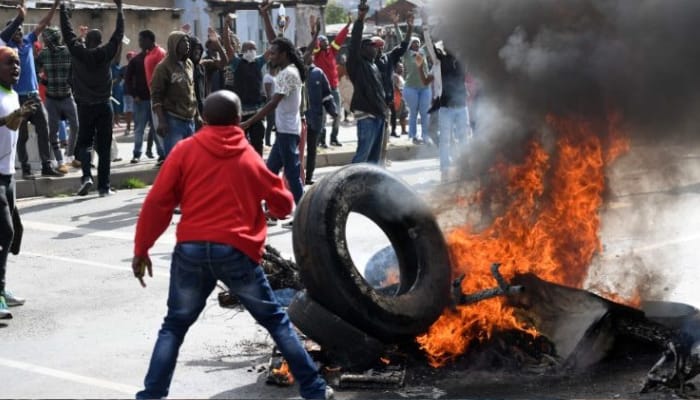
The video did not emerge in a vacuum. It arrived in the same week that thousands marched through Johannesburg and Tshwane under the banners of March and March and Operation Dudula, demanding the expulsion of undocumented foreigners. It arrived as the United Nations issued a formal warning to the South African government about rising xenophobic violence, and as the Nigerian and Ghanaian diplomatic missions advised their nationals to exercise extreme caution. For many South Africans, the woman was stating what they believe to be true. For the data, she was voicing a prejudice dressed up as a fact.
The “60% figure” has a traceable origin — and it does not come from Nigerian crime data. It belongs to a statement by a Gauteng SAPS Provincial Commissioner, who said approximately 60% of suspects arrested for violent crimes in Gauteng were illegal immigrants. Not Nigerians. Illegal immigrants — a category dominated in South Africa by Zimbabweans and Mozambicans, who share a land border and cross in their hundreds of thousands annually.
SAPS does not publicly release data on the nationalities of those they arrest. More critically, SAPS detects perpetrators in only 23.9% of murders and 17.9% of aggravated robberies — meaning in over 80% of the country’s most violent crimes, police have no idea who the perpetrators are. A claim of “60% Nigerians” against this backdrop is not a statistic. It is a guess — or worse, a deliberate misdirection.
The World Prison Brief and South Africa’s own Department of Correctional Services settle the matter with numbers. South Africans comprise 89.5% of the prison population. Foreign nationals account for just 10.5%. Among those foreign nationals, Zimbabweans are the largest group, not Nigerians. Zimbabwe accounts for 591 foreign offenders in South African prisons, Mozambique 330, and Nigeria 245. The woman in the video has redirected real frustration toward the most visible foreign community in the country. It is psychologically understandable. It is statistically false.
To understand why South Africa has arrived at this moment, one must trace a society that achieved a peaceful democratic transition in 1994 and then steadily squandered the inheritance. South Africa today is the most unequal country in the world by Gini coefficient. The official unemployment rate stands at 32.9%, with 8.2 million officially unemployed, 3.5 million discouraged work seekers, and nearly 25 million South Africans of working age with no income. Youth unemployment has escalated to 46.1%. More than half the population lives below the poverty line.
This is not a temporary shock. It is a generational failure — two decades of declining education quality, deindustrialisation, and state capture that successive governments have refused to honestly confront. Into this pressure-cooker, the xenophobia narrative offers a release valve. The foreign national becomes the explanation for everything: unemployment, crime, drugs, housing shortages. Distrust of African immigrants among South Africans climbed from 62.6% in 2021 to 73.1% in 2025, tracking directly with the rise of organised anti-immigrant movements.
There is a bitter irony that history demands be stated plainly. Nigeria was among the most vocal and generous supporters of the ANC during the anti-apartheid struggle, contributing funds, diplomatic pressure, and moral solidarity to the liberation of Black South Africans during the darkest decades of apartheid. As the Council on Foreign Relations noted in April 2026, Nigerians often accuse South Africans of not showing gratitude for that support. On the current evidence, the accusation is difficult to refute.
A second viral video added further dimension to the conversation. In it, a South African citizen demands that the government give every South African one million rands as a guaranteed lifetime income. South Africa has lots of money, the argument runs. The government should simply share it.
National Treasury rejected this idea in 2024, calculating it would cost R400 billion annually and create over-dependence on the state without solving unemployment. The uncomfortable question it forces to the surface is this: when a citizen demands one million rands from the state while simultaneously demanding that productive foreign nationals be expelled, who exactly will build the economy that funds the grant?
The foreign nationals being marched against are, in thousands of cases, doing precisely what the state has failed to do for its own citizens — creating economic activity, absorbing risk, and providing services in communities the government has long abandoned. Expelling them does not create a single South African job. It destroys existing ones. The million-rand demand is the symptom of a society told, for thirty years, that its suffering is someone else’s fault.
The numbers on crime do not support South Africa’s narrative either. According to the Numbeo Crime Index 2025, South Africa leads all African nations with a crime index of 74.7, a position it has held for several years. Nigeria ranks second in Africa at 66.6 — nearly 9 full points lower. Nigeria’s murder rate stands at approximately 22 per 100,000 people, less than half of South Africa’s rate of 45 per 100,000. South Africa, with 62 million people, recorded 27,494 murders in a single year. Nigeria, with nearly four times the population at over 230 million, records a comparable or lower absolute count. On every per-capita measure, South Africa is dramatically more dangerous than Nigeria.
In a peer-reviewed 2025 study of 40 incarcerated foreign nationals across four South African correctional centres, participants came from Mozambique at 14, Zimbabwe at 6, Nigeria at 5, Lesotho at 4, and smaller numbers from the DRC, Tanzania, Malawi, and Pakistan. The data is consistent and clear. Nigerians are the target of South Africa’s fury not because the evidence supports it, but because they are resented for thriving in an environment where many South Africans feel left behind.
If South Africans want to understand why their country is the most dangerous in Africa, the answer is not found in Nigerian passports. It is found at home.
Inequality is the first culprit. South Africa’s Gini coefficient is the highest on Earth, a direct inheritance of apartheid’s engineered wealth disparity that three decades of democratic governance have failed to dismantle. Unemployment is the second. Generating idle, desperate young men with no economic stake in social stability is a guaranteed formula for violent crime, and South Africa has done so at industrial scale for thirty years. The illegal firearms crisis is the third. Weapons smuggled from Mozambique, Zimbabwe, Namibia and Lesotho, compounded by corrupt law enforcement officials diverting arms directly into criminal hands, have made South Africa’s gangs as well-armed as paramilitary units. Institutional collapse is the fourth. A detective service solving fewer than one in four murders, courts backlogged for years, and mob justice deaths surging from 849 in 2017/18 to 2,124 in 2022/23 describe a state that has lost its monopoly on justice. Political failure is the fifth and most damning. State capture, looted institutions, and thirty years of a governing party that prioritised its own survival over the transformation its people were promised produced the crisis South Africa now inhabits. No immigrant group caused any of this.
The remedies are not mysterious. South Africa must invest in education at generational scale. It must rebuild its police and justice system from the ground up. It must pursue genuine economic reform rather than expanding grant dependency. It must tackle the regional firearms crisis through serious diplomacy with its neighbours. And above all, it must build a culture in which citizens direct their energy toward the officials who failed them, not the immigrants who outworked them.
South Africa is the continent’s most symbolically significant democracy — the nation that was supposed to prove that reconciliation and constitutional government could produce a better future for Black Africans. When it burns foreign nationals’ shops and tells the world its problems are Nigeria’s fault, it sends a message from Cairo to Cape Town: that African solidarity is a promise made at summits and broken in the streets.
The woman in the video deserves empathy. She lives in a country that has failed her. Her frustration is legitimate and her fear is real. But her answer is wrong — and the movements channelling that anger toward foreign nationals, rather than toward the policies that manufactured the crisis over thirty years, are doing their country a profound disservice.
South Africa’s crime problem has a South African solution. It starts with honesty. And honesty starts with looking in the mirror — not pointing at the neighbour who helped you build the house.
For comments, reflections and further conversation, email samuelagogo4one@yahoo.com or call +2348055847364