Opinion
Twelve Years After Annexation, Crimea Begins to Crack

By Sam Agogo
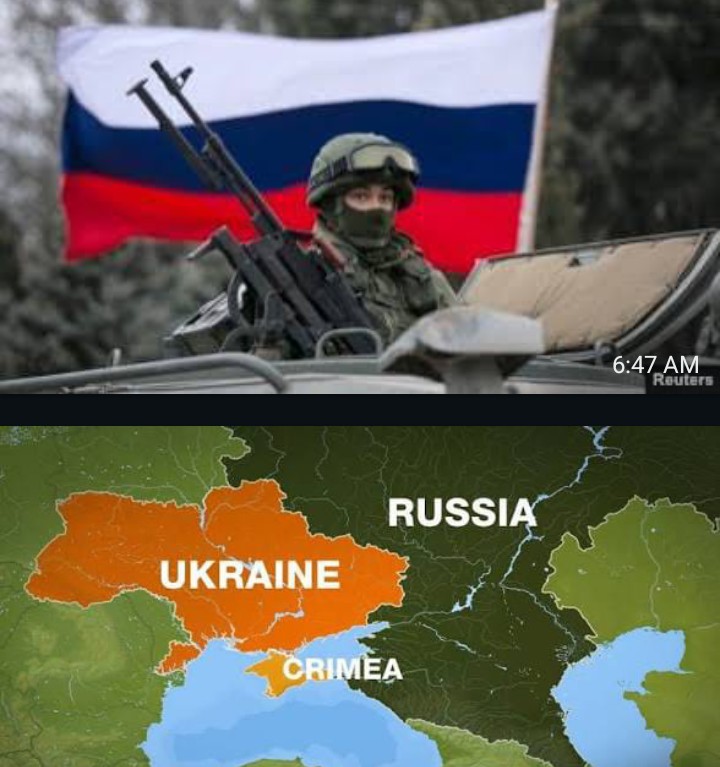
Every war carries a moment that historians eventually point to as the beginning, and for Crimea, that moment was a quiet, cold week in February 2014. Armed men in unmarked uniforms — soldiers the world would soon call “little green men” because they wore no insignia identifying their nationality — took up positions outside Crimea’s parliament and along its roads. Within days, the peninsula’s government had been replaced, its airports and bases quietly surrounded, and a referendum organised under the shadow of Russian rifles delivered the result Moscow wanted. By March, Vladimir Putin formally declared Crimea part of Russia. Most of the world refused to recognise it, but on the ground, the annexation held, and Crimea — a peninsula of roughly 2.4 to 2.5 million people, once a jewel of Black Sea tourism drawing millions of visitors a year — became a showcase of Russian permanence: a bridge across the Kerch Strait, resorts rebranded for Russian holidaymakers, and an electricity and water system re-engineered to break its old dependence on mainland Ukraine.
For eight years, Crimea remained a frozen conflict, a wound Ukraine could not close but had no immediate means of reversing. That changed when Russia launched its full-scale invasion of Ukraine on 24 February 2022, using the peninsula as a staging ground for its southern offensive on Kherson and the Black Sea coast. Through most of the war that followed, Crimea itself stayed largely untouched — a rear base shielded from the consequences of the fighting it helped sustain.
That shelter has now been stripped away, and the manner of it is itself the story. In late May, Ukraine’s Ministry of Defence announced a campaign called the “Logistics Lockdown” — a deliberate effort to sever every route Russia uses to supply Crimea, using medium-range drones capable of striking up to 200 kilometres away. Russia has only two supply lines into the peninsula: a land corridor through occupied Donetsk, Zaporizhzhia and Kherson, and the Kerch Strait crossing. Ukraine has systematically targeted both.
The railway has taken the heaviest blows, since it is the backbone for moving heavy military equipment that road transport cannot easily carry. Ukrainian special forces destroyed a railway bridge over the North Crimean Canal near Rozdolne, collapsing one of its spans in what they called the first strike of its kind on the peninsula, and struck another bridge near Ichki days later. Over an eighteen-day stretch, Ukrainian drones hit eleven separate bridges a combined twenty-one times, including repeated strikes on the Chongar crossing linking Crimea to the Ukrainian mainland. The damage forced occupation authorities to suspend passenger rail services within Crimea entirely, leaving Kerch as the only functioning link to Russia.
The Kerch Bridge itself — the showpiece Putin personally opened in 2018 as proof of Crimea’s permanence — has not escaped either. It has been closed to traffic for hours at a stretch after nearby strikes, and Russia has since banned fuel and heavy freight from crossing it, citing the risk of destruction. Alongside the bridges, Ukraine has hit fuel depots, power substations, air-defence systems and radar stations across the peninsula, aiming to strip away both Crimea’s supply lines and its ability to defend them.
The clearest sign of how deep the damage runs is Russia’s own fuel policy. Civilian petrol sales across Crimea have effectively been suspended, with remaining stocks channelled first to the military and only then to hospitals and other institutions deemed critical. An entire civilian population of roughly 2.4 million has, in effect, been placed behind the military in the queue for fuel on its own peninsula — a stark demonstration of how completely the war’s logistics now dictate daily life there.
The strain shows in other ways too. Sevastopol has suffered repeated blackouts after strikes on its main substation, at times halting public transport entirely. A dozen substations feeding the peninsula were knocked offline in a single 48-hour window this month, and power stations built after 2014 now run on foreign turbines that sanctions have made nearly impossible to repair — so every fresh strike compounds damage never fully resolved from the last one.
Perhaps most tellingly, analysts report a growing outflow from Crimea — tourists cutting holidays short, ordinary residents, military personnel and even occupation officials heading back to the Russian mainland. On one particularly chaotic day, that movement swelled into a jam of roughly three thousand vehicles at the entrance to the Kerch Bridge, as people rushed to leave while the crossing still functioned. President Volodymyr Zelenskyy says Ukrainian intelligence shows the crisis deepening “on a virtually daily basis,” with Russians who relocated to Crimea after 2014 now returning to the mainland “while they still can.”
This pressure has coincided with a broader shift on the battlefield. Ukraine’s commander-in-chief, General Oleksandr Syrskyi, announced in early June that Ukrainian forces had recaptured more than 600 square kilometres of territory since the start of 2026 — the first sustained run of Ukrainian gains since the failed 2023 counteroffensive — as Russia’s pace of advance has slowed considerably, a slowdown analysts link directly to Ukraine’s expanding drone campaign against supply lines.
Twelve years after an annexation meant to settle Crimea’s fate for good, what has emerged is not a single decisive battle but a strategy of patient exhaustion — cutting the bridges, railways, fuel lines and air defences that let the occupation function at all. Whether this eventually culminates in Crimea’s return to Ukrainian control remains genuinely uncertain; Russia retains vast reserves of manpower and industrial capacity, and Putin has given no public sign of abandoning his claim. But the myth that Crimea was safely, permanently Russian has been unmistakably punctured. Seized quickly and quietly in 2014, it is now, twelve years on, beginning to crack.
For comments, reflections, and further conversation:
Email: samuelagogo4one@yahoo.com
Phone: +2348055847364