Opinion
THE OPUTA PANEL: NIGERIA’S MOMENT OF RECKONING THAT MAY NEVER RETURN

By Sam Agogo
Some nations forget on purpose. They bury their worst years under new anthems, new flags, new men in old uniforms, and hope the silence does the work that justice should have done. Nigeria almost became one of those nations. Then, in 1999, it did something rare enough to still feel astonishing a quarter of a century later: it opened the vault of its own violence and asked its people to walk through it, room by room, name by name.
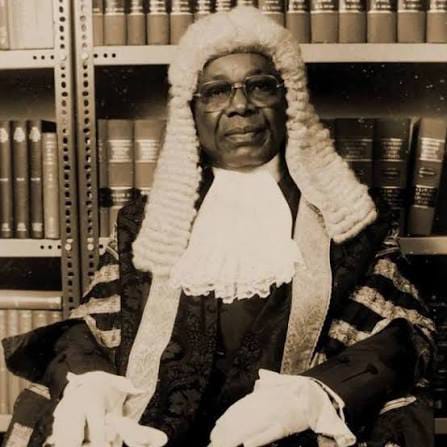
The instrument of that reckoning was the Human Rights Violations Investigation Commission, set up by President Olusegun Obasanjo in the earliest months of his first civilian term. History would remember it by a gentler name, the Oputa Panel, after the retired Supreme Court justice who sat at its head, Chukwudifu Oputa, a man whose quiet, unhurried authority made even the most decorated soldiers in the room sit a little straighter. The panel’s brief was enormous by design. It was to investigate human rights violations stretching from 1966, the year the guns first turned inward on Nigeria’s own political class, through three decades of coups, counter-coups, and military decree, all the way to the handover that had just placed a democratic government back in charge. Thirty-three years of buried grievance, compressed into a single commission’s in-tray.
The scale of what poured in still startles anyone who studies it today. More than ten thousand petitions arrived from every corner of the federation, from villages that had never once appeared in a national newspaper to families whose sons had disappeared from Lagos barracks decades earlier and were never spoken of again. The panel took its hearings on the road, moving through all six geopolitical zones, so that testimony would not be a privilege reserved for the capital. Farmers stood at the same microphone where retired generals would later stand. Widows described the night soldiers came for their husbands with the same unflinching detail that journalists used to describe the cells they had been tortured in. For once, the machinery of the state was not there to silence these stories. It was there to record them.
What made the hearings genuinely unprecedented, though, was not merely that victims spoke. It was that power was made to listen, in person, without the cushion of rank. Men who had once commanded army divisions, men whose signatures had authorised detentions and worse, were summoned like anyone else and made to explain themselves before a panel of lawyers who did not appear to be impressed by medals. There is a particular kind of political courage in that image, a nation’s most feared men reduced, for an afternoon, to witnesses answering for their own conduct in front of the very citizens they had once ruled by fear. Nigeria had never staged that scene before. It has not staged it since.
It would be comforting to end the story there, with truth triumphant and power humbled. But the Oputa Panel’s tragedy is that its moral authority far outran its legal one. The Supreme Court, ruling on a challenge to the commission’s powers, found that it lacked the constitutional muscle to compel certain individuals to appear before it. That single ruling gutted the panel’s teeth at precisely the moment its bite mattered most. Several of the most consequential figures on its witness list simply declined the invitation, protected by a court judgment rather than by innocence. When the panel finally delivered its report in 2002, thick with documented atrocity, recommended reparations, and proposals for institutional reform, the government’s response was not rejection. It was something quieter and more devastating: silence. The report was neither disowned nor acted upon. It was simply allowed to gather dust in the way that only inconvenient Nigerian truths know how to gather dust.
And yet it would be its own kind of dishonesty to call the Oputa Panel a failure. It left behind something that cannot be un-created: an official, documented, cross-examined record of what Nigeria’s military years actually cost its people, compiled not from rumour but from sworn testimony taken in public. It gave grief a stage it had never been granted before. It planted, deep in the national imagination, the idea that rank should never be a shield against account, an idea that resurfaces every time a new generation of Nigerians demands answers from power, as it did when young people flooded the streets during the EndSARS protests, calling, whether they knew the lineage of the demand or not, for a reckoning cut from the same cloth Justice Oputa once wove.
The harder truth is that the particular conditions which made 1999 possible have not returned, and may not return again soon. The Supreme Court’s ruling against the panel’s authority still stands as law; any future commission of similar ambition would meet the same constitutional wall unless the ruling itself is undone. Many of the men implicated in the violations of the military era, or their political descendants, remain comfortably embedded in Nigeria’s present-day corridors of power, in government, in business, in the barracks. A leader bold enough to summon them now would not simply be settling old scores. He would be provoking networks with every capacity to fight back.
There is, beneath all of this, a deeper and more corrosive obstacle, one that has grown rather than shrunk in the years since Oputa’s gavel fell silent: the poison of religion, region, and ethnicity that runs through nearly every serious institution Nigeria tries to build. A truth commission is, at its core, an act of national trust. It asks victims from Enugu to believe that a panel dominated by voices from Kano will judge their pain fairly, and it asks the reverse of victims in the north. It asks Christians to trust that Muslim panelists will not shield their own, and Muslims to trust the same of Christians. In a country where appointments to far smaller bodies routinely collapse into arguments over zoning, quotas, and who is being favoured over whom, the idea of assembling a panel that every region and every faith could simultaneously see as neutral is not a small ask. It may be the single hardest requirement of all. Where regionalism and bigotry seep into the composition of such a body, or even into the public’s perception of it, the panel is finished before its first hearing, because its verdicts will be read not as justice but as tribal score-settling, regardless of how honestly the evidence is weighed.
That raises the harder question underneath the institutional one: who, in today’s Nigeria, could actually chair such a panel and be believed? The answer cannot simply be someone competent or well-credentialed; Nigeria has no shortage of capable jurists. It requires someone whose name, the moment it is announced, does not immediately trigger a calculation in the mind of a Fulani herder, an Ijaw fisherman, an Igbo trader, or a Yoruba civil servant about which side that person is really on. It requires a figure with no visible debt to any political godfather, no history of defending one region’s excesses while condemning another’s, and no religious posture that reads as tribal loyalty in disguise. Justice Oputa himself carried that rare currency in 1999, a reputation for incorruptibility so consistent across decades on the bench that even the generals he summoned could not credibly accuse him of bias. Finding his equivalent today, someone Nigerians across every fault line would simultaneously fear enough to answer honestly and respect enough to accept the verdict, is not merely difficult. It may be the scarcest resource in the entire country, scarcer even than the political will to convene the panel in the first place. Nigeria has judges, clerics, retired generals, and elder statesmen in abundance. What it lacks is consensus on any single one of them as being above suspicion, and that lack, more than any court ruling, may be the real reason a second Oputa Panel remains out of reach.
What is left, then, is not a blueprint but a benchmark. The Oputa Panel showed Nigeria what it looks like when a nation finds, however briefly, the nerve to confront its own reflection, and finds, if only for a season, a man the whole country was willing to trust with that reflection. That the standard has gone unmatched for twenty-five years does not diminish what was achieved in 1999. It only confirms how rare, how costly, and how easily squandered such moments of national courage, and such figures of shared trust, really are. The question the panel put to Nigeria, whether the powerful can ever truly be made to answer to the powerless, across every line of faith and region that divides this country, was never fully answered. It was only, for one remarkable season, asked out loud. It is still waiting for its reply.
*For comments, reflections, and further conversation, Email: samuelagogo4one@yahoo.com | Phone: +2348055847364*