
General News
Olukoyede: EFCC Secures 10,872 Convictions, Returns ₦661bn to Beneficiaries

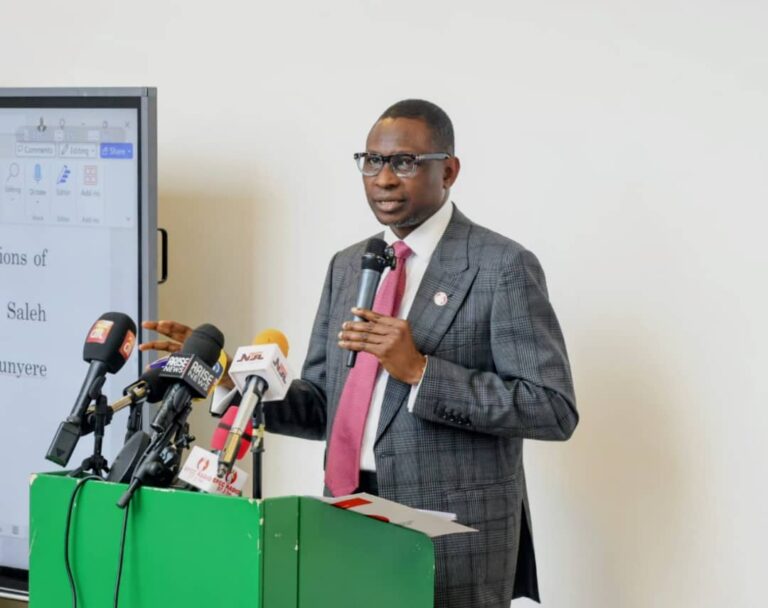
The Economic and Financial Crimes Commission (EFCC) says it has secured 10,872 convictions and recorded massive asset recoveries within the first 34 months of the administration of its Executive Chairman, Ola Olukoyede.
Olukoyede disclosed this on Monday in Abuja during an interactive session with select editors, publishers and media chiefs, where he highlighted the achievements and reforms recorded by the commission between October 2023 and July 2026.
According to him, the commission received 49,673 petitions, investigated 39,615 cases, filed 14,476 cases in court and secured 10,872 convictions within the period, representing a 75.1 per cent conviction-to-filing ratio.
He added that in the first half of 2026 alone, the EFCC recorded 1,370 convictions from 1,889 cases filed.
Olukoyede said the results reflected diligence, resilience and a prosecutorial approach anchored on evidence and courtroom outcomes.
He explained that data from petitions and case analysis showed changing trends in financial crimes, noting that between 2024 and 2026 year-to-date, 46,288 offences were recorded across nine major categories.
According to him, advance fee fraud and cybercrime accounted for nearly two-thirds of the recorded offences.

He further disclosed that total recorded offences increased by 24.1 per cent between 2024 and 2025, with notable increases in procurement fraud, bank fraud, cybercrime and economic-governance offences.
The EFCC chairman stressed that the fight against economic and financial crimes was not limited to grand corruption, but also involved protecting citizens, businesses and institutions from fraud, cyber-enabled crimes and other forms of economic exploitation.
On high-profile cases, Olukoyede said the commission had continued to pursue complex matters without regard to the status of suspects.
He noted that its high-profile case portfolio included former governors, ministers, public office holders, heads of agencies, financial-sector operators and corporate officials.
He said the commission had recently secured convictions involving some high-profile Nigerians, including Saleh Mamman, Robert Orya and Chukwunyere Nwabuoku.
Olukoyede reaffirmed that no office or title placed anyone beyond the reach of the law, stressing that the EFCC would continue to investigate professionally, prosecute based on evidence and allow the courts to determine guilt or innocence.
Specialised Enforcement
The EFCC chairman said the commission’s specialised enforcement portfolio covering money laundering, unlicensed bureaux de change, illegal mining,
virtual assets and terrorist financing recorded 920 cases, with 212 convictions secured and a substantial pipeline of active investigations and prosecutions.
He said money laundering and unlicensed bureau de change cases accounted for the largest share of the portfolio, while the commission was also responding to emerging risks involving virtual assets and illicit financial flows from the extractive sector.
Asset Recovery
Olukoyede said asset recovery had remained a major pillar of the commission’s activities.
Between October 1, 2023 and June 30, 2026, he said the EFCC recorded recoveries of ₦1,233,612,040,411.11, $684,478,457.32, £373,905.78 and €9,343,803.66, in addition to recoveries in other currencies.
He explained that approximately ₦397.26 billion, representing 33 per cent of the naira recovery, constituted direct recoveries for the Federal Government, while ₦836.34 billion, representing 67 per cent, was recovered on behalf of ministries, departments and agencies, state revenue services, companies, individuals and foreign victims.
According to him, two out of every three naira recovered were on behalf of beneficiaries other than the Federal Government.
On the utilisation of recovered funds, Olukoyede said ₦661.32 billion and $492.37 million were released to beneficiaries during the period.
He said the naira releases included approximately ₦325.35 billion paid directly to individuals and corporate bodies, while ₦335.97 billion was released to various MDAs, the Nigerian Revenue Service, states’ internal revenue services and other public institutions, companies and individuals.
He said the commission’s priority remained making restitution faster, more transparent and more efficient.
Revenue Mobilisation
Olukoyede said federal and state tax recoveries amounted to approximately ₦288.1 billion during the period, comprising about ₦173.2 billion in federal tax recoveries and ₦114.9 billion attributed to states’ Internal Revenue Services.
He stressed that the recoveries represented fiscal value obtained through enforcement of existing obligations rather than the imposition of new taxes.
He added that approximately ₦257.2 billion in naira recoveries were recorded for federal ministries, departments and agencies, demonstrating how anti-corruption enforcement could strengthen government revenue.
The EFCC chairman also highlighted the impact of recovered proceeds on social investment.
He recalled that in August 2024, the Federal Government directed that ₦50 billion each be allocated to the Nigerian Education Loan Fund (NELFUND) and the Nigerian Consumer Credit Corporation from proceeds of crime recovered by the EFCC.
He said further funding of ₦50 billion each for NELFUND and Credit Corp from EFCC recoveries was subsequently approved in 2026.
According to him, recovered property, NOK University, was converted into the Federal University of Applied Sciences, Kachia, Kaduna State, with 1,909 students matriculating in December 2025.
He said the institution had provided tertiary education opportunities to students who might otherwise not have been able to access such education, while also contributing to the local economy of Southern Kaduna.
He added that another private university of high value had also been finally forfeited to the Federal Government.
Forfeited Assets
Olukoyede disclosed that the EFCC secured the forfeiture of 10,053 tangible assets under interim and final court orders between October 2023 and July 2026.
The assets included 8,198 electronic items, 1,177 real-estate assets, 370 automobiles and 251 plots of land, as well as schools, factories, hotels, shops, oil rigs, barges, machinery and aircraft.
He added that the commission also recorded the forfeiture of 102 tonnes of solid minerals.
According to him, proceeds from the disposal of assets under final forfeiture orders amounted to approximately ₦12.07 billion and were paid to the Federal Government.
Financial System Integrity
Olukoyede said the EFCC’s enforcement activities had also contributed to strengthening the integrity of Nigeria’s financial system.
He noted that sustained enforcement in money laundering, terrorist financing, asset freezing and confiscation, virtual assets and other high-risk sectors formed part of Nigeria’s broader efforts to address deficiencies in its anti-money laundering and counter-financing of terrorism framework.
He said Nigeria’s removal from the Financial Action Task Force Grey List in October 2025 was a national achievement, with the EFCC’s casework and enforcement activities forming part of the collective effort.
In the foreign exchange market, he said the commission’s enforcement against unlicensed bureaux de change supported reforms by the Central Bank of Nigeria.
He disclosed that the EFCC recorded 234 BDC cases and 73 convictions within the last three years.
Collaboration
The EFCC chairman said the achievements recorded over the past three years would not have been possible without the support of domestic and international partners.
He explained that organised crime was becoming increasingly sophisticated and crossing national borders and jurisdictions, making international cooperation essential.
He said the EFCC worked domestically with law-enforcement agencies, regulators, the judiciary, ministries, departments and agencies, and state revenue authorities.
Internationally, he said the commission collaborated with organisations including the Federal Bureau of Investigation, the United Kingdom’s National Crime Agency, the Royal Canadian Mounted Police and INTERPOL.
Olukoyede also disclosed that he was re-elected President of the Network of National Anti-Corruption Institutions in West Africa (NACIWA) for another three-year term.
Reforms and Restructuring
At the institutional level, Olukoyede said the EFCC had recorded significant improvements in its processes and procedures.
He listed reforms introduced during the period to include new guidelines on arrest and bail, a review of sting operations, the establishment of the Department of Fraud Risk Assessment and Control, the Security Department, the Immigration and Visa Section and the Cybercrime Rapid Response Centre.
He added that the commission commissioned the Enugu and Ilorin Directorates and established new directorates in Ekiti, Anambra and Katsina states, thereby improving citizens’ access to the EFCC.
The commission, he said, also introduced policies on gifts and hospitality, conflict of interest and exhibit-room security.
He disclosed that the Internal Affairs Department had been renamed and restructured as the Ethics and Integrity Department as part of efforts to strengthen internal cleansing.
According to him, almost 60 per cent of the commission’s processes and operations had been digitalised.
He said the EFCC was also investing in innovation and digitisation through its new Academy, the 24/7 Cybercrime Rapid Response Centre (E-C2R2) and EFCC Radio.
Olukoyede said the commission was not merely counting arrests or announcing recoveries, but focused on converting information and intelligence into prevention, petitions into investigations, investigations into prosecutions, prosecutions into convictions and recoveries into restitution.
He said the EFCC had made significant progress but that its work was not finished.
Looking ahead, he said the commission’s priorities included deepening prevention, ensuring faster restitution, investing in better investigative technology and improving professionalism in its engagement with citizens.
He pledged that the EFCC would intensify the fight against corruption and economic crimes while respecting due process and maintaining focus on measurable value for the public.
In conclusion, Olukoyede thanked President Bola Ahmed Tinubu, members of the National Assembly, the judiciary, civil society, the media and the Nigerian public for supporting the commission’s work.
He assured stakeholders that the EFCC would not take their trust and confidence for granted.