
General News
Tinubu: Security Summit Must Deliver Measurable Results …Tasks North Central Stakeholders on Collective Action

From Dooshima Terkura, Makurdi
President Bola Tinubu has called on traditional and religious leaders, communities, youths, women, development partners and the private sector in the North Central to strengthen collaboration with government and security agencies in tackling insecurity and building lasting peace across the region.
The President particularly urged traditional and religious leaders to serve as the first line of early warning and trusted voices of reconciliation in their communities. He also called on citizens to share intelligence with security agencies and refuse to shield criminals on the basis of kinship or sentiment.
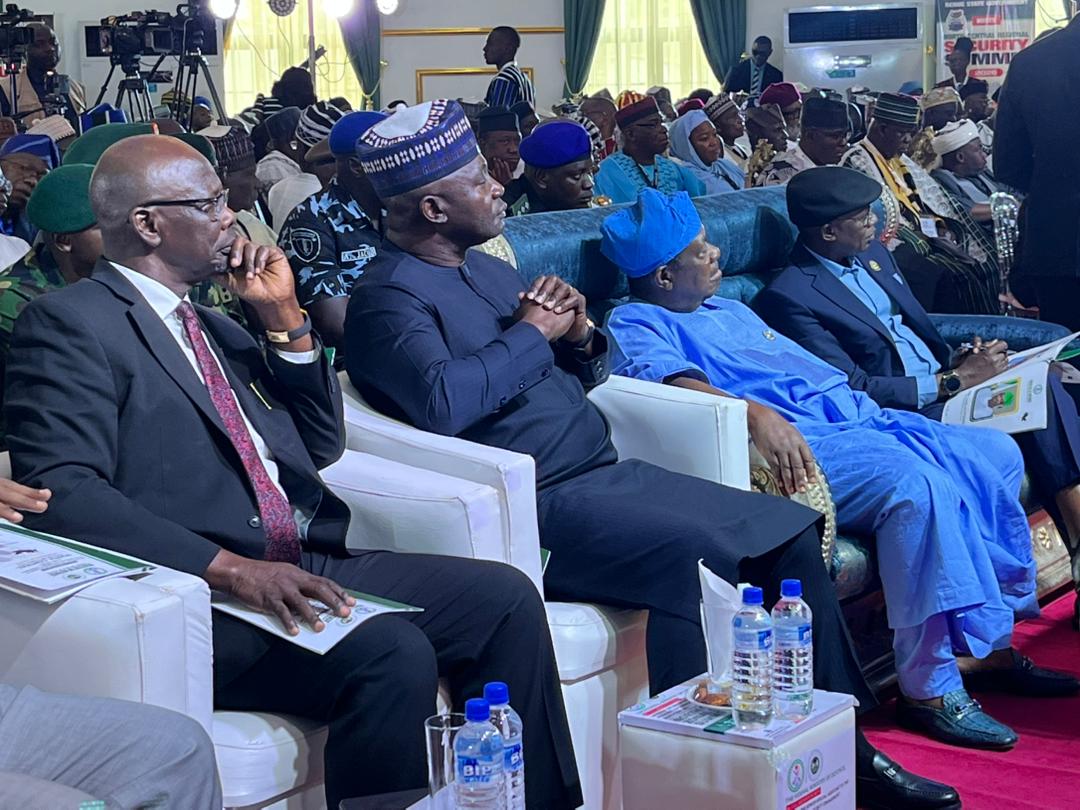
President Tinubu made the call at the 2026 North Central Regional Security Summit held in Makurdi, Benue State, where he was represented by the Secretary to the Government of the Federation, Senator George Akume, CON.
He also called on women and youths to take their rightful place at the centre of peace-building efforts, while urging development partners and the private sector to see the North Central not merely as a region requiring assistance, but as an investment destination with enormous economic potential.
Speaking on the theme of the summit, “Collaborative Approaches to Strengthening Security and Regional Stability,” President Tinubu stressed that no single security agency, tier of government or community could effectively secure the region acting in isolation.
According to him, insecurity transcends state boundaries and institutional mandates, requiring security agencies and communities to overcome rivalry, duplication of efforts and the withholding of vital information.
“No single agency, no single tier of government and no single community can secure this region acting alone.
Insecurity does not respect state boundaries or agency mandates. Criminals move freely across local government areas while our responses are too often slowed by rivalry, duplication and the withholding of information. That must end,” the President stated.
President Tinubu said his administration had deliberately strengthened the nation’s security architecture through enhanced collaboration among the Armed Forces, Nigeria Police Force and intelligence services, as well as the acquisition of new platforms and advanced capabilities for the military.
He added that the administration was rebuilding Nigeria’s indigenous defence industry through the Defence Industries Corporation of Nigeria (DICON) Act, while improving the welfare of troops to enhance their operational effectiveness.
The President commended the Armed Forces and other security agencies for the gains recorded against terrorists and other criminal elements, noting that terrorist commanders had been neutralised, thousands of fighters had surrendered, captives rescued and normalcy restored to several communities.
He paid tribute to servicemen and women, police officers and other security personnel operating in the North Central, particularly those who had paid the supreme price in defence of the country.
President Tinubu, however, cautioned that military action alone could not guarantee sustainable peace in the region, stressing the need to address the underlying social, economic and environmental factors fuelling insecurity.
He identified competition over land and water, climate change, desertification, unresolved land-use issues, weak local dispute-resolution mechanisms and the proliferation of illicit weapons as some of the conditions sustaining violent conflicts.
“Military action alone will not deliver lasting peace to the North Central. Force can suppress violence; it cannot resolve the grievances that produce it,” he said.
The President said the Federal Government’s response would therefore continue to combine kinetic operations with developmental interventions.
He cited the Federal Government’s efforts through the Ministry of Livestock Development to transition from open grazing to modern, settled livestock production as part of measures to protect farmlands, improve pastoral livelihoods and remove a major trigger of conflict.
He also highlighted the Reclaiming the Ungoverned Space for Economic Benefits Programme of the Ministry of Defence, designed to deploy the experience of retired military personnel towards securing and reviving communities recovering from violence.
President Tinubu said investments in irrigation, mechanised agriculture, rural roads and access to credit under the Renewed Hope Agenda were aimed at transforming the region’s vulnerabilities into economic opportunities.
Addressing traditional and religious leaders, the President said their closeness to the grassroots placed them in a strategic position to detect emerging threats and prevent disputes from escalating into wider conflicts.
“To our revered traditional rulers and religious leaders, you hold an authority that no uniform confers. You know your communities intimately. You know when a stranger arrives, when a young man falls into bad company, and when a quarrel between two families is about to become a conflict between two peoples.
“I ask you to be our first line of early warning and our most trusted voice of reconciliation,” he said.
He also urged them to firmly reject inflammatory rhetoric from whatever quarters, warning that the country had suffered considerably from reckless rhetoric around ethnic, religious and other differences.
President Tinubu similarly called on communities to take greater responsibility for their security by providing timely information to security agencies and refusing to harbour criminal elements.
“Security begins with you. I call on every citizen to share information with the security agencies, to refuse to shield criminality out of kinship or sentiment, and to resist those who would recruit our sons into violence for a handful of naira,” he said.
The President acknowledged the critical role of women in peace-building, saying they should be placed at the centre rather than the margins of security conversations.
He assured young people that his administration remained committed to expanding economic opportunities and creating livelihoods capable of insulating them against recruitment into criminality and violent groups.
“To our women, who bear the heaviest burden of every conflict and yet remain the most effective peacebuilders in every community, your place is not at the margins of this conversation but at its centre.
“And to our young people, your energy is this region’s greatest asset. This administration is committed to expanding the opportunities that make a rifle a far less attractive prospect than a livelihood,” he assured.
President Tinubu also invited the private sector and development partners to increase their economic commitments to the region, noting that investment, employment and economic opportunities were essential components of sustainable security.
“Peace and investment reinforce one another. Every factory built, every farm expanded and every young person employed in this region is a contribution to its security,” he said.
The President further directed the Minister of Defence, retired General Christopher Gwabin Musa, OFR, to transmit the outcomes of the summit to him and report on the implementation of its recommendations.
He warned against producing another communiqué that would be “filed away and forgotten,” insisting that the summit must come up with practical recommendations backed by clearly identified responsibilities, timelines and measurable outcomes.
“I expect this gathering to produce clear and practical recommendations, each with an identified owner, a defined timeline and a measurable outcome.
“We will be judged not by the quality of our deliberations here, but by whether a farmer in this region sleeps more soundly a year from now,” President Tinubu said.
He commended the Ministry of Defence and the Office of the Senior Special Assistant to the President on Community Engagement, North Central, for organising the summit, which is the second in a series of regional security engagements following the South East Regional Security Summit held in Umuahia on July 30, 2026.
The President said the regional engagements reflected the conviction of his administration that Nigeria’s security must be built from communities upwards rather than exclusively from the nation’s capital.
He also commended the Government and people of Benue State for hosting the summit and praised the resilience of the people of the North Central in the face of security challenges.
President Tinubu urged participants, including governors, ministers, Service Chiefs, traditional and religious leaders, civil society organisations, women, youths and private sector representatives, to engage candidly and constructively and offer practical solutions to the region’s security challenges.
He thereafter declared the 2026 North Central Regional Security Summit open.
Also speaking, the Minister of Defence, retired General Christopher Musa, said the summit was organised to hear directly from the people of the region about the real threats on the ground and find common ground to address the challenges.
While noting that everyone was interested in security in the region, Musa commended the people for not giving up on themselves. He stressed the need to prevent cattle from grazing on farms, saying collective efforts should be made to ensure that farmers are safe in their communities and on their farms, while also ensuring that livestock production thrives without friction.
He pledged that the Federal Government remained committed to improving security across the nation and tackling challenges that undermine it.
Welcoming participants to the North Central Zonal Security Summit, Benue State Governor, Rev. Fr. Hyacinth Alia, said the theme of the summit, “Collaborative Approaches to Strengthening Security and Regional Stability,” could not have come at a more critical time.
He noted that its focus on banditry, farmer-herder conflicts, kidnapping, violent extremism spillover, organised crime and community resilience speaks directly to the realities confronting communities across the North Central region.
According to him, Benue State, and indeed other parts of the North Central, are facing a unique security challenge that requires a collaborative security strategy.
“It is my considered position that our diversity should be a source of strength rather than weakness. What are those things that unite us, and what are those things that divide us and breed insecurity?” Alia asked.
The governor called for the setting aside of differences to confront the enemy of insecurity, saying that if this was achieved, half the battle would already be won.
Speaking separately, his Nasarawa and Plateau State counterparts, Engr. Abdullahi Sule and Caleb Mutfwang, appreciated President Tinubu for the initiative and called for trust, sincerity and collaboration among North Central governments to enable them to tackle their common enemy.