
Opinion
FROM ROYAL DECREE TO GLOBAL ICON: THE UNTOLD STORY OF THE MERCEDES-BENZ G-WAGEN

_By Sam Agogo_
There are few automobiles in the history of the industry whose origin story reads as much like political drama as engineering triumph.
The Mercedes-Benz G-Class, affectionately known the world over as the G-Wagen, is one such vehicle.

Conceived at the request of a monarch who would be swept from his throne before a single unit reached him, it has, against every reasonable expectation, gone on to become one of the most coveted, most enduring and most commercially successful luxury sport utility vehicles ever produced. Today it sits in driveways from Lagos to Los Angeles, from Dubai to Moscow, a boxy, unapologetic symbol of wealth and permanence in an industry otherwise obsessed with reinvention.

Its journey from a cancelled royal order to a modern status icon offers not merely an interesting tale for automotive enthusiasts, but a case study in resilience, foresight and the peculiar economics of authenticity.

The story begins in the early 1970s, in an Iran flush with oil wealth and imperial ambition. Mohammad Reza Pahlavi, the Shah of Iran, was no ordinary customer of the German automaker.

He was among Daimler-Benz’s most significant shareholders, a position that afforded him not merely commercial interest but genuine influence over the company’s direction. At the time, Mercedes-Benz possessed no serious four-wheel-drive vehicle capable of rivalling Britain’s Land Rover or Japan’s Toyota Land Cruiser, both of which had already established formidable reputations with militaries and civilian buyers across the developing world. Recognising this gap, and eager to modernise his own armed forces, the Shah is understood to have personally urged Mercedes-Benz executives to design and manufacture a rugged, dependable off-road vehicle suited to both military and civilian use.
He was not a passive investor placing a distant order; by most credible accounts, he took an active hand in shaping the vehicle’s specifications, insisting on the kind of uncompromising toughness that could withstand desert heat, mountain terrain and the punishing rigours of sustained military deployment.
Mercedes-Benz, sensing both a lucrative opportunity and a genuine gap in its product portfolio, moved to answer the Shah’s challenge. It entered into a joint venture with the Austrian manufacturer Steyr-Daimler-Puch, a firm with its own long history in engineering rugged, military-grade equipment, to co-develop and eventually assemble the new vehicle. What followed was nearly a decade of painstaking development.
Engineers subjected prototypes to extreme conditions, testing early models in the punishing heat and shifting dunes of the Sahara Desert to ensure the vehicle could survive conditions far removed from the comfort of a German proving ground.
Underwriting this considerable investment of time, capital and engineering resource was one extraordinary commercial commitment: the Shah of Iran, acting on behalf of his military, is widely reported to have placed an order for approximately twenty thousand units, a figure substantial enough to justify Mercedes-Benz’s full commitment to an entirely new category of vehicle it had never previously attempted at commercial scale.
History, however, is rarely accommodating to even the grandest of plans.
The Geländewagen, a German name that translates simply as “terrain vehicle,” was formally unveiled to the world on the 4th of February, 1979. It would prove to be a moment of almost unbearable historical irony.
Barely a week later, on the 11th of February 1979, the Iranian Revolution reached its decisive climax, and the Pahlavi monarchy that had inspired and underwritten the vehicle’s very existence collapsed entirely.
The Shah himself had already fled the country weeks earlier, never to return, and the new Islamic Republic established under Ayatollah Ruhollah Khomeini had neither the inclination nor the inheritance to honour the extravagant procurement ambitions of the deposed monarch.
The order for twenty thousand vehicles, the commercial bedrock upon which the entire G-Wagen programme had been justified, was cancelled outright and in full. Not a single unit from that original Iranian commission was ever delivered. The man whose vision, capital and specifications had shaped the vehicle would never sit behind its wheel.
It is here that the story of the G-Wagen might easily have ended, another cautionary tale of an ambitious industrial project undone by the shifting sands of geopolitics.
Instead, Mercedes-Benz and its Austrian partner chose a different path. Rather than abandon a vehicle that had already consumed years of development and engineering investment, the two companies pressed ahead, releasing it to the open market and inviting any government or civilian buyer, anywhere in the world, to purchase what Iran no longer would.
In Austria, Switzerland and parts of Eastern Europe, where Steyr-Daimler-Puch handled final assembly, the vehicle was marketed under the name Puch G. Other militaries, sensing opportunity in the vacuum Iran had left behind, moved swiftly to adopt it. In time, the vehicle would go on to serve more than sixty armed forces across the globe, including the German Bundeswehr, the Norwegian and Swiss armies, and eventually forces aligned with NATO. A later variant developed specifically for the Bundeswehr, the 250GD, earned the nickname “Wolf,” a title that has endured as shorthand for the most formidable military editions of the vehicle to this day.
From its earliest days, the G-Wagen was engineered for punishment rather than comfort. Its body-on-frame construction, portal axles and generous ground clearance gave it the ability to climb gradients and traverse terrain that would defeat almost any conventional passenger vehicle of its era.
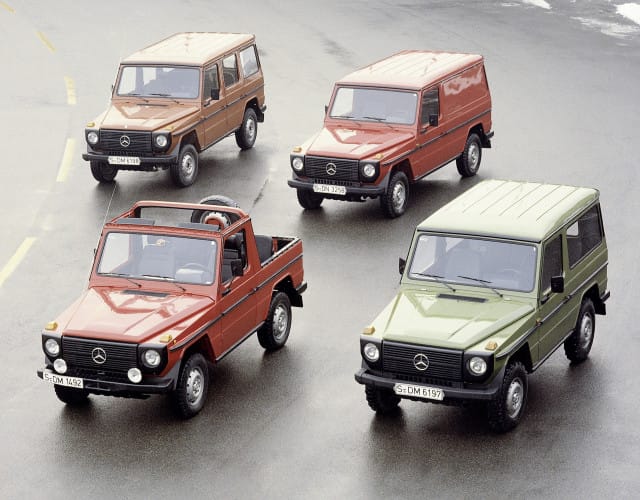
It was offered in short and long wheelbase forms, as an enclosed station wagon, an open convertible and a canvas-topped military variant, with engine options spanning four-cylinder petrol units to five-cylinder diesels. Yet even in that unglamorous first decade, the vehicle’s magnetism reached far beyond military circles and into unlikely corners of popular culture. Arnold Schwarzenegger acquired one of the earliest Puch G models.
Pope John Paul II employed a bulletproofed version as a Popemobile. Erich Honecker, the East German communist leader, reportedly favoured it over Soviet-built alternatives available to him. Long before Mercedes-Benz consciously marketed the vehicle as a luxury item, the world had already begun to recognise something distinctive in its uncompromising character.
Mercedes-Benz, to its considerable commercial credit, took note of this shifting audience and responded deliberately rather than accidentally. In 1989, the company introduced the W463 generation, a version of the G-Class engineered specifically with comfort and refinement in mind, while carefully preserving the vehicle’s unmistakable boxy shape, its exposed door hinges and its spare wheel mounted conspicuously on the tailgate. Wood trim, leather upholstery and, eventually, air conditioning found their way into a cabin that had once been built purely for endurance. It marked the beginning of what might fairly be called the G-Class’s second life, one in which uncompromising off-road credibility would coexist, rather than compete, with genuine luxury.
Through the 1990s and into the 2000s, this transformation accelerated further still as Mercedes-Benz’s performance division, AMG, reimagined the G-Class as a high-performance status object powered by a thunderous V8, and later a V12, favoured in equal measure by footballers, musicians, film actors and business magnates. The vehicle officially reached American shores in 2002, further cementing its place in a global culture that increasingly equated it with wealth, power and rugged individualism.
Remarkably, through all these decades of reinvention, Mercedes-Benz resisted the temptation to abandon the G-Class’s original shape. While rivals redesigned their off-roaders into sleeker, more aerodynamic forms, the G-Class retained its flat panels, upright windscreen and utilitarian silhouette, turning scarcity of change into a virtue. Owning a G-Wagen came to signal not merely wealth, but an appreciation for heritage and permanence in a world of disposable trends.
That appeal shows no sign of fading. Even as Mercedes-Benz’s overall global sales dipped in 2025, the G-Class recorded its best sales year in its history, with demand climbing to roughly 49,700 units worldwide, the highest figure since the model’s debut in 1979. That milestone arrived alongside one of the boldest chapters in the vehicle’s story: the introduction of the G580 with EQ Technology, Mercedes-Benz’s first fully electric G-Class.
Equipped with four independently controlled electric motors producing more combined power than even the AMG G63, the electric G-Class introduced a novel manoeuvre known as the “G-Turn,” allowing the vehicle to rotate almost on the spot, all while preserving the classic body, the upright cabin and the go-anywhere character that has defined the nameplate for nearly half a century. Mercedes-Benz has said the electric variant substantially contributed to that record-breaking year, even as uptake in some European markets has been slower than anticipated, a reflection of a clientele still weighing tradition against transformation.
There is much to learn from the G-Class’s improbable journey. It stands, firstly, as a lesson in resilience, proof that a project need not perish with the patron who inspired it; Mercedes-Benz and its Austrian partner absorbed the loss of a twenty-thousand-unit order and an entire monarchy, yet found the resolve to press forward and place the vehicle before a wider, hungrier market. It is, secondly, a lesson in the fragility of concentrated dependence, a reminder that even the grandest commercial commitment, backed by a head of state and a major shareholder, can vanish overnight when politics shifts beneath it, and that enterprises which spread their risk across many buyers rather than one patron are far better placed to survive such shocks.
It is, thirdly, a lesson in the enduring value of authenticity and restraint, since the G-Class’s refusal to abandon its original, unfashionable shape across nearly five decades has become the very source of its desirability, a suggestion that consistency of identity can outlast the pressure to chase passing trends. And it is, finally, a lesson in adaptability without erasure, demonstrated most recently by the electric G580, which shows that even the most tradition-bound icon can embrace the future, provided it does so without abandoning the character that made it worth preserving in the first place. From a cancelled royal order to one of the most powerful status symbols in the modern world, the story of the Mercedes-Benz G-Class is, at its heart, a story of what survives when the best-laid plans of the powerful fall apart.
*For comments, reflections and further conversation, reach Sam Agogo at samuelagogo4one@yahoo.com or +2348055847364.*