
Opinion
The Hero Who Returned His Knighthood for His People – Dr. Akanu Ibiam sacrificed personal honour and recognition to stand with his people during the Nigerian Civil War.

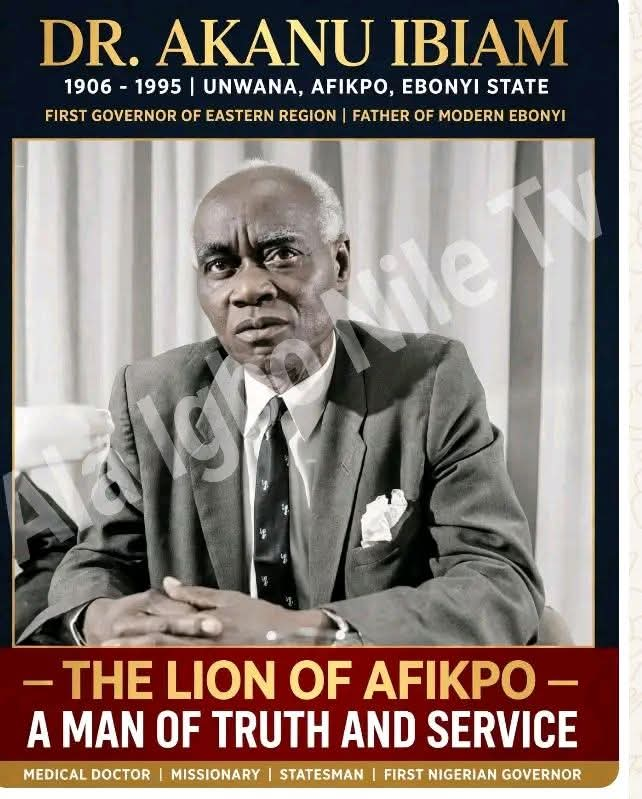
Nigerian whose contributions to medicine, education, politics and Christianity left an enduring legacy.
Although his name is recognised through the Akanu Ibiam International Airport in Enugu and Akanu Ibiam Federal Polytechnic in Unwana, many young Nigerians may not fully understand the life and achievements of the man behind these institutions.
His story is one of discipline, faith, courage, selfless service and unwavering commitment to his people.
1. FROM A SMALL VILLAGE TO THE WORLD STAGE
Akanu Ibiam was born on 29th November 1906 in Unwana, Afikpo, in present-day Ebonyi State.
He was the second son of Chief Ibiam Aka, a traditional ruler of Unwana.
Although he did not come from a wealthy background, he distinguished himself through discipline, faith and a strong desire to serve humanity.
He began his education at Hope Waddell Training Institution, Calabar, before proceeding to King’s College, Lagos, where he graduated with distinction.
His elder brother, Samuel, recognised his academic brilliance and sponsored his education abroad.
Ibiam subsequently gained admission to the University of St. Andrews in Scotland, one of the oldest universities in the world, where he graduated as a medical doctor in 1934.
He became one of the earliest Igbo medical doctors and the first African medical missionary of the Church of Scotland.
From a small village in Unwana, he rose to international prominence.
2. THE DOCTOR WHO CHOSE THE VILLAGE OVER MONEY
When Akanu Ibiam returned to Nigeria in 1935, he had the opportunity to secure a lucrative government position in Lagos and enjoy a comfortable lifestyle.
However, he chose a different path by becoming a medical missionary, dedicating his services to rural communities where medical facilities were limited.
Between 1936 and 1945, he developed Abiriba Hospital from a small dispensary, providing healthcare services to Abiriba, Ohafia, Item, Igbere, Nkporo and neighbouring communities.
He later supervised mission hospitals at Itu and Uburu.
Ibiam specialised in ophthalmology at Moorfields Eye Hospital in London because he recognised the need to address eye diseases that were causing preventable blindness among Nigerians.
He treated poor patients without charge, cared for mothers and children, and promoted maternity services and child welfare at a time when many hospitals paid little attention to women’s healthcare.
He regarded his patients as brothers and sisters rather than mere numbers.
He was not just a medical doctor but also a compassionate servant of humanity.
3. THE TEACHER WHO BELIEVED IN EDUCATION FOR ALL
Akanu Ibiam firmly believed that education was a powerful instrument for transforming individuals, families and society.
In 1957, he became the first Nigerian Principal of Hope Waddell Institution, Calabar.
He was also a strong advocate of free and universal primary education.
Ibiam was among the early voices advocating the establishment of a Nigerian university so that young Nigerians would not have to travel to London to acquire higher education.
In 1959, he became President of University College, Ibadan.
In 1962, he chaired the committee responsible for establishing the Protestant Chapel at the University of Nigeria, Nsukka.
His vision was to ensure that education was accessible to every child, regardless of family background or financial status.
4. THE GOVERNOR WHO FEARED GOD MORE THAN POLITICIANS
Following Nigeria’s independence in 1960, Akanu Ibiam was appointed the first Governor of Eastern Nigeria.
He served from December 1960 to January 1966.
Although the position was largely ceremonial, his commitment to morality, justice and good governance was evident throughout his tenure.
One of the defining moments of his administration was his refusal to sign a bill seeking to legalise gambling or lottery in the Eastern Region.
He reportedly maintained that he would rather resign than approve legislation he believed could destroy families. Consequently, the bill did not become law.
He also openly condemned corruption at a time when concerns about dishonesty among political leaders were growing.
Ibiam opposed tribalism and insisted that appointments should be based on merit rather than ethnic considerations.
He advocated the principle of:
“Credibility rather than Ethnicity. Meritocracy rather than mediocrity.”
He believed Nigeria could not make meaningful progress without justice, fairness and an end to ethnic prejudice.
His leadership represented integrity, honesty and accountability.
5. THE CHRISTIAN LEADER THE WORLD RESPECTED
Beyond medicine and politics, Akanu Ibiam was a devoted Christian whose influence extended beyond Nigeria.
He was ordained as an Elder of the Presbyterian Church and served as President of the Christian Council of Nigeria between 1955 and 1958.
He also helped establish the Bible Society of Nigeria and the Christian Medical Fellowship.
His contributions to Christianity earned him international recognition, including his emergence as President of the All Africa Conference of Churches and one of the Six Presidents of the World Council of Churches.
He commanded respect within the Christian community because his actions reflected the values he preached.
At home, he also held traditional leadership positions as Eze Ogo Isiala I of Unwana and Osuji of Uburu.
He successfully combined his Christian faith with respect for his Igbo cultural heritage.
6. THE MAN WHO RETURNED HIS KNIGHTHOOD FOR HIS PEOPLE
In 1951, the British Queen honoured Akanu Ibiam with a knighthood, making him Sir Francis Akanu Ibiam.
It was a prestigious recognition, particularly for an African at the time.
However, in 1967, following Britain’s support for actions during the Nigerian Civil War that resulted in the suffering and deaths of Biafran civilians, Ibiam took a remarkable decision.
He returned his knighthood and dropped the English name Francis, choosing to be known simply as Akanu Ibiam.
He also wrote an open letter condemning Britain’s position and support during the crisis.
For him, personal honour and prestigious titles were less important than his conscience and the welfare of his people.
During the Civil War, he travelled to different parts of the world, including Sweden and Canada, appealing for food, medicine and humanitarian assistance for starving children, refugees and other affected civilians.
He also helped initiate the nightly airlift of relief supplies into Biafra, which saved thousands of lives.
At a time when standing with his people came with significant risks, Ibiam remained committed to speaking for the suffering and the voiceless.
His decision demonstrated courage, conviction and loyalty to humanity.
7. AFTER THE WAR, HE DID NOT RUN AWAY
When the Nigerian Civil War ended in 1970, Akanu Ibiam remained in Nigeria rather than relocating abroad.
He returned to reconstruction efforts and hospital services, continuing his medical work and contributing to rebuilding communities affected by the war.
He quietly dedicated himself to treating the sick and restoring what had been destroyed.
He worked without seeking public recognition or praise.
Akanu Ibiam died on 1st July 1995 at the age of 88.
More than 20,000 people reportedly attended his funeral in Unwana, reflecting the enormous respect and admiration he commanded.
8. HIS LEGACY LIVES ON
Today, Nigeria continues to honour the memory of Dr. Akanu Ibiam through several institutions and facilities named after him.
They include:
Akanu Ibiam International Airport, Enugu.
Akanu Ibiam Federal Polytechnic, Unwana.
Francis Akanu Ibiam Stadium, University of Nigeria, Nsukka.
However, his greatest legacy goes beyond the buildings and institutions that bear his name.
His contributions include:
A medical doctor who dedicated his life to serving the poor.
An educationist who championed accessible education.
A governor who stood firmly against corruption and injustice.
A Christian leader who practised what he preached.
A patriot who placed his people’s welfare above personal recognition.
LESSONS FOR US TODAY
The life of Akanu Ibiam offers important lessons about leadership, integrity, humility and service.
His example challenges present and future generations to consider whether it is possible to achieve success without compromising honesty, exercise power without arrogance, acquire wealth while serving the poor, and demonstrate patriotism while remaining committed to one’s cultural identity.
He demonstrated that all these values could coexist.
His story deserves to be taught to younger generations so they can understand the contributions of those who helped shape Nigeria’s history.
Igbo leaders and other Nigerian leaders have much to learn from his example.
Leadership is not about stealing. Leadership is about serving.
A QUESTION FOR YOU
Have you ever travelled through Akanu Ibiam International Airport in Enugu?
Did you know that the airport was named after a medical missionary and former Governor of Eastern Nigeria from Ebonyi State?
Share your thoughts in the comment section and write “RESPECT SIR AKANU IBIAM” if his story inspires you.
Share this story with others, especially young Nigerians, so that the legacy of this remarkable Nigerian will continue to live on.
#AkanuIbiam #IgboHero #Ebonyi #Afikpo #Unwana #IgboAmaka #AlaIgboNileTv #IgboHistory #IgboKwenu #EasternNigeria #NigerianHistory