
Opinion
The Poison on Our Shelves: Nigeria’s Silent Emergency

_By Sam Agogo_
Nigeria’s markets are alive with the pulse of daily life — bargaining voices, clattering coins, and the aroma of spices. Yet beneath this vibrant commerce lies a silent emergency.
It creeps into kitchens, medicine cabinets, and refrigerators, disguised as toothpaste that refuses to foam, gin that smells faintly of petrol, apples bleeding green dye when scratched, sachet water refilled from unsafe sources, and beverages whose labels mimic trusted brands almost perfectly.This is not a minor nuisance.

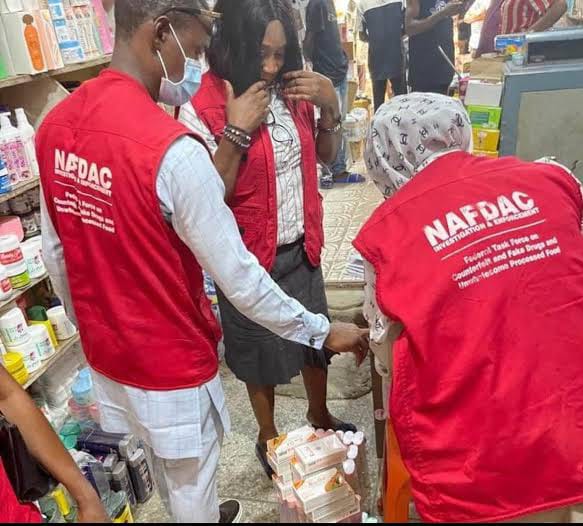
It is a sprawling counterfeit industry that threatens consumer trust, public health, and national security.Nigeria’s drug and food regulator, NAFDAC, has revealed staggering figures.

Between May and July alone, its officers inspected more than 6,000 facilities and seized over 7,000 non-compliant products. Food and water accounted for the largest share.
In 2025, coordinated raids across Lagos and the South-East destroyed counterfeit goods valued at over ₦1.5 trillion, carted away in more than 130 truckloads. Ibadan saw ₦15 billion worth of fake medicines incinerated, while Nasarawa witnessed the seizure of 1,600 bags of counterfeit rice worth ₦5 billion.

By the end of 2024, the total street value of destroyed fake goods exceeded ₦120 billion.These are not isolated seizures. They are evidence of an entrenched industry.Counterfeiting in Nigeria has evolved.
Gone are the days of crude imitations with poorly printed labels. Syndicates now identify fast-selling products, send samples abroad for replication, and establish clandestine factories within Nigeria. Arrests in Kano, Sokoto, Delta, and Anambra have uncovered networks producing fake toothpaste, beverages, and refilled branded water dispensers.
This shift from importation to domestic production has made counterfeit goods harder to detect and more dangerous. They move through logistics networks controlled by the syndicates themselves, blending seamlessly into legitimate supply chains.The human cost is devastating.
Nigerians increasingly link counterfeit consumables to rising cases of cancer, kidney disease, liver failure, and infertility. The death of veteran actor Taiwo Hassan, popularly known as Ogogo, after a battle with stage-four cancer, became a rallying point for public anger.
Commentators demanded a regulatory overhaul reminiscent of Dora Akunyili’s aggressive enforcement era.Medical professionals warn that contaminants and industrial chemicals in counterfeit products can damage vital organs. While a direct scientific link between fake goods and Nigeria’s cancer burden has not been firmly established, counterfeit medicines pose a proven danger.
Falsified chemotherapy drugs, including a counterfeit breast cancer treatment traced across Nigeria, Turkey, and the Philippines, have endangered lives already fighting disease.For a population suspicious of institutions, the distinction between proven and unproven dangers collapses into a single fear: that what they consume may kill them.Porous borders and corruption fuel this crisis. Land border commands around Seme, Idiroko, Ipokia, Ilaro, and the Igbeti-Kishi axis bordering Benin are routinely cited as vulnerable corridors. Smugglers conceal contraband beneath legitimate cargo — expired noodles repackaged for sale, unregistered pharmaceuticals, narcotics, cigarettes, and even explosives.But geography is only part of the story.
Investigative reports allege that trafficking is actively facilitated by elements within border agencies. Cash payments secure undervaluation, uniformed personnel escort smuggled trucks, and a mafia-style hierarchy ensures profits are shared among insiders.A smuggler does not need a weakness in the fence if the officer at the gate can be paid to open it. Corruption at points of entry renders every other regulatory effort a mop chasing a tap deliberately left running.Once inside Nigeria, the problem multiplies. Domestic manufacturing operates outside regulatory sight.
Importers exploit weak inspection capacity at ports. Open markets, roadside stalls, and informal drug hawking make it nearly impossible to trace every product back to a licensed source. Nigeria’s port and border infrastructure was not built for the volume and sophistication of goods now moving through it, and enforcement agencies remain chronically outmatched.NAFDAC insists it is not failing. It points to 64 counterfeiting convictions secured between June last year and June this year, with sentences of up to seven years.
It highlights its achievement of WHO’s Maturity Level Three regulatory status, the highest benchmark on the continent. The agency argues that its continued discovery of fake products is proof of surveillance, not absence.
The Standards Organisation of Nigeria (SON) acknowledges persistent challenges but maintains its certification and market surveillance programmes. The Nigeria Customs Service points to steady interceptions at land borders.Critics remain unconvinced.
They argue that Nigerian regulators are reactive rather than preventive, mobilising only after viral videos force public attention. They note that announcing the destruction of ₦1 trillion in fake goods is also an admission of how much was consumed before being caught.What must change?
Reform must begin at the border. Proper staffing and equipping of land border commands with modern scanning and tracking technology is essential.
Allegations of Customs and security personnel colluding with smugglers must be investigated transparently. Licensing and monitoring of ports and free trade zones must be tightened, as syndicates now produce counterfeits domestically using imported equipment and materials.Beyond the border, regulation should mandate verifiable track-and-trace technology — scannable codes tied to live NAFDAC or SON databases — on high-risk consumables like bottled water, dairy products, beverages, toothpaste, and medicines.
Sentencing for industrial-scale counterfeiting should carry penalties heavy enough to outweigh profits, and convictions should be publicised as deterrents.NAFDAC and SON need budgetary independence and expanded laboratory capacity to verify viral social media claims within days, not months.
Whistleblower protections and rewards for market associations, importers, and Customs officers who report smuggling could help break the culture of silence.Most importantly, the National Assembly must pass stronger laws to empower these agencies. Without legislative backing, enforcement remains toothless.
Parliament must legislate harsher penalties for industrial-scale counterfeiting, grant regulators financial autonomy, and establish oversight mechanisms to ensure accountability. Laws should also mandate technological adoption — such as digital track-and-trace systems — and protect whistleblowers who expose smuggling rings.
Judicial fast-track courts dedicated to counterfeit cases should be created to ensure swift justice.Nigeria has shown before that it can fight counterfeit products when leadership, funding, and public pressure align. The challenge now is to convert outrage into reform — and that reform must begin in the legislature.
Until the National Assembly passes laws that strengthen the regulators, ordinary Nigerians will continue to bear the unfair burden of verifying what is safe to eat, drink, or swallow.
*For comments, reflections and further conversation, email samuelagogo4one@yahoo.com or call +2348055847364.*