
Opinion
The Jacana: Africa’s ‘Jesus Bird’ and the Science Behind Its Walk on Water

_By Sam Agogo_
Across the wetlands of Africa, where rivers slow into lagoons and lilies spread their green carpets across the water’s surface, a small bird performs a spectacle that has fascinated generations.
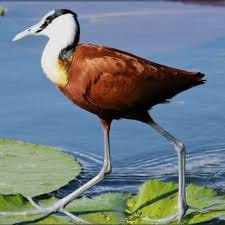
The African Jacana, affectionately nicknamed the Jesus Bird, appears to walk on water.

To fishermen, villagers, and travelers, it is a sight that never loses its wonder: a russet-and-white bird stepping lightly across lily pads as though gravity itself had bent to its will.What seems miraculous is, in truth, a story of adaptation, evolution, and an unusual social order that challenges our assumptions about nature.
To understand the jacana is to glimpse not only the ingenuity of biology but also the quiet lessons it offers about resilience, devotion, and balance.The jacana’s most famous trick lies in its feet. Unlike ducks that swim or herons that wade, jacanas stride across floating vegetation. Their toes are extraordinarily long — disproportionately so for a bird weighing little more than a large apple. These toes act like natural snowshoes, spreading the bird’s weight across a wide surface area.
This adaptation allows the jacana to forage atop lilies and hyacinths without sinking. What looks like levitation is actually a masterclass in weight distribution. Millions of years of evolution have refined this balance, enabling the bird to exploit a niche where few others can tread.

If the jacana’s walk is its most visible wonder, its social life is its most surprising. In this species, the female is larger, stronger, and dominant. She does not confine herself to one mate. Instead, she maintains territories with multiple males, laying eggs in each nest before moving on. The males, left behind, take on the full responsibility of parenting.
They incubate the eggs for three weeks, guard the nests against predators, and lead the chicks to food once they hatch.
This reversal of roles — where the female is the wanderer and the male the caregiver — is rare in the bird world and challenges traditional assumptions about gender and parenting in nature.The male jacana’s devotion is extraordinary. He not only incubates the eggs but also protects the chicks with remarkable ingenuity.
When danger strikes — a hawk overhead, a snake in the reeds — he gathers his chicks beneath his wings and carries them to safety. Sometimes he runs across the lily pads, sometimes half-flies, but always with his brood hidden from view.
To an onlooker, it seems as though the bird has swallowed its young whole, vanishing them into the architecture of his feathers.
This act of protection is one of the most affecting behaviors in the animal kingdom, a testament to paternal care that rivals the most devoted mothers elsewhere in nature.The jacana’s world is precarious. Its survival depends on the delicate balance of floating vegetation. Too few lilies, and the bird cannot forage.
Too many disturbances, and its nests are exposed. Yet the jacana thrives in this fragile ecosystem, embodying resilience in the face of uncertainty. Its diet consists of insects, seeds, and small aquatic creatures found among the lilies.
By living atop vegetation, it avoids competition with swimmers and waders, carving out a unique ecological niche.The jacana’s story is more than biology. It is a parable of adaptation and devotion.
Its nickname, “Jesus Bird,” captures the wonder of its walk, but its true marvel lies in its inverted family roles and extraordinary paternal care.
In a world where dominance is often equated with strength, the jacana reminds us that survival can rest on patience, protection, and the quiet courage of those who nurture.
Its ability to walk on water is not a miracle but a metaphor: a lesson in how balance, adaptation, and devotion can make the impossible seem effortless.
For communities living along Africa’s rivers and lagoons, the jacana is more than a curiosity. It is part of the rhythm of daily life, a bird that embodies both wonder and wisdom. Its presence signals the health of wetlands, ecosystems that sustain countless species and provide livelihoods for people. To watch the jacana is to be reminded that nature’s most profound lessons often come in small, quiet forms — a bird that walks where walking should not be possible, a father who carries his children beneath his wings, a creature that thrives by spreading its weight across a fragile world.
In the end, the African Jacana is not simply a bird that walks on water. It is a symbol of resilience, a teacher of balance, and a living testament to the power of adaptation.
Its story belongs not only to science but to culture, to the wetlands it inhabits, and to the people who have marveled at its steps for centuries. The “Jesus Bird” may astonish with its illusion, but its true miracle lies in the devotion and ingenuity that keep it alive, generation after generation, across the shimmering waters of Africa.
*For comments, reflections and further conversation, email samuelagogo4one@yahoo.com or call +2348055837364.*