
Opinion
The Black Heron: The Bird That Builds Its Own Umbrella to Catch Dinner

_By Sam Agogo_
Among the many remarkable birds that inhabit Africa’s wetlands, few have fascinated me as much as the Black Heron. At first glance, it appears to be just another dark-coloured wading bird moving quietly through shallow water. But a closer look reveals one of nature’s most ingenious hunters.
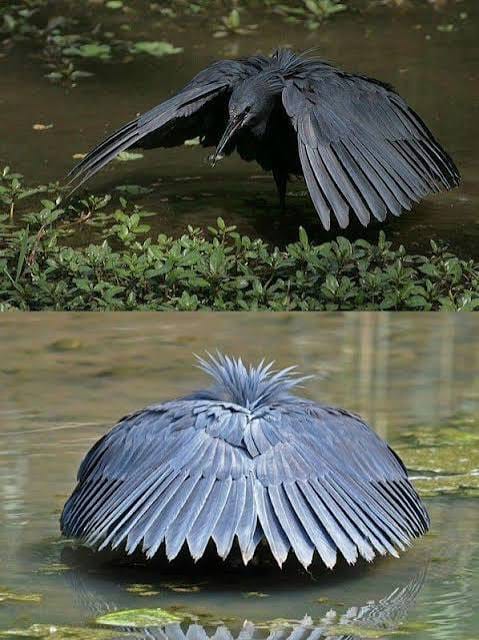
This bird has mastered a fishing technique so unusual that it seems almost human in its creativity. It literally builds an umbrella with its own wings to catch its dinner.
The Black Heron, scientifically known as Egretta ardesiaca, belongs to the heron family, which also includes egrets and bitterns. It is a medium-sized bird, standing between 42 and 66 centimetres tall with a wingspan that can reach a metre. Its body is covered in dark slate-black feathers, giving it a striking appearance against the bright waters and green vegetation of African wetlands. One of its most noticeable features is its bright yellow feet, which stand out sharply against its dark plumage.
This remarkable bird is found across much of sub-Saharan Africa and Madagascar. In Nigeria, it can be seen around floodplains, lagoons, swamps, creeks, marshes and the shallow edges of lakes and reservoirs. It thrives in open wetland habitats where fish and other aquatic creatures are abundant. Like many wetland birds, its movements often follow the seasonal rise and fall of water levels.
What truly sets the Black Heron apart is its extraordinary hunting method, known as canopy feeding. As I observed this bird moving through shallow water, I was amazed by the precision of its behaviour.
Without warning, it stretches its wings forward over its head until they form a complete canopy, almost like an umbrella. Beneath this living tent, it peers intently into the water before striking suddenly at unsuspecting prey.
Scientists believe this clever technique serves several purposes. The shade created by the wings reduces glare from the sun, allowing the bird to see fish more clearly beneath the surface.
The dark patch may also attract fish seeking shelter, drawing them directly into the hunter’s reach. In some cases, the sudden shadow may startle prey into movement, making them easier to detect. Whatever the reason, the strategy is remarkably effective. Entire groups of Black Herons can sometimes be seen standing beneath their self-made umbrellas, each engaged in its own hunt.
The bird’s diet consists mainly of small fish, though it also feeds on tadpoles, frogs, aquatic insects, crustaceans, worms and other creatures that inhabit shallow waters. It is both patient and active, alternating between standing motionless and moving briskly through the water. Its bright yellow feet are sometimes used to stir the mud and flush hidden prey into the open.
Equally fascinating are the Black Heron’s breeding habits.
The species nests in colonies, often sharing breeding sites with other waterbirds such as egrets, herons, ibises and cormorants. Nests are usually built in trees, reeds or papyrus growing near water. Both parents participate in constructing the nest and caring for the young. The female generally lays between two and four bluish-green eggs, and the pair takes turns incubating them for about three weeks.
Once hatched, the chicks are fed by both parents until they are strong enough to leave the nest and eventually fly.
Although it is generally a quiet bird, the Black Heron is not completely silent. It communicates through low croaks and harsh calls, particularly during the breeding season or when disturbed. Outside the breeding period, it is usually seen alone or in small groups, gathering in larger numbers only where food is plentiful.
From a conservation perspective, the Black Heron is currently considered a species of Least Concern. Its population remains relatively stable across its wide range.
However, like all wetland wildlife, its future depends heavily on the health of its habitat. Wetland destruction, pollution, uncontrolled development, agricultural expansion and changes to natural water systems pose growing threats. When marshes are drained and rivers polluted, birds such as the Black Heron lose the feeding and breeding grounds on which they depend.
The Black Heron offers an important lesson for humanity. In nature, success is not always achieved through strength or speed. Sometimes it is achieved through intelligence, patience and innovation. Rather than chasing its prey or overpowering it, the Black Heron simply creates the perfect conditions for success. Its self-made umbrella is a powerful reminder that clever solutions can often accomplish what brute force cannot.
As wetlands face increasing pressure across Africa, this extraordinary bird reminds us of the value of preserving the natural world. Protecting rivers, lagoons, marshes and floodplains is not merely about saving wildlife.
It is about safeguarding a rich natural heritage that future generations deserve to inherit. Among the many wonders these habitats support is the Black Heron, a small dark bird whose self-made umbrella remains one of nature’s most remarkable inventions.
*For comments, reflections and further conversation, email: samuelagogo4one@yahoo.com or call: +2348055847364..*