
Business and Economy
Gambo Unveils 100-Day Plan to Rescue Businesses, Preserve Jobs

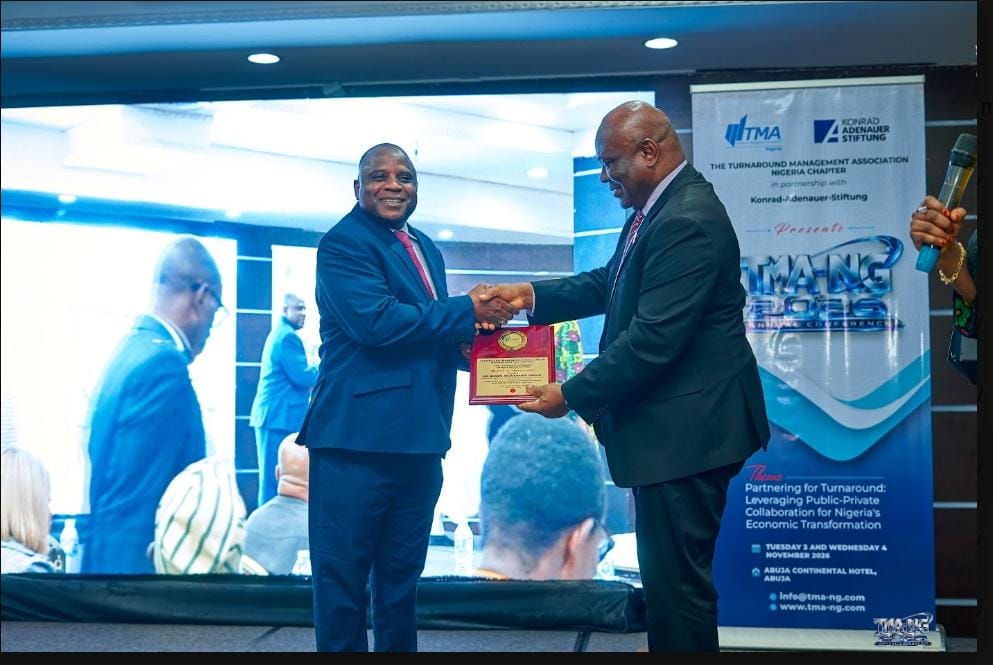
The newly inaugurated President of the Turnaround Management Association (TMA), Nigeria Chapter, Mr Adamu Abdulqadir Gambo, has urged the Federal Government to prioritise the survival and recovery of small and medium-sized enterprises (SMEs), strengthen business rescue mechanisms and facilitate the revival of dormant industrial assets.


Gambo assumed office on November 4, 2026, following a formal handover from the immediate past President, Dr Steve Ogidan, at the conclusion of the TMA Nigeria Annual Summit.

Speaking with journalists in Abuja on his plans for the association, Gambo pledged to reposition TMA Nigeria from an organisation largely focused on discussing business failures into an institution actively involved in preventing corporate distress, facilitating business recovery and preserving jobs.

He said his administration would begin by strengthening the association’s internal structures, promoting unity, improving governance and developing a more active and engaged membership.
“In our first 100 days, we will audit our membership, activate our committees, bring past presidents and founding members into an advisory platform, and reopen formal engagement with TMA Global,” he said.
Gambo identified the proposed National SME Business Survival and Turnaround Programme as a flagship initiative of his administration.
According to him, the programme will provide business health clinics, early-warning diagnostics and practical recovery support in collaboration with banks and development finance institutions.
He added that the association would assess dormant factories and agro-processing facilities to identify viable assets that could be restored to productive use.
The new President also announced plans for TMA NEXTGEN, an initiative aimed at developing the next generation of turnaround professionals through mentorship, professional certification, internships and a young professionals’ fellowship.
“Everything will carry clear targets and quarterly reports because our success should be measured by businesses recovered, jobs preserved and professionals developed, not by the meetings we hold,” he said.
Nigeria’s Economic Recovery Remains Fragile
Assessing the Nigerian economy, Gambo described the recovery as fragile, noting that improvements in macroeconomic indicators had yet to translate into meaningful relief for many businesses and households.
He cited economic growth of 4.43 per cent in the second quarter of 2026, compared with 3.89 per cent in the preceding quarter, as evidence of improving economic performance.
However, he noted that high operating costs, limited access to affordable finance, energy challenges and declining purchasing power continued to constrain businesses, particularly SMEs.
Referring to assessments by the World Bank and S&P Global, Gambo observed that inflationary pressures and weak real income growth remained significant concerns.
He further noted that Nigeria needed sustained, employment-generating economic growth to meet the demands of its expanding population and labour force.
“The macroeconomic picture may be improving, but many SMEs continue to struggle with high financing and operating costs, energy challenges and thin margins. This is precisely where turnaround professionals are needed,” he said.
Calls for Policy Consistency and Business Rescue Reforms
Gambo urged the Federal Government to maintain policy consistency, emphasising that predictability was essential for investment decisions and long-term business planning.
He also called for greater attention to SMEs through improved access to affordable finance, reliable energy and reduced regulatory burdens.
The TMA President advocated stronger business rescue and insolvency mechanisms, including the practical implementation of restructuring provisions under the Companies and Allied Matters Act (CAMA) 2020.
“Viable businesses should be rescued early rather than liquidated when recovery is no longer possible,” he said.
He further urged the government to support the reactivation of idle industrial and agro-processing assets, arguing that restoring existing productive capacity could preserve jobs and stimulate economic activities more quickly than developing entirely new facilities.
Gambo also stressed the importance of collaboration among government agencies, professional associations, private sector operators and development partners in developing practical economic recovery interventions.
He said TMA Nigeria was ready to provide independent technical expertise and support initiatives aimed at preserving viable businesses and productive assets.
Business Owners Urged to Recognise Early Warning Signs
Addressing business owners, Gambo advised entrepreneurs and company executives to identify early signs of financial distress and seek professional assistance before their businesses reached a crisis point.
“Most business failures are visible long before collapse through cash-flow difficulties, rising liabilities, declining sales and weak internal controls. Seek professional help when the warning signs appear, not when creditors are already at the gate,” he advised.
He emphasised the need for accurate financial records, regular cash-flow monitoring and the separation of personal finances from business funds.
Gambo also urged business owners to carefully manage energy and inventory costs, borrow within realistic repayment capacities, strengthen corporate governance and make plans for succession and business continuity.
He encouraged businesses to diversify their markets, explore export opportunities and engage lenders and creditors proactively whenever financial difficulties arise.
“A viable business, supported by honest engagement and a credible recovery plan, has far better options than one that waits until default becomes unavoidable,” he added.
TMA Nigeria is one of only two African chapters of the global Turnaround Management Association, an international non-profit professional organisation founded in 1988 and dedicated to corporate renewal, business restructuring and distressed investing.
The global association has nearly 10,000 members across 54 chapters spanning North America, Europe, Australia, Asia and Africa. Its membership comprises turnaround practitioners, insolvency and restructuring professionals, financiers, investors and other stakeholders involved in business recovery.
Through professional education, networking, mentoring and industry collaboration, TMA Nigeria seeks to strengthen the country’s business recovery ecosystem, promote the preservation of viable enterprises, restore corporate value and contribute to sustainable economic growth.