
Business and Economy
CNG Initiative Gains Momentum as State House Opens New Fueling and Conversion Facility

By our Correspondent
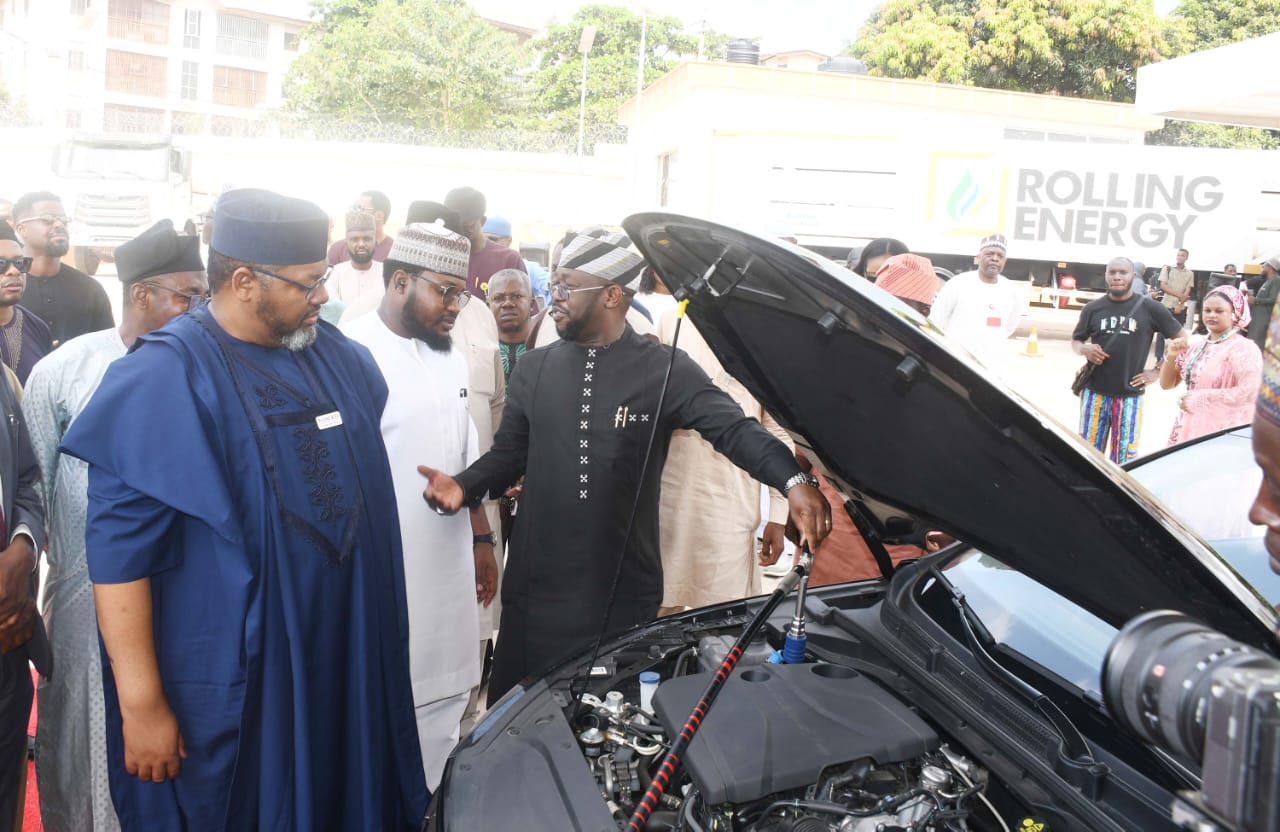
The State House management, in collaboration with the Presidential Compressed Natural Gas Initiative (P-CNGI) and private energy firm Rolling Energy, has officially commissioned an integrated CNG fueling and conversion facility at the abandoned fuel facility of the State House in Karu, Abuja.
The development marks a major milestone in Nigeria’s transition to cleaner and cheaper vehicle energy.
Speaking during the commissioning, the Permanent Secretary of the State House , Temitope Peter Fashedemi,emphasised that the project demonstrates the government’s commitment to “walking the talk” following President Bola Tinubu’s fuel subsidy removal policy and the country’s shift towards Compressed Natural Gas (CNG).
Addressing journalists at the facility, the Permanent Secretary explained that the new station, previously an abandoned State House fuel dump, had been repurposed into a hub for dispensing CNG and converting eligible petrol vehicles to gas-hybrid systems.
“For several decades, this fuel dump was abandoned and fell into disrepute. We thought the best thing we could do is reactivate this place and make it available for dispensing CNG. And that is what we have done in partnership with P-CNGI,” the Permanent Secretary stated.
The Permanent Secretary highlighted that the infrastructure was established without drawing funds from the government budget, relying instead on private-sector investment and expertise.
“The State House hasn’t spent any naira on this place. We made this place available, and our partner, Rolling Energy, renovated it. They have already demonstrated capacity with several stations of their own, and for over a week during testing, they dispensed free CNG to the local community as a show of good faith.”
The facility will serve the Presidential Villa’s growing fleet, which already includes recently acquired hybrid JAC vehicles and internal shuttle buses.
It will also provide conversion services to staff and eligible vehicle owners in the area.
Addressing questions about public demand for a faster CNG rollout, the Permanent Secretary, Tope Fadeshemi, clarified that the government’s role is to create an enabling environment and demonstrate the viability of the market, while private investors drive infrastructure development.
Building on this, the Executive Vice Chairman (EVC) of the P-CNGI Ismaeel Ahmed explained that the initiative had moved beyond the “proof-of-concept” stage and was now undergoing rapid nationwide expansion.
“This is almost our 160th station across the country in less than two years,” the P-CNGI EVC revealed. “The market has been proven, and investors are trooping in. Over $2.6 billion worth of private investment has come into the sector.”

Nationwide CNG Expansion
The initiative has recorded the following developments:
160 Active Refuelling Stations: CNG refuelling stations currently operating nationwide.
170 Stations in Development: Another 170 stations are at various stages of development or awaiting licensing from the Midstream and Downstream Petroleum Regulatory Authority (MDPRA).
Over 2,000 Infrastructure Units: Infrastructure units ordered by the President are expected to arrive between late this year and early next year.
Expanding Coverage:
The initiative is scaling up to serve Nigeria’s estimated 12 million vehicles across a population of over 220 million.
The EVC noted that Nigeria currently has one of the fastest CNG and electric vehicle adoption rates globally, contrasting the rapid expansion with the 60 years it took the country to establish its 24,000 traditional petrol stations.
Direct Impact on Transportation Costs
Highlighting the economic relief for Nigerians, the P-CNGI leadership disclosed that operational CNG routes were already recording significant reductions in transportation fares.
“CNG has significantly reduced transportation costs by about 30% to 40% on routes where CNG buses are operating,” the EVC stated.
“For instance, on the Kano-to-Katsina route, a journey that used to cost between ₦3,000 and ₦4,000 has dropped to ₦1,500 on operating CNG buses.”
The initiative aims to extend these cost savings across major commercial transportation routes nationwide as more vehicle conversion centres and CNG filling stations become operational.