Business and Economy
FCCPC, NMDPRA Deepen Collaboration for Fairer Petroleum Market

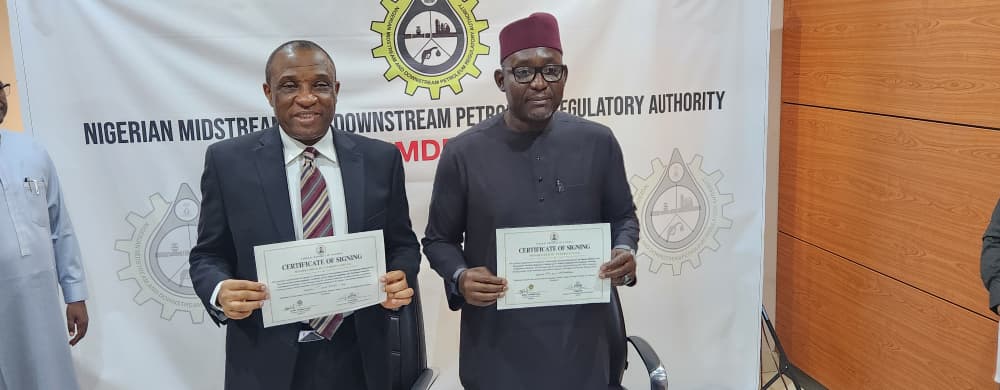
The Federal Competition and Consumer Protection Commission (FCCPC) has signed a Memorandum of Understanding (MOU) with the Nigerian Midstream and Downstream Petroleum Regulatory Authority (NMDPRA) to strengthen consumer protection, promote confidence in Nigerian markets and support the gains of economic reforms in the petroleum sector.
Speaking during the signing ceremony in Abuja, the Executive Vice Chairman of FCCPC, Mr Tunji Bello, said the agreement would further strengthen institutional cooperation between the two government agencies.
Bello described the petroleum sector as one of the most strategically important sectors of Nigeria’s economy, stressing the need for the industry to operate competitively and transparently to protect consumers’ rights and encourage investment.
According to him, the FCCPC does not regulate or approve petroleum prices in a deregulated downstream market but ensures that market outcomes are driven by consumer choice rather than exploitation.
“Today is particularly significant because it formalises a statutory relationship that has been developing through various levels of collaboration between the two institutions. It is the strengthening of institutional cooperation in the service of Nigerian consumers, enhancing confidence in our markets, and ensuring the gains of economic reform,” he said.
Bello said the petroleum sector affects transportation, food prices, manufacturing and the daily lives of millions of Nigerians, making efficiency, competition and transparency essential.
“The Petroleum Industry Act 2021 empowers the NMDPRA as the technical and licensing regulator for licensing, technical standards, operational compliance, price setting, and supply oversight of the midstream and downstream petroleum sector and the FCCPC, on the other hand, derives its mandate from the Federal Competition and Consumer Protection Act 2018.
“Its responsibility is different, but complementary. The Commission is charged with promoting fair competition, preventing anti-competitive conduct, protecting consumers from unfair and exploitative practices, and ensuring that markets work for the benefit of all participants,” the FCCPC boss stressed.
He reiterated that the FCCPC does not regulate or approve petroleum prices in a deregulated downstream market.
He said the Commission ensures that market outcomes are driven by fair competition rather than collusion, innovation rather than dominance, and consumer choice rather than exploitation.
Bello added that where there is evidence of cartel behaviour, price fixing, abuse of dominance, restrictive agreements, market allocation, misleading pricing, under-dispensing, adulteration or other harmful conduct designed to undermine competition, the FCCPC has a statutory obligation to investigate and take appropriate action.
He said the partnership would strengthen the agencies’ collective capacity through deeper information sharing, enhanced market intelligence, coordinated enforcement activities and clear mechanisms for collaboration on matters that intersect their respective mandates.
“For industry operators, this partnership should be seen as a positive development. Competitive and transparent markets ultimately benefit responsible businesses. Businesses that innovate, invest, comply with regulations, and serve consumers fairly have nothing to fear from effective regulation,” he said.
Bello also assured Nigerian consumers that their welfare remained at the centre of the FCCPC’s work, encouraging them to continue reporting suspected violations through the appropriate channels available at both FCCPC and NMDPRA.
He commended the leadership of NMDPRA for its commitment to deeper institutional collaboration, saying effective regulation in today’s marketplace requires cooperation, coordination and a common focus on the national interest.
“Together, the agencies will work to protect consumers, promote fair competition, strengthen confidence in the petroleum sector, and contribute to the sustainable growth of the Nigerian economy,” he said.
On his part, the Chief Executive Officer of the Nigerian Midstream and Downstream Petroleum Regulatory Authority, Mr Rabiu Umar, commended the FCCPC’s efforts towards safeguarding the rights of Nigerian consumers and pledged to work with the Commission towards achieving its objectives.
“This milestone marks the establishment of a robust cooperation framework between the Nigerian Midstream and Downstream Petroleum Authority (NMDPRA) and the Federal Competition and Consumer Protection Commission (FCCPC) to strengthen our shared regulatory mandates, promote competitive markets, protect consumers, and ensure full transparency across Nigeria’s energy value chain,” he stated.
Umar commended the FCCPC for its leadership, commitment and proactive collaboration in advancing competition and consumer welfare.
He noted that both the Petroleum Industry Act 2021 and the Federal Competition and Consumer Protection Act 2018 expressly require the two institutions to work together to define, monitor and enforce compliance with the law.
According to him, the agencies have constructively engaged on issues of mutual interest since 2022, adding that the track record demonstrated that coordinated institutional synergy, rather than regulatory friction or operational duplication, delivers the most effective results for the economy.
“In translating that statutory mandate into an actionable operational framework, our focus on consumer and market protection extends across the entire landscape—from refining and processing, whether liquid fuels or gas, to transportation, bulk storage, wholesale distribution and retail prices at the pumps,” he said.
Umar stressed that in an evolving regulated market structure, regulation must not be interpreted as the absence of oversight.
He said the Authority was committed to safeguarding the entire ecosystem against exploitative practices, ensuring accurate product monitoring, maintaining uncompromised fuel quality and enforcing zero tolerance for collusive pricing, product withholding or anti-competitive market allocation.
He added that the partnership establishes clear operational guidelines for market surveillance, information sharing, joint investigations and consumer grievance resolution.
Umar explained that the collaboration is anchored directly on the Authority’s operational mantra of being fair, fast and firm, stressing that both agencies must be fast in investigating market distortions and resolving complaints.
“We must be fair in maintaining a transparent and competitive playing field for all operators and we must be firm in enforcing compliance to preserve market integrity,” he said.