
General News
Gbenga Daniel shares bold insights on Nigeria’s future at his 70th birthday book launch.

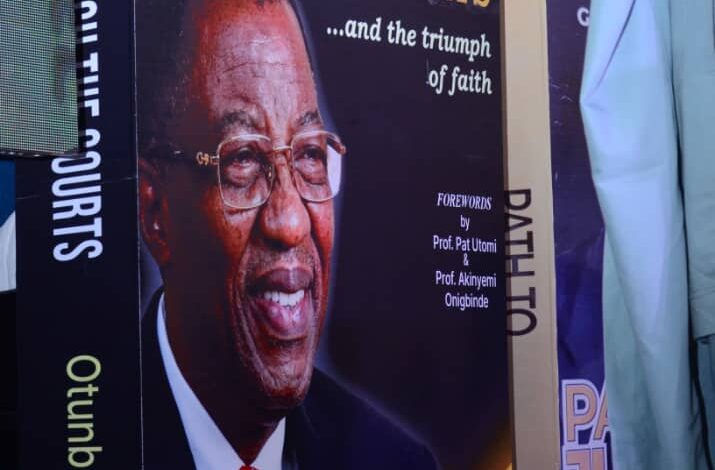
Remarks by His Excellency, Senator Otunba Gbenga Daniel at the Book Launch Marking His 70th Birthday Anniversary at the Yar’Adua Centre, Abuja on Wednesday, April 1, 2026.
Protocol.
Distinguished ladies and gentlemen,
Let me begin by expressing my profound gratitude, with all due compliments and respect, to this distinguished gathering who have found it worthy and convenient to honour us on this special occasion as we celebrate this significant milestone—my 70th birthday anniversary. This celebration is marked by the launch of four books, two of which are my autobiographies, while the other two are written by individuals who have studied the trajectory of our politics and challenges, and who strongly believe in the direction and conviction of our policies.
Most importantly, I thank the Almighty God for the gift of life, good health, and the opportunity to serve our beloved country in various capacities over the decades.
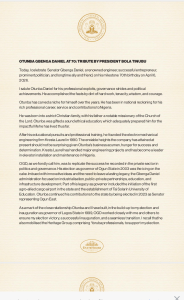
I extend my heartfelt appreciation to everyone present. I am particularly grateful to President Bola Ahmed Tinubu, who is represented here today, for his leadership and continued support for national development. Let me emphasise that Asiwaju Bola Ahmed Tinubu remains one of the most pragmatic individuals I have encountered. I say this from close experience, having worked with him for decades. Nigeria is yet to witness the very best of him. Mr President is a textbook in governance and creative intelligence from which many of us have learned. I owe the modest success of my tenure as Governor of Ogun State to his insights and innovative ideas, many of which we adopted. I remain grateful for his friendship and loyalty.
My sincere thanks also go to the Senate President, Distinguished Senator Godswill Akpabio, the Chief Launcher, special guests, royal fathers, statesmen, captains of industry, members of the diplomatic corps, friends, family, and well-wishers. Your presence reflects our shared commitment to building a better Nigeria.
Today, I wish to share some reflections from a statesman’s perspective on the challenges facing our nation.
One of the most critical issues confronting Nigeria is the lack of credible information, as well as the prevalence of misinformation and disinformation. Public opinion is often shaped by ignorance, distorted narratives, and half-truths. Political decisions are sometimes based on flawed perspectives, while even the elite often fail to interrogate issues deeply. This information deficit weakens public discourse and undermines informed citizenship. We must therefore invest deliberately in credible, fact-based information systems.
Another major challenge is corruption. Tackling it effectively requires a holistic and systemic approach. A significant portion of illicit funds passes through the banking system, and with modern technology and financial intelligence tools, tracing such funds should not be as difficult as it currently appears. Additionally, the role of the Code of Conduct Bureau must be strengthened to ensure greater accountability.
A particularly damaging aspect of corruption is capital flight. Much of the wealth acquired illicitly is transferred abroad, enriching other economies while depriving Nigeria of much-needed development resources. As a pragmatic solution, the government could consider a structured moratorium or amnesty to encourage the repatriation of such funds, provided they are invested productively within the country.
On leadership, citizens naturally look up to those in positions of authority—political leaders, religious figures, and the wealthy—as role models. This places a significant responsibility on leaders to restore dignity, class, and integrity in governance. There is an urgent need to re-establish a strong public code of ethics guiding behaviour in public service.
Regrettably, ethical standards have declined, and questions are no longer asked about sudden wealth acquisition. We must return to the Omoluabi ethos—a value system rooted in integrity, honour, accountability, and moral uprightness. Reviving this ethos is essential to rebuilding trust in governance.
Distinguished guests,
No discussion about Nigeria’s future is complete without addressing the role of our youth. They represent both the strength of today and the promise of tomorrow. A nation that fails to engage its youth effectively delays its own progress.
We must invest significantly in youth development across sectors such as sports, vocational training, music, arts, entertainment, industrialisation, and ICT. These areas are not merely recreational; they are critical pathways to economic empowerment and innovation.
At the same time, we must address the growing challenges confronting young people, including cultism, drug abuse, excessive betting, mental health issues, and predatory lending platforms. These problems are eroding the fabric of society and limiting the potential of our youth.
It is the collective responsibility of government, families, and institutions to provide guidance and opportunities that channel their energy positively. In doing so, we secure not only their future but also the stability and prosperity of our nation.
On security, we must adopt practical solutions. I commend the President’s initiative on state policing and the ongoing constitutional considerations by the 10th National Assembly. While supporting this initiative, we must ensure it is not misused by state governments as a tool for oppression.
To safeguard its integrity, I propose the establishment of a State Police Council (SPC) in each state, chaired by the Governor and comprising key security and legal stakeholders, including the Attorney General, Police Commissioner, DSS Director, Civil Defence Commander, Area Commanders, and District Attorneys at the local government level. The National Assembly should also provide comprehensive legal backing for this structure.
Nigeria is a nation blessed with immense human and natural resources. The challenges we face—information gaps, corruption, leadership deficits, and inadequate youth engagement—are not insurmountable. What is required is collective will, sincerity, and a renewed commitment to nation-building.
As we reflect on these issues through the pages of these books, I urge all of us to move beyond rhetoric and embrace practical, result-oriented actions that will drive development and improve the quality of life for all Nigerians.
Once again, I sincerely thank you all for your presence and support.
May God bless our individual efforts and collectively bless the Federal Republic of Nigeria.
Thank you.
His Excellency, Senator Otunba Gbenga Daniel
Governor of Ogun State (2003–2011)
Senator of the Federal Republic