
News
Navy Rescues Seven After Boat Collision in Bayelsa, Search Continues for Missing Passengers

By our Correspondent
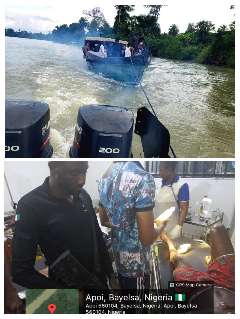
A prompt response by the Nigerian Navy prevented what could have turned into a major maritime disaster in Bayelsa State, as seven people were rescued following a violent boat collision along the Ogboinbiri waterways in Southern Ijaw Local Government Area.
The incident, which caused panic among residents of nearby riverine communities, involved a Tantita patrol boat and a wooden market vessel—both commonly used within the region’s busy but often risky inland water transport system.
Naval authorities disclosed that the rescue mission began after a distress call was received, prompting the swift deployment of personnel from Nigerian Navy Ship (NNS) SOROH.
Within a short time, naval operatives arrived at the scene and carried out a coordinated search and rescue operation, successfully pulling seven victims from the water.
Those rescued were immediately taken to a nearby medical facility for urgent care, while concerns remain about other passengers who are still unaccounted for.
Although investigations into the cause of the collision are ongoing, the Navy confirmed that search efforts have been intensified, with more personnel and resources deployed to comb the waterways.
The incident once again highlights the increasing dangers associated with water transportation in the Niger Delta, where commercial, security, and local vessels often navigate narrow and challenging routes.
For the Nigerian Navy, the operation reflects its growing role beyond traditional security duties to include emergency response and life-saving interventions.
Naval spokesperson, Captain A.A. Folorunsho, noted that the mission aligns with the strategic vision of the Chief of the Naval Staff, Vice Admiral Idi Abbas, which prioritises both maritime security and the protection of lives.
Observers say the Navy’s expanding involvement in humanitarian efforts signals a shift toward a more people-focused maritime approach—one that blends security operations with civilian safety.
Recent figures support this trend. In March 2026 alone, naval personnel rescued 16 passengers during a sea robbery incident along the Ibaka–Calabar Channel.
This followed other major interventions, including the rescue of 20 crew members from a burning vessel near Calabar in December 2025, 10 crew members from a distressed vessel in November 2025, and 17 kidnapped victims in October 2025 within the same corridor.
Collectively, these efforts point to a more active maritime force addressing both security threats and emergency situations across Nigeria’s waterways.
Back in Bayelsa, attention remains on the ongoing search operation, as anxiety grows among families and residents awaiting news of those still missing.
The waterways—vital for daily movement and commerce in the region—have once again become a scene of uncertainty.
However, the Nigerian Navy has reassured the public of its commitment to continue the operation, pledging sustained deployment of personnel and equipment in line with international search and rescue standards.
As investigations continue and rescue efforts intensify, the incident serves as a stark reminder of the risks tied to inland water travel and the fine line between routine journeys and tragedy.