General News
Nigeria Reaffirms Support for ECOWAS as New Leadership Assumes Office

By Iyojo Ameh
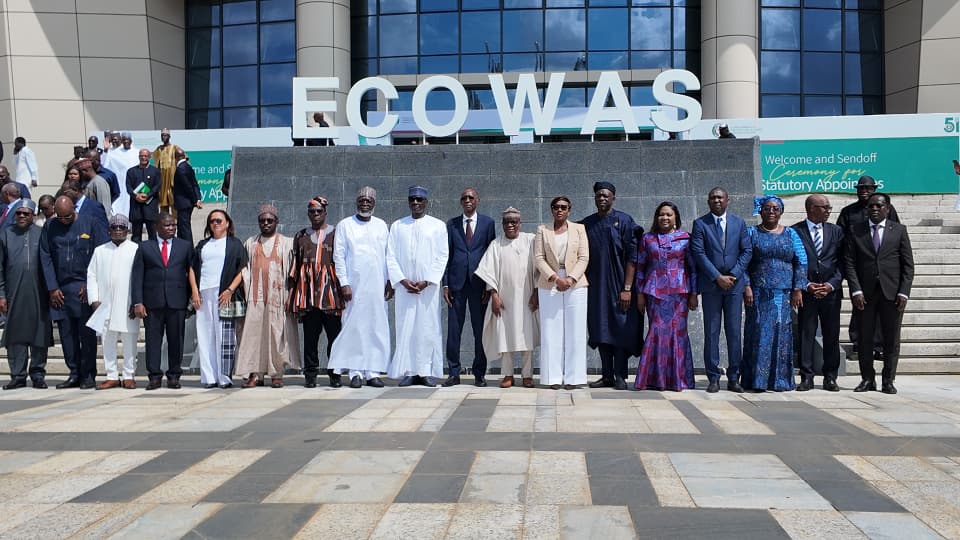
Nigeria has reaffirmed its commitment to a stronger, more integrated and people-centred Economic Community of West African States (ECOWAS), as new statutory appointees of the regional organisation assume office.
The Minister of State for Foreign Affairs, Ambassador Sola Enikanolaiye, made this known in Abuja during the formal handover ceremony between outgoing and incoming officials of ECOWAS institutions.
Enikanolaiye, who spoke as Nigeria’s host minister, conveyed the goodwill of President Bola Ahmed Tinubu and described the transition as a reflection of continuity in the efforts to advance regional integration.
He urged the new leadership to remain faithful to the vision of ECOWAS’ founding fathers and work towards a united, peaceful and prosperous West Africa.
The minister particularly advocated an “ECOWAS of citizens and not of governments,” urging the new administration to place the interests and welfare of citizens at the centre of its policies.
He charged the incoming leadership to accelerate the implementation of ECOWAS Vision 2050, “The ECOWAS of Peoples: Peace and Prosperity for All.”
According to him, priority should be given to free movement, intra-regional trade and investment, infrastructure development, food and energy security, youth and women empowerment, and employment creation.
Enikanolaiye also called for greater financial accountability within the regional organisation, stressing the need for probity, cost-effectiveness and prudent management of ECOWAS resources.
He said Nigeria and other member states make substantial contributions through the Community Levy and should therefore see those investments reflected in programmes that improve the lives of West African citizens.
Nigeria Calls for Stronger Security Cooperation
The minister identified peace and security as the foundation for sustainable regional integration.
He urged the new ECOWAS leadership to intensify engagement with countries of the Alliance of Sahel States (AES), noting that the countries share common challenges and aspirations with other members of the West African community.
Enikanolaiye also commended the outgoing officials for their contributions to the development of ECOWAS and congratulated the incoming team.
He urged them to demonstrate vision, integrity, efficiency and commitment in the discharge of their responsibilities.
“Nigeria remains committed to working constructively with the new leadership and all Member States towards a stronger, more integrated and people-centred ECOWAS,” he said.
Diop Takes Over ECOWAS Commission
The leadership transition also saw General Birame Diop formally assume office as President of the ECOWAS Commission.
Diop, a former Senegalese Minister of Defence and former Chief of the General Staff of the Senegalese Armed Forces, was appointed at the 69th Ordinary Summit of the ECOWAS Authority of Heads of State and Government in Sierra Leone.
He succeeds Dr Omar Alieu Touray of The Gambia, whose four-year tenure has ended.
Diop has pledged to provide strategic leadership focused on regional integration, peace and security, economic cooperation and stronger institutional effectiveness.
Anthony Ogunjimi of Nigeria has assumed the position of Vice President of the ECOWAS Commission, while new commissioners have also taken over from the outgoing officials.
The Abuja ceremony was attended by the Chair of the ECOWAS Council of Ministers, H.E. Cheikh Niang; members of the Permanent Representatives Committee; Chairman of the ECOWAS Business Council, Alhaji Aliko Dangote; officials and staff of ECOWAS institutions; and members of the media.
The new leadership is expected to steer ECOWAS through a challenging period marked by security concerns, political divisions and the need to deepen economic cooperation and regional integration.