Opinion
Nigeria’s Inherited Crisis: When the Founding Fathers Chose Control Over Unity

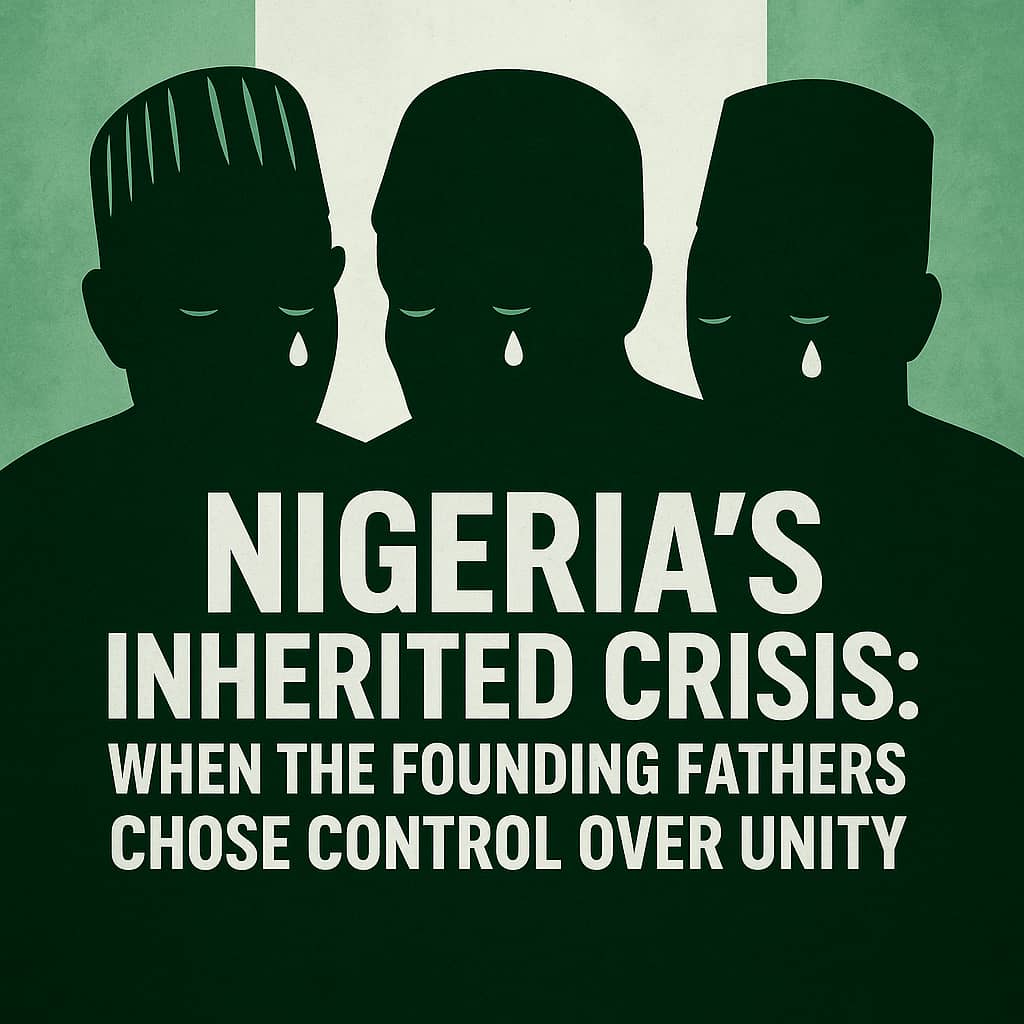
There’s a persistent ache in Nigeria’s political story that refuses to fade with time. It resurfaces during every election, every ethnic agitation, every constitutional debate. At the heart of this national migraine is a painful truth we’ve long avoided: the founding fathers of Nigeria, despite their brilliance and personal sacrifices, failed to build a united foundation.
As students of history, we must never deny the towering intellect of the trio—Ahmadu Bello, Nnamdi Azikiwe, and Obafemi Awolowo. These men were products of colonial suppression and pioneers of African resistance. But beyond their bold rhetoric and symbolic patriotism, their actions—particularly in the years leading to and immediately after independence—betrayed a deeper loyalty to regional interests. While they may have dreamt of one Nigeria, they each built stronger walls around their own ethnic constituencies than bridges between each other.
The 1959 federal election was a defining moment. It offered a chance to realign Nigeria’s political destiny on the values of trust and coalition-building. No single party won a majority—a natural reflection of our ethnic diversity. But instead of using that opportunity to forge a genuine national alliance, strategic ethnic calculations took center stage. Azikiwe’s NCNC allied with the NPC, not based on ideological synergy, but on political expedience. The AG, with its progressive policies, was left out—its federalist vision discarded. That alliance, perceived by many as betrayal, was not just a political maneuver—it was a signal that power would be negotiated through ethnic numbers, not national vision.
This laid the blueprint for a country that would later become obsessed with “our turn,” where regions saw themselves not as parts of a federation but as rivals in a zero-sum game. It’s no surprise then that Nigeria’s politics has remained a dangerous dance of mistrust. Every zone feels like a tenant, not a stakeholder. Every leader is judged not just by performance but by ethnic identity. The early decision to prioritize political control over unity haunts us till today, as successive governments struggle to command national loyalty.
The tragedy is that the founding fathers had the opportunity to reverse the colonial design of division. The British built Nigeria for control, not cohesion. The tools they left behind—ethnic census politics, regional parties, unequal development—were supposed to be dismantled. Instead, those tools were sharpened and used against each other. Ethnic supremacy became political capital. Power was seen as inheritance, not responsibility.
One must acknowledge that these leaders were also human—flawed, pressured, and navigating uncharted terrain. But even with that allowance, the refusal to embrace true federalism, the dismissal of inclusion, and the weaponization of identity cannot be overlooked. Awolowo’s consistent advocacy for a Nigeria where each region grows at its own pace, yet united in shared progress, was mocked, sidelined, and eventually buried under the weight of centralism and suspicion.
It is important to say this not to rewrite history, but to confront it. Nigeria didn’t just happen into crisis—it was wired for it. From the moment our independence was filtered through ethnic lenses and controlled by old colonial habits, we inherited a body called Nigeria but never agreed on the soul it should have. This is why the national anthem rings hollow for many, and why every national conversation turns tribal before it turns constructive.
If we must move forward, we must go back—not to romanticize the past, but to understand how its failures built our present. The founding fathers should be honored for their courage, but also held to account for their choices. National unity cannot be an afterthought. It must be the first thought. And had they built Nigeria on that principle, we may have inherited less tension and more trust.
The instability in Nigeria today is not an accident. It is the interest-driven outcome of a foundational compromise.
That said, the time to reset is not too late—but it demands courage. Nigeria’s structure as it stands, with 36 states spread unevenly across six geopolitical zones, has fed inequality and fostered competition over collaboration. Any true solution must begin with consensus—not imposed from the top, but achieved from the grassroots to the center. The 2014 National Conference under President Goodluck Jonathan was a bold attempt, yet it failed, largely due to political boycotts and selfish alignments. But the idea was sound: bring every voice to the table, including dissenting ones, and find a path forward.
We must return to that roundtable. Let every region, no matter its number of states, be heard and fairly represented. Let a new generation of leaders not only revisit the recommendations of past conferences but rework them into binding commitments, rooted in justice and mutual respect. Let restructuring not be a threat but a tool—one that strengthens unity by respecting diversity.
Nigeria cannot afford to keep patching a broken house with electoral bandages. We need to rebuild from the foundation. The ghosts of our political ancestors must not haunt us into paralysis—they must push us into purpose.
And this time, we must get it right—not for power, but for posterity.
Adeniran Taiwo Olugbenga
(Transparency Advocacy for Development Initiative) wrote in from Abuja.