
Legislature
Reps Push Technical Education for Skills, Jobs and Self-Reliance

By Bashir Mayeri
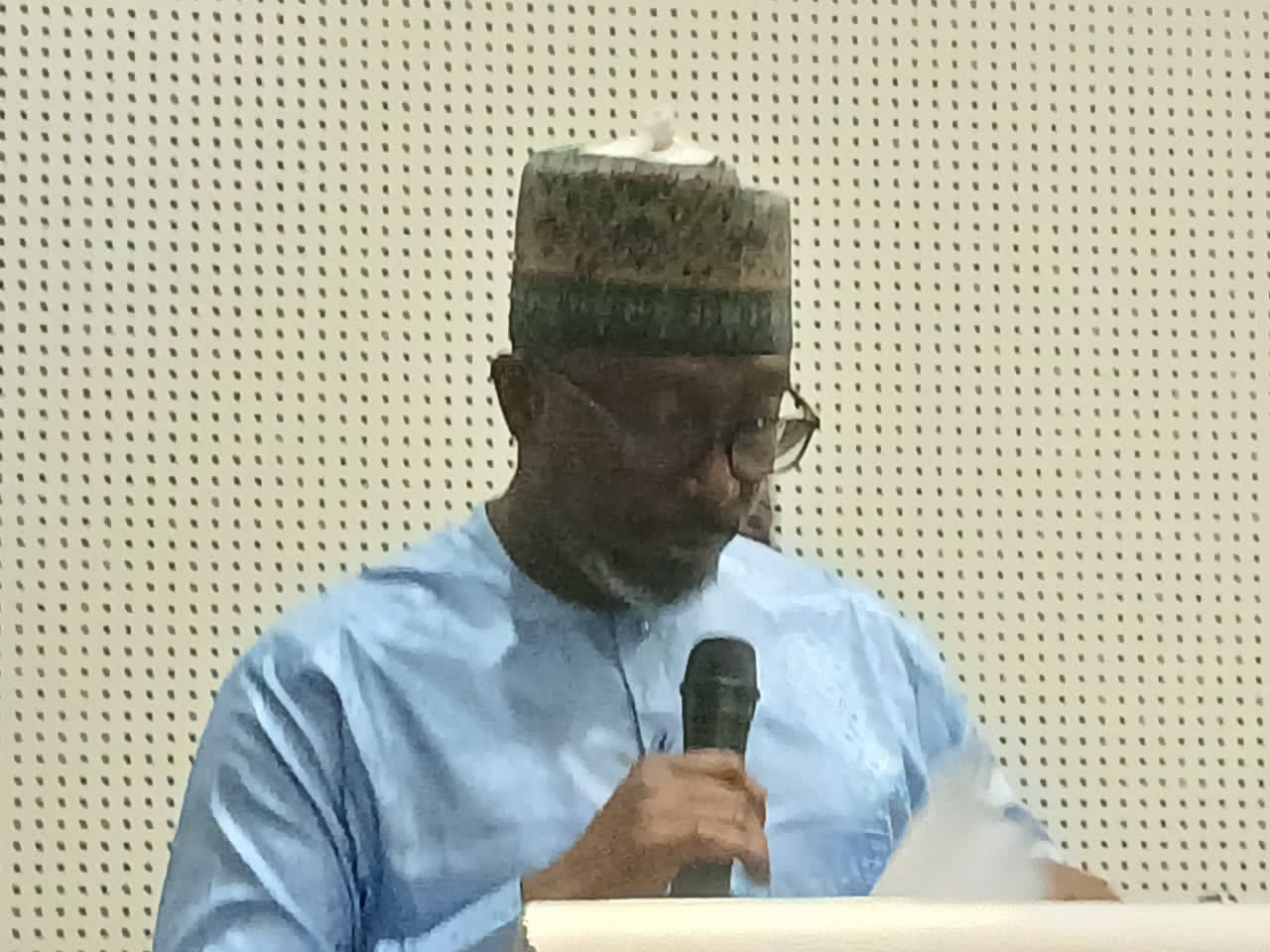
The House of Representatives has reiterated its commitment to ensuring that technical education receives the necessary boost to promote economic development and self-reliance in Nigeria.
The Speaker, Hon. Tajudeen Abbas, made the commitment while declaring open a one-day public hearing on a bill seeking to amend the Act establishing the Federal Technical College, Nasarawa Burkullu, in Zamfara State.

Represented by Hon. Abubakar Hassan III, the Speaker said Nigeria had, for too long, placed disproportionate emphasis on certificates rather than skills, noting that the country had produced graduates without jobs and jobs without skilled hands to fill them.

He argued that the imbalance was no longer sustainable, stressing that the world had changed and that the global economy no longer rewards degrees alone, but skills, competence and problem-solving abilities.

According to him, nations that have made significant progress, including China, Germany and South Korea, did so by deliberately investing in technical and vocational education.

He said this was why the 10th House of Representatives had made skills acquisition, entrepreneurship and youth empowerment a legislative priority.
The House, he added, aligns with the Federal Government’s renewed agenda on Technical and Vocational Education and Training (TVET), which seeks to reposition Nigeria’s human capital for industrialisation, innovation and self-reliance.
Abbas said the bill before the House was therefore not merely about establishing another school, but about closing a critical skills gap and giving young Nigerians in Zamfara the opportunity to become electricians, welders, builders, solar technicians, fabricators and ICT specialists, while earning a decent living.
He noted that insecurity in Zamfara and across the North-West had disrupted farming, schooling and economic activities, stressing that young people deprived of hope and opportunities could become vulnerable.
“When we give them skills, we give them alternatives. We give them a stake in the stability of the nation. Technical education is therefore a security strategy, an economic strategy, and a social strategy all in one,” he said.
He urged all stakeholders, including the Federal Ministry of Education, NBTE, academia, professional bodies and community leaders, to make robust contributions to the bill and help improve it so that, when enacted into law, it would create an institution that is relevant, sustainable and impactful.
“Let us build a Nigeria where a child who chooses technical education is not seen as one who has failed, but as one who has chosen to build, to create, to invent and to prosper,” he said.
In his welcome address, the Chairman, House Committee on Alternative Education, Hon. Ibrahim Aliyu Almustapha, emphasised that the world was changing and that the demand for skilled labour across various sectors was increasing.
He said this made robust technical education necessary in Nigeria, where unemployment and underemployment remain critical challenges.
Almustapha stressed that establishing a technical college in the state was a timely intervention that would address several challenges by empowering young people with practical skills to enable them to compete in the global economy.
He said the institution would enhance economic growth, foster local industries and entrepreneurship, leading to job creation and sustainable economic development, while promoting inclusivity and ensuring that education was accessible to all, particularly those in underserved areas.
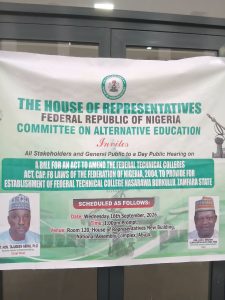
Speaking on the bill, its sponsor, Hon. Abubakar Sulaiman Gummi, said the proposed establishment of the Federal Technical College, Nasarawa Burkullu, Zamfara State, was founded on the simple premise that Nigeria could not achieve industrial development without deliberate investment in technical and vocational education.
Gummi said there was also a compelling case of equity and national policy, noting that the North-West zone has over 50 million people, yet Zamfara remains the only state without a Federal Science and Technical College.
He said the case was even stronger when viewed against Zamfara’s realities, stressing that years of insecurity and displacement had deprived many young people of education and livelihoods.
“We need interventions that go beyond conventional education. Technical education provides practical, marketable skills that lead to legitimate employment and entrepreneurship, restore economic resilience, and reduce vulnerability to criminal recruitment,” he said.
Commenting on the bill, Engineer Kasimu Abdullahi Burkullu said the proposed school, when established, would significantly help unemployed youths become self-reliant.
He added that it would expand access to technical education in Zamfara and the North-West, correct disparities in the distribution of Federal Technical Colleges, and equip young people with employable and entrepreneurial skills.
He urged the committee to expedite action on the passage of the bill for the sustainable development of the area, particularly in view of the challenges arising from incessant attacks by insurgents in Zamfara State.