
General News
Healing Through Enterprise: 50 Benue Women Survivors of SGBV Trained in Business, Vocational Skills

From Dooshima Terkura, Makurdi
A business and vocational empowerment initiative designed to strengthen the economic resilience of women who survived Gender-Based Violence (GBV) in Internally Displaced Persons (IDP) and host communities has recorded major success, with beneficiaries already generating over N250,000 in sales from newly established enterprises.
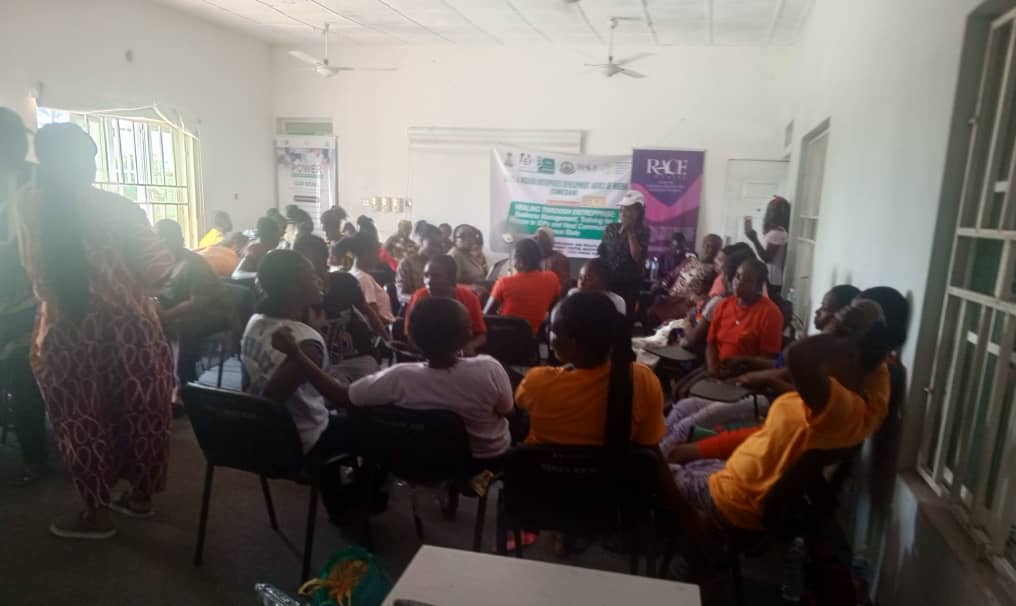
Fifty Benue women, all survivors of Sexual and Gender-Based Violence (SGBV), have been trained under the programme “Healing Through Enterprise: Business Management Training for Women GBV Survivors in IDP and Host Communities in Benue State.” The project was officially launched in Makurdi by the Small and Medium Enterprises Development Agency of Nigeria (SMEDAN), with plans to reach more women subsequently.

Evelyn Ugbe, Executive Director of the Centre for Redefining Alternative Civic Engagement for Africa, described the initiative as “a pathway to healing, hope, and transformation” for vulnerable women. She noted that the training aligns with the global 16 Days of Activism Against Gender-Based Violence and supports women who bear the often unseen consequences of conflict.

Ugbe explained that the programme has equipped numerous women with both vocational and business management skills to enable them take control of their economic prospects. She highlighted the establishment of the TAHAV Women Cooperative Society as a major accomplishment, with several participants launching their businesses and showcasing their products at exhibitions.

She revealed that the women have collectively earned over N250,000 from sales—an achievement she described as clear evidence of their strength and potential. Ugbe appealed for stronger government partnerships to improve the business environment, stressing that streamlined processes and increased support would help the women thrive and contribute to rebuilding their communities.

She emphasized that women in IDP settings are key contributors to community recovery and urged stakeholders to prioritize the use of technology as a tool for empowerment rather than harm. Ugbe also commended SMEDAN, GERI, and other partners for their dedication, expressing gratitude to the Embassy of France in Nigeria for sponsoring the programme. She affirmed that healing involves not only recovery but also reclaiming hope and rebuilding lives.
Speaking with journalists, the Executive Director of the Gender and Environmental Risk Reduction Initiative (GERI), Mrs. Elizabeth Jeiyol—represented by her Assistant, Stephanie Tamang—explained that the training forms part of a broader empowerment initiative known as the POWER Project, aimed at promoting economic resilience among women in conflict-affected areas.
According to Tamang, the programme involves 50 women—40 from IDP camps and 10 from host communities—to ensure balanced representation. She said the beneficiaries are being trained in vocational, economic, and financial management skills to guarantee sustainability. Instead of giving out money, she explained, the programme focuses on skills that beneficiaries can grow and use to uplift others.
The day’s session centered on business skills, including guidance on how to operate and formalize a business—elements referred to as Healing Through Vocational Training.
On the selection of beneficiaries, Tamang stated that GERI conducted a needs assessment before choosing participants. Although the initial plan was to train 100 women, funding limitations reduced the number to 50. Priority was given to GBV survivors and female heads of households, many of whom had lost spouses or parents. She added that the selection process involved key partners, including SEMA, traditional authorities, and relevant ministries.
During the training, representatives from NAFDAC, the Corporate Affairs Commission (CAC), and SMEDAN educated participants on business registration, product approval, and access to future government support schemes. NAFDAC’s Wanger Akange encouraged product registration, CAC’s Simon Ayangeor urged business name registration, and SMEDAN’s John Adah assured them of qualification for future interventions.
Beneficiaries also shared testimonies.
Nguhiden Ugber, trained in catering and baking, said the programme broadened her skills and changed her mindset. Previously baking only for personal use, she now applies business skills, money management, and savings techniques learned from the training.
Another participant, Miss Dorcas Shaaho from Daudu IDP Camp 2, said tailoring has boosted her financial stability. She now sews clothes and bags and plans to produce children’s clothes for sale during the festive season. She added that the skills have empowered her to support her younger sister in school and assist her mother with household needs, thanking the French Embassy and GERI for their support.
The training brought together facilitators, government agencies, humanitarian groups, and community leaders, all united in helping displaced and vulnerable women rebuild their livelihoods through enterprise.
—