
News
The Maleo: The Rare Bird That Lays Its Eggs in Volcanic Soil and Leaves Its Chicks to Survive Alone

By Sam Agogo
For centuries, local communities in parts of Sulawesi in Indonesia have told stories about a mysterious forest bird that lays giant eggs in the hot earth and disappears before its young are born. For a long time, the practice appeared almost unbelievable. But scientific study later confirmed that the stories were true. The bird, known as the Maleo and scientifically called Macrocephalon maleo, is one of the most unusual species in the natural world, famous for a reproductive strategy that is rarely seen among birds.
The Maleo belongs to a group of birds known as megapodes, often called mound-builders, which are known for relying on natural environmental heat to incubate their eggs rather than sitting on them. However, the Maleo takes this behavior even further. Instead of building mounds like many of its relatives, it travels to special nesting grounds where volcanic activity or the heat of the sun warms the sand. There, it buries its eggs deep in the ground and leaves them to develop on their own.
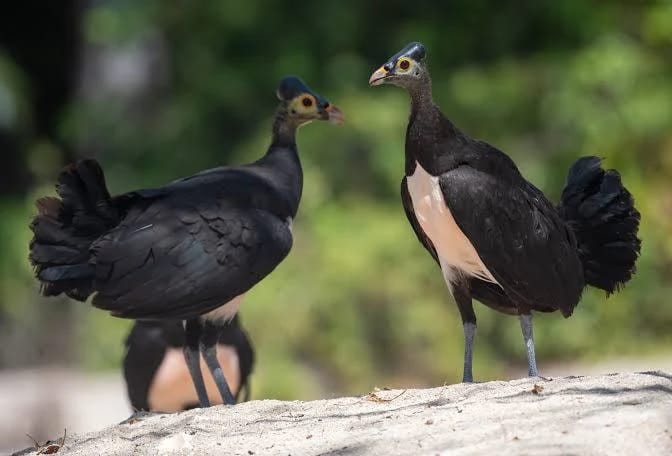
The bird itself has a striking and distinctive appearance that makes it easy to recognize. It is a medium-sized ground bird measuring about 55 to 60 centimeters in length. Its body is covered with glossy black feathers, while the underside of the body appears pale pink or salmon-colored. The Maleo has strong grey legs adapted for digging and walking on forest floors. Its face has patches of bright yellow bare skin, and its beak is reddish-orange. One of its most notable features is a dark helmet-like crest or casque on its head, which gives the bird a bold and almost ancient appearance. This unusual head structure is reflected in its scientific name, which roughly translates to “large-headed bird.”
Maleos spend most of their lives in tropical forests where they move quietly along the ground searching for food. Their diet consists mainly of fruits, seeds, ants, beetles, termites and other small invertebrates found on the forest floor. Although they are capable of flying, they prefer to walk and forage beneath the forest canopy where they are protected from predators.
The most remarkable stage of the Maleo’s life begins during the breeding season. At this time, the birds leave their forest homes and travel long distances to reach communal nesting grounds. These locations are often found on sandy beaches, riverbanks, or areas where geothermal heat from underground volcanic activity warms the soil. Many of these nesting grounds have been used by generations of Maleo birds for hundreds of years.
At the nesting site, a pair of Maleo birds digs a deep hole in the warm sand or volcanic soil, sometimes reaching nearly one meter in depth. The female then lays a single egg that is extraordinarily large—often five to six times the size of a typical chicken egg. In fact, the Maleo’s egg is considered one of the largest eggs relative to body size among birds.
After placing the egg inside the hole, the birds carefully cover it with sand and soil. Instead of incubating the egg with body heat like most birds, they depend entirely on natural heat from the sun-warmed sand or geothermal heat beneath the earth’s surface to incubate the egg. Once the egg is buried, the parents leave the nesting ground and return to the forest, abandoning the egg and never returning to care for the chick.
After an incubation period that usually lasts between 60 and 80 days, the chick hatches beneath the sand. Without any parental help, the young bird must struggle upward through the soil to reach the surface. When it finally emerges, it is already fully feathered and strong enough to run and fly almost immediately. From the very first moment of its life above ground, the young Maleo must survive independently.
Despite its fascinating behavior and ecological importance, the Maleo is now facing a serious threat of extinction. Over the years, many nesting sites have been destroyed by deforestation, agricultural expansion, and human development. In addition, the bird’s unusually large eggs are often dug up by humans who consider them a delicacy, drastically reducing the number of chicks that successfully hatch in the wild.
To protect the species, conservation groups and the Indonesian government have begun guarding important nesting grounds and collecting some eggs for safe incubation before releasing the young birds back into protected forest areas. These efforts aim to preserve a species that represents one of nature’s most extraordinary survival strategies.
Today, the Maleo stands as one of the most remarkable birds on the planet. Its unusual habit of laying giant eggs in volcanic soil and leaving its chicks to fend for themselves has fascinated scientists and wildlife observers for generations, highlighting the astonishing diversity and ingenuity of life in the natural world.
For comments, reflections and further conversation:
Email: samuelagogo4one@yahoo.com
Phone: +2348055847364