General News
UN Human Rights Council Recognises ‘Reproductive Violence’ as Distinct Form of Gender-Based Violence

By Caroline Ameh
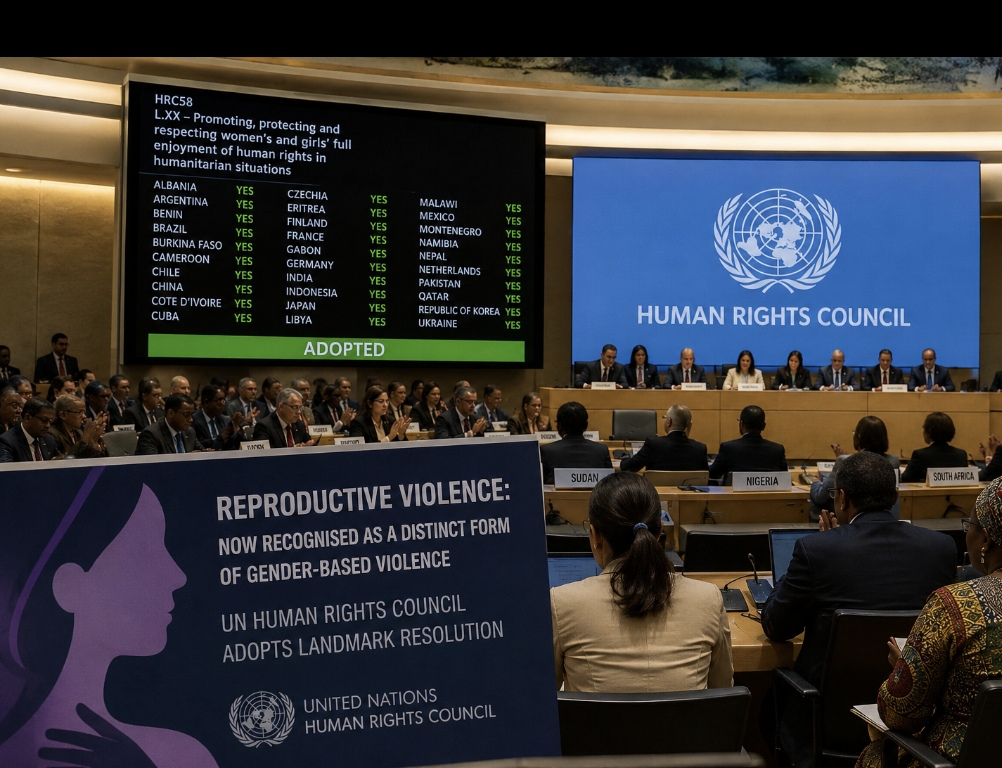
The United Nations Human Rights Council (UNHRC) has unanimously adopted a landmark resolution formally recognising “reproductive violence” as a distinct form of gender-based violence, marking the first time the term has appeared in a negotiated UN outcome document.
The resolution, titled “Promoting, Protecting and Respecting Women’s and Girls’ Full Enjoyment of Human Rights in Humanitarian Situations,” was adopted by consensus during the Council’s session in Geneva on Monday.

The resolution expresses deep concern over the disproportionate impact of humanitarian crises on women and girls, citing conflict-related sexual violence, trafficking, sexual exploitation, sexual slavery and, for the first time, reproductive violence.
It defines reproductive violence as acts that interfere with an individual’s reproductive autonomy or target people because of their reproductive capacity. These include forced pregnancy, forced abortion, forced sterilisation, forced contraception and attacks on reproductive healthcare facilities.
The Council also called on governments, humanitarian agencies and other stakeholders to strengthen measures for preventing and responding to sexual and gender-based violence by establishing safe, confidential and survivor-centred reporting and support systems.

Although specific acts such as forced pregnancy and enforced sterilisation are already prohibited under the Rome Statute of the International Criminal Court, the adoption of the new terminology broadens international recognition of abuses that affect women’s reproductive rights during armed conflicts and humanitarian emergencies.
The resolution follows growing concerns by UN agencies and human rights mechanisms over documented cases of reproductive violence in conflict zones, including Gaza, Sudan, Yemen, Syria and Ukraine.
Reacting to the development, Dr. Diana Pulido, Global Technical Lead for Humanitarian Programmes at the International Planned Parenthood Federation (IPPF), described the decision as a major step toward improving protection for women and girls.
She said the recognition gives visibility to a form of violence that has long gone unnamed and should now translate into stronger protection, accountability and survivor-centred services.
Implications for Nigeria and Africa
The resolution, while not legally binding on member states, carries significant policy and legal implications for Nigeria and other African countries.
Recognition of conflict-related abuses: Countries affected by insurgency and armed conflict, including Nigeria, Sudan, the Democratic Republic of Congo, Ethiopia and parts of the Sahel, may now face increased pressure to recognise reproductive violence as a separate category of abuse in investigations and humanitarian responses.
In Nigeria, survivors of violence linked to insurgent groups such as Boko Haram and ISWAP, including women subjected to forced marriages, forced pregnancies and denial of reproductive healthcare, could receive greater international attention.
Policy and legal reforms: African governments may be encouraged to review existing laws on sexual and gender-based violence to explicitly address reproductive violence. Although many countries criminalise rape and related offences, few have comprehensive legal provisions covering forced contraception, reproductive coercion or attacks on reproductive health services during conflicts.
Humanitarian response: Aid agencies operating across Africa may be required to expand services to include specialised medical care, psychosocial support and legal assistance for survivors of reproductive violence, particularly in displacement camps and conflict-affected communities.
Documentation and accountability: The new recognition provides investigators, courts and human rights bodies with a clearer framework for documenting violations. This could strengthen future prosecutions before domestic courts, regional tribunals or the International Criminal Court where evidence exists.
International funding and programming: Donors and development partners are likely to increase support for programmes focused on reproductive health, protection of women and girls, and survivor services in humanitarian settings across Africa.
For Nigeria, where conflict and displacement continue to affect millions of people in the North-East and parts of the North-West and North-Central regions, the resolution may influence future government policies on victim support, transitional justice and humanitarian programming. It also places greater emphasis on protecting healthcare facilities and ensuring access to reproductive healthcare during emergencies.
Although the resolution does not automatically create new legal obligations, it establishes an internationally agreed standard that is expected to shape future UN policies, humanitarian operations, national legislation and accountability efforts relating to women’s rights in conflict and humanitarian crises.