Opinion
The Man Who “Slept” at the UN — and Woke Nigeria to the World

_By Sam Agogo_
History remembers Jaja Wachuku, Nigeria’s first Minister of Foreign Affairs, for a moment that lasted only minutes but which travelled further than almost anything he said standing upright.
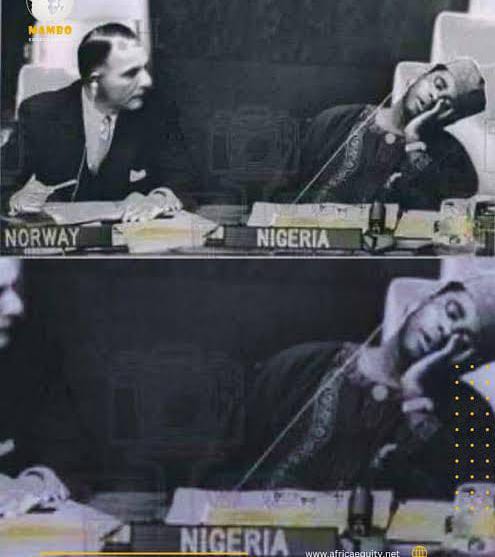
At a United Nations meeting in 1960, barely weeks after Nigeria’s flag went up as the world body’s ninety-ninth member, Wachuku appeared to nod off in his seat. Newspapers abroad seized on it as the picture of a fledgling nation’s ambassador overwhelmed by the solemnity of the chamber.

The truth, as those who knew him told it afterward, was almost the opposite of sleep. Wachuku had been denied the floor to answer a racial slight directed at him during the session, and rather than sit in silent submission, he closed his eyes and switched off from the proceedings altogether, a calculated withdrawal dressed up as slumber. It was protest wearing the costume of indifference, a young diplomat refusing to dignify an insult with attention while still occupying his chair as a matter of principle.
That single gesture, more than any speech, fixed itself into the folklore around him, but it was also entirely in character. Wachuku’s whole career was built on a similar instinct: absorb the provocation, then answer it on his own terms rather than the terms his provocateurs expected.

Born on the first day of January 1918 in Nbawsi, in what is now Abia State, to a royal Ngwa household, Wachuku carried the bearing of a prince into rooms that were not built to receive African princes.
His father was the Eze of Ngwaland, his mother a women’s rights campaigner in an era when that phrase barely existed in colonial Nigeria.
He excelled early, topping his province in the leaving certificate examination as a boy and riding that success into Government College Umuahia and eventually to Trinity College Dublin, where he became the first African to win the college’s medal for oratory.
That skill with language and argument would define the rest of his life. He was called to the Irish bar, practised law briefly in Dublin, and returned home in 1947 determined to fight colonial rule from inside the system rather than merely against it.
The path from there to national prominence ran through grassroots politics in the Eastern Region, a stint as deputy leader of the National Council of Nigeria and the Cameroons, and years of constitutional wrangling that culminated, in 1959, in his election as the first indigenous Speaker of Nigeria’s House of Representatives. He held that gavel through the tense, hopeful months leading to independence, and it was Wachuku who stood at the despatch box on the first of October 1960 to receive Nigeria’s instrument of independence from the British Crown’s representative.
From the Speaker’s chair he moved almost immediately to New York, as Nigeria’s first ambassador to the United Nations, hoisting the new nation’s flag there within a week of independence.
It was in that seat, only months later, that the sleeping episode occurred, and it was also from that seat that he built the reputation which would carry him into Nigeria’s first substantive Cabinet as Minister of Foreign Affairs and Commonwealth Relations in 1961, a post he held for four eventful years under Prime Minister Abubakar Tafawa Balewa.
As foreign minister, Wachuku styled himself the equal of any European or American counterpart, a posture that unsettled diplomats used to a more deferential Africa.
He pushed for African representation on the Security Council, campaigned successfully to get Liberia elected to it, and worked the corridors of the General Assembly on behalf of newly independent states across the continent. But it is his quiet intervention in South Africa’s most consequential political trial that historians now regard as his defining act of statesmanship.
When Nelson Mandela and his co-accused faced the death penalty at the Rivonia Trial in 1963 and 1964, Wachuku did not reach for microphones or grandstand at the UN. Instead he worked the back channels, privately pressing Britain’s High Commissioner in Lagos and the American ambassador to lean on their governments to persuade Pretoria against hanging Mandela and the others. He carried the same message directly to the United States Secretary of State and the British Foreign Secretary, arguing that the apartheid government could be moved by discreet pressure from men it respected rather than by public condemnation alone.
When the death sentences did not come, and Mandela and his comrades were sentenced instead to life imprisonment, associates of Wachuku pointed to his interventions as part of what tipped the balance. South African officials themselves later described their government’s respect for Wachuku’s diplomacy, an irony given how forcefully he had condemned the apartheid system before the General Assembly, arguing there that all Africans, including the white minority ruling South Africa, belonged to the same continent and the same human family.
His conscience did not soften with time or comfort. In the Second Republic, decades after leaving the Foreign Ministry, Wachuku returned to the apartheid question as a senator and chairman of the Senate’s Foreign Relations Committee.
He made secret trips to South Africa to meet President P.W. Botha, pressing again for the dismantling of apartheid and the release of Mandela, and he told the Senate floor that apartheid’s defeat would come through dialogue and contact rather than isolation and guns. The position cost him his committee chairmanship at the time, dismissed by critics as too soft on Pretoria.
Years later, when Nigeria finally opened diplomatic relations with a post-apartheid South Africa, many of those same critics called for an apology to the man they had once sidelined.
Wachuku’s independence of mind extended to his own government.
He resigned his ministerial post and his seat in Parliament at midday on the fourteenth of January 1966, hours before Nigeria’s first military coup, unwilling to bend to pressure over a personnel dispute he considered a matter of principle. During the civil war that followed the collapse of the First Republic, he was arrested by the Biafran authorities for speaking out against the conscription of child soldiers, and was freed only at the war’s end by a young army officer, Theophilus Danjuma, who escorted him home under military protection.
He died in Enugu in November 1996, aged seventy-eight, remembered less for any single office he held than for a lifetime of choosing, again and again, to answer power on his own terms — whether with his eyes closed in a New York conference hall or in whispered appeals that helped keep Nelson Mandela alive.
*For comments, reflections and further conversation, reach Sam Agogo at samuelagogo4one@yahoo.com or +2348055847364.*