Features
Women At The Ballot Box, But Where Is Their Power?

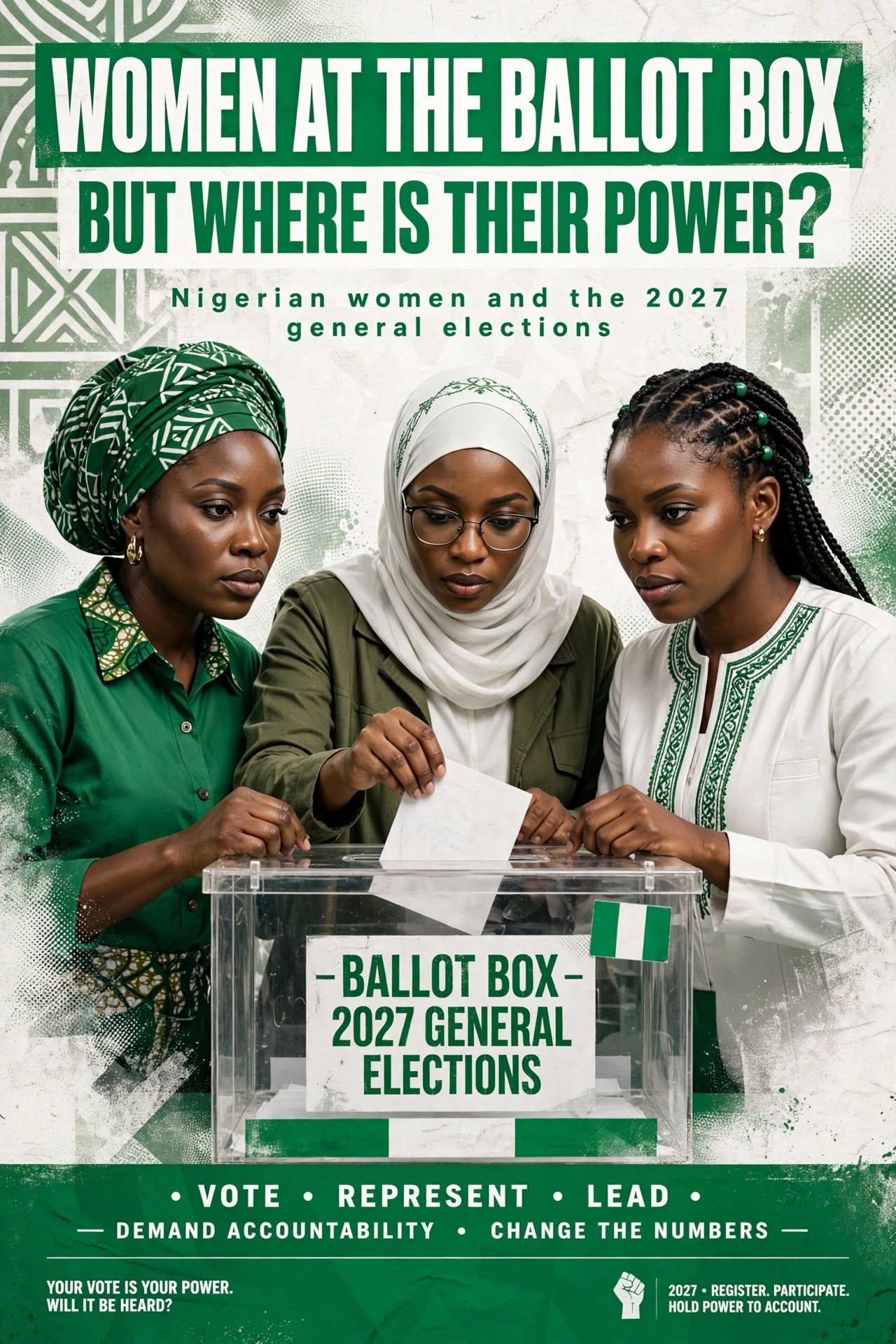
By Caroline Ameh
They are there when the rain falls.
They are there when the sun becomes unbearable.

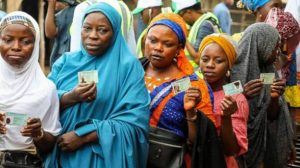
They queue patiently at polling units, sometimes with children strapped to their backs, sometimes after travelling long distances, and often after spending hours waiting for the ballot box to arrive.

Across Nigeria and much of Africa, women are among the most visible participants in elections.

They vote.
They mobilise.
They campaign.
They persuade family members and neighbours.
They attend party meetings and rallies.
They work as polling agents, volunteers and community organisers.
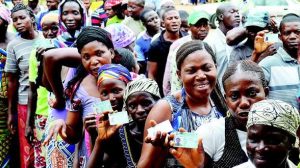
Yet when the votes are counted and political positions are distributed, their presence at the ballot box is rarely reflected in the rooms where political power is exercised.
This raises a difficult question for Nigeria’s democracy:
Could women who enjoy the legal right to participate in politics nevertheless be experiencing a form of structural exclusion because of money, party politics, culture, religion and other barriers that make it harder for them to contest and win elective office?
The question is becoming more urgent as Nigeria moves towards the 2027 general election.
With 122 days to the January 16, 2027 Presidential and National Assembly elections and 143 days to the February 6 Governorship and State Houses of Assembly elections, the country is already deep into the electoral cycle.
Those dates are contained in INEC’s revised timetable following the enactment of the Electoral Act 2026.
But the question confronting women is not simply whether they will be allowed to vote.
They have been voting for decades.
The bigger question is whether they will be given a meaningful opportunity to move from voters to political decision-makers.
The latest numbers provide an uncomfortable answer.
The Independent National Electoral Commission has cleared 4,408 candidates for the 2027 Senate and House of Representatives elections.
Of them, 3,965 are men and only 443 are women.
Women therefore account for about 10 per cent of the National Assembly candidate field.
For the Senate, 115 women are among 1,195 candidates.
For the House of Representatives, 328 women are among 3,213 candidates.
At the presidential level, the picture is similarly stark: INEC’s final list contains 18 presidential candidates and their running mates.
The figures do not mean Nigerian women are uninterested in politics.
They suggest that somewhere between the desire to participate and the opportunity to contest, something is going wrong.
From The Queue To The Corridors Of Power
For many Nigerian women, the journey into politics ends before the general election begins.
It can end when the nomination form is priced beyond their reach.
It can end at the party screening stage.
It can end when delegates are mobilised around a more financially powerful male aspirant.
It can end during a consensus arrangement negotiated behind closed doors.
It can end when a woman is asked to step aside for a “more experienced” male candidate.
Or it can end because her family, community or political network considers elective office inappropriate for a woman.
The general election may therefore be only the final stage of a process in which women have already faced several barriers.
This is why the 443 women on INEC’s candidate list should not be viewed simply as a statistic.
They represent the end product of a political pipeline.
And that pipeline remains overwhelmingly male.
Is This A Question Of Rights?
Nigeria’s Constitution gives citizens the right to participate in political life, while Nigeria’s international obligations also recognise women’s political participation.
Under Article 7 of the Convention on the Elimination of All Forms of Discrimination Against Women, states are required to eliminate discrimination against women in political and public life.
The African Union’s Maputo Protocol similarly calls for women’s equal participation in political and decision-making processes.
The issue, therefore, is not whether Nigerian women have a formal right to participate.
They do.
The harder question is whether they enjoy equal practical access to political competition.
There is a difference between being told that a door is open and being able to afford the journey to the door.
A woman may legally be free to contest an election.
But if she cannot afford the nomination fee, cannot access party delegates, cannot raise campaign funds, cannot secure political protection and faces intimidation because of her gender, the formal right may exist while the practical opportunity remains unequal.
That distinction is at the heart of the debate about women and Nigerian politics.
The Price Of Politics
Money is perhaps the most visible barrier.
Politics in Nigeria is expensive.
The cost does not begin with campaign posters.
It begins with political organisation.
Nomination forms.
Consultations.
Transport.
Meetings.
Mobilisation.
Media.
Campaign offices.
Agents.
Party structures.
Security.
And, in many cases, the informal costs associated with maintaining relationships within political networks.
For wealthy aspirants, these may be manageable.
For women who are entering politics without established political wealth, they can become a formidable barrier.
This is why political finance cannot be separated from women’s representation.
If money determines who can enter a primary, who can build a campaign structure and who can remain politically visible, then access to political money also affects access to political power.
And political money is not evenly distributed.
But Is Religion The Problem?
Religion is another issue that requires careful treatment.
Nigeria is religiously diverse, and attitudes towards women’s leadership differ across communities and denominations.
It would therefore be too simplistic to say that religion alone prevents women from entering politics.
However, religious interpretations can interact with cultural and patriarchal expectations about women’s roles.
Research on women’s political participation in Nigeria has identified religion, culture, discrimination and marginalisation among the factors associated with women’s limited political participation.
In parts of the country, expectations surrounding marriage, motherhood, family responsibility and public leadership can affect whether women are encouraged to seek political office.
The problem is therefore not necessarily faith itself.
It is how particular social interpretations of gender roles can influence who society considers suitable for political leadership.
And Then There Is Culture
Culture may be an even deeper barrier because it operates quietly.
A man who spends time building political networks may be described as politically serious.
A woman doing the same thing may be asked who is taking care of her home.
A man who is ambitious may be praised for leadership.
A woman displaying the same ambition may be described as overly aggressive.
A man who campaigns late into the night may be considered committed.
A woman doing so may attract questions about her character.
These double standards can influence both political parties and voters.
They can also influence women themselves.
Some potential candidates may never enter the race because they have already calculated the social cost.
That is a form of exclusion that electoral statistics cannot easily capture.
Africa Has Already Shown That The Numbers Can Change
Nigeria’s position becomes more striking when viewed against the wider African experience.
The continent is not operating under one model of women’s political representation.
Countries have adopted different approaches, including reserved seats, electoral quotas, gender-balanced candidate lists and political-party commitments.
Rwanda, for example, has achieved female representation above 60 per cent in its lower chamber.
Senegal is above 40 per cent.
South Africa is also above 40 per cent.
Nigeria remains far below these levels.
The comparison does not mean Nigeria should simply copy another country’s political system.
It does demonstrate, however, that women’s political representation is influenced by institutional choices.
The number of women who reach parliament is not determined solely by whether women are interested in politics or whether voters are willing to elect them.
The rules governing who gets onto the ballot matter.
So, What Should Nigerians Expect In 2027?
Can Nigerians confidently say that women will be given a greater opportunity in the 2027 elections?
The evidence does not yet justify such certainty.
The latest candidate list shows that women constitute only about one in every ten National Assembly candidates.
That is participation.
But it is not parity.
And the number of women who eventually win will depend on another set of factors: the parties they represent, the competitiveness of their constituencies, their access to campaign resources, their grassroots structures and the behaviour of voters.
The 2027 election could produce an increase in the number of women elected.
But the candidate figures alone do not demonstrate that a major transformation is already underway.
What they demonstrate is that women remain significantly underrepresented at the starting line.
And that takes the debate beyond election day.
It forces Nigeria to confront a more fundamental question:
What does political citizenship mean if women can stand in the queue for hours to cast a ballot, but remain a tiny minority of those permitted to compete for the offices that determine how the country is governed?
That is the question Nigeria must answer before January 16.
Not simply whether women will vote.
But whether the political system will give them a fair opportunity to be voted for.
Because democracy is not only about who turns up at the polling unit.
It is also about who is allowed to stand on the ballot paper, who can afford to compete, who can survive the political process and who ultimately gets a seat at the table where decisions are made.