Opinion
At 66, Nigeria’s Independence Remains an Illusion… not independent from bad governance, poverty, and elite capture

By Kenneth Eze
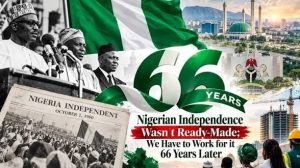
We celebrate the flag, the anthem, and the ceremonial parades every October 1st, yet the substance of independence – the power of the people to freely choose their leaders, to hold government accountable, and to prosper in their own land – remains elusive.
True independence is not merely the departure of the British in 1960; it is freedom from poverty, from institutional capture, from electoral manipulation, and from a local government system that has collapsed under the weight of state control.

Sixty-six years after independence, Nigerians are still asking not whether we are independent, but what our independence is truly worth.
In December 2014, while Nigerians fiercely criticised and abused him, former President Goodluck Ebele Jonathan said:
“I am the most abused and insulted President in the world, but when I leave office, you will all remember me for the total freedom you enjoyed under my government.”
Eleven years later, that statement reads less like political nostalgia and more like a question for Nigeria at 66: what exactly does independence mean if citizens cannot freely exercise political, civic and constitutional rights?
President Bola Ahmed Tinubu’s Independence Day address speaks repeatedly of freedom, sovereignty, reform, prosperity and a Nigeria that has “corrected its course.” Yet, for many Nigerians, the speech was another missed opportunity: long on promises, economic projections and future aspirations, but remarkably light on the democratic freedoms, institutional accountability and constitutional safeguards that give independence meaning.
How can government speak of freedom while 37 suspected illegal miners died in NSCDC custody in Niger State without any judicial trial, no resignation nor immediate return by the president himself back to the country?
While the Federal Government has ordered an independent investigation and suspended officers, Nigerians still deserve answers about how such a tragedy occurred and whether overcrowding, inadequate facilities or institutional negligence contributed to it.
Thus, the speech missed an opportunity to confront the deaths of 37 suspected illegal miners on September 17.
Nor did the speech confront allegations of intimidation and violence. The opposition parties had reported attacks on meetings, destruction of party property, assaults and threats against opposition supporters; other reports have documented inflammatory threats surrounding the 2026 Osun election. These allegations require investigation, regardless of party affiliation.
Can a nation claim democratic independence when political power is perceived to overwhelm institutional checks? A serving minister’s boast that he could overturn the popular will if deployed by the President – as claimed in the recent Osun election – and his threat to replicate the same in Rivers and the FCT in 2027, the states where the same minister has now been mandated by his party, the APC, with presidential approval, to lead the party’s campaigns.
How independent are citizens when political expression itself can become a pathway to arrest? In Borno, five men were arrested and charged after wearing shirts inscribed “Tinubu Must Go” with the charges alleging that the men conspired by printing and wearing the shirts with the intention of causing a breach of public peace.
That makes the political expression central to the controversy, regardless of the additional allegations later advanced by police. Peaceful dissent should never be treated as a crime merely because it embarrasses those in power.
Then comes the question of institutional independence. Can Nigeria genuinely claim democratic independence when the legislature appears reluctant or unable to robustly check executive power? Section 145 requires a President proceeding on vacation to transmit a written declaration to the Senate President and Speaker.
The constitutional provision also provides a mechanism for National Assembly intervention if the declaration is not transmitted within 21 days.
Tinubu’s prolonged absence from August 30 raised legitimate constitutional questions that deserved transparent answers rather than political silence – unfortunately the national Assembly hands were handicapped to invoke the law.
Independence must also mean sovereignty over agreements entered into in Nigeria’s name and Sovereignty must include transparency in foreign agreements. Nigeria signed a US health MoU in December 2025.
Following Ghana’s recent rejection of a proposed US health compact over concerns including medical records and pathogen data, Nigerians deserve the full text of Nigeria’s agreement and clarity on implementation and should be publicly accessible, including its obligations and safeguards That is the standard an independent democracy should demand from government.
The President’s speech rightly speaks of prosperity. But prosperity without accountability is incomplete; sovereignty without transparency is fragile; and independence without freedom of expression is merely independence on paper.
At 66, Nigeria should move beyond celebrating the flag and begin measuring the substance of freedom: Can citizens criticise government without fear? Can institutions check power? Can opposition parties organise freely?
Are public officials accountable for deaths in custody? Are international and commercial agreements transparent to citizens? Can Nigerians genuinely determine their political future through free and credible elections? – These are the questions an Independence Day speech should answer.
Nigeria may have been independent for 66 years. But until freedom becomes a lived reality, we must confront the uncomfortable possibility that we are celebrating the anniversary of political independence while still living under an illusion of democratic independence.
Kenneth Eze, Good Governance Campaigner (engrchukeze2014@gmail.com) wrote in from Abuja.